Learning Myths and Neuromyths: Some Began as Real Findings
Comparison index Feedback & Forgetting Published
Short answer. Neuromyths are popular claims about the brain and learning that research does not back, and teachers in a survey published in 2012 believed about half of those put to them, on average. Some began as real but narrow findings: a 2019 repeat of the violinist study behind the 10,000-hour rule still found less practice in the least skilled group, and brain scans do show some functions leaning to one side. Neither result says what the myth later claimed. For others, such as the learning pyramid’s retention rates and the claim that you keep 2–3% of a lecture after a month, the sources read here found no study behind the numbers.
In one sentence: Several famous learning myths and neuromyths began as real but narrow findings; this scorecard sets each claim beside the research on it, or notes when no source study was found.
Myth checked: A learning pyramid gives fixed retention rates for different ways of learning, credited to Edgar Dale or the National Training Laboratories. Source status: not found Earliest readable source on its origin: a 2020 review’s abstract, which says the figures do not come from Dale; the earliest version was not read. Searched Crossref and Europe PMC; no study behind the retention rates found as of 2026-11-06. Checked 2026-11-06.
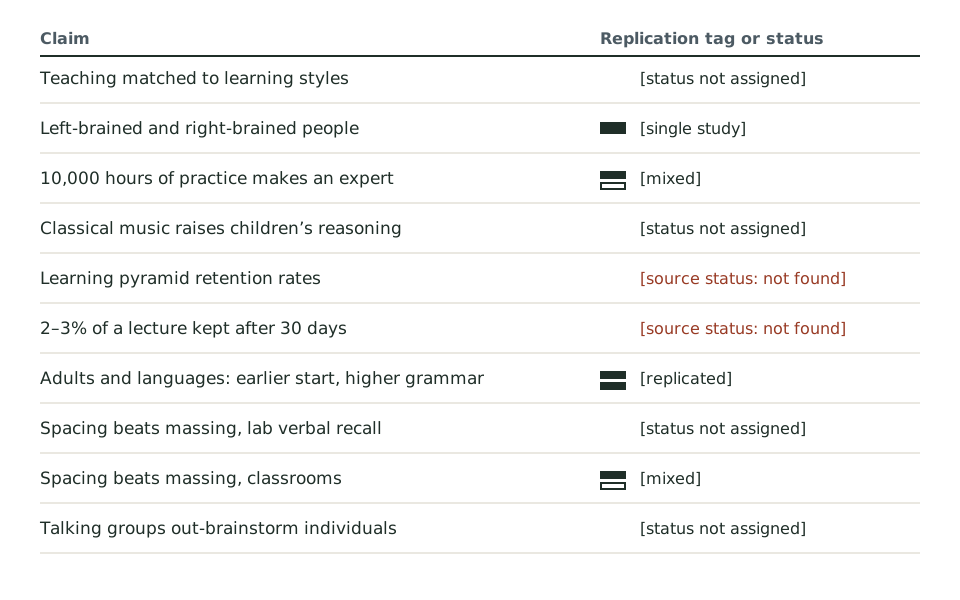
Diagram: Feedback & Forgetting, CC BY 4.0
Copy the credit line
"Learning myths scorecard at a glance" by Feedback & Forgetting, https://feedbackandforgetting.com/learning-memory/learning-myths/, licensed under CC BY 4.0, https://creativecommons.org/licenses/by/4.0/The ten claims in the scorecard below, each with the tag or status this page gives it. The table gives the source, reading level and scope for every row.
Of 613 articles citing three papers that criticized a famous research claim, 468 still affirmed the claim. Kåre Letrud and Sigbjørn Hernes counted them in 2019, for the Hawthorne effect, and they list the learning pyramid among other ideas that spread despite basic flaws. This page asks which popular claims about learning hold up, and which began as something narrower.
The scorecard takes ten claims. Four echo neuromyths that surveys put to teachers and the public. Each row gives a popular source, the research that tested the claim, how much of it was read here, and the resulting tag or status. The two spacing rows are study advice, included for comparison.
Replication scorecard
| Claim | Popular source | Tested by | Read as | Status |
|---|---|---|---|---|
| Individuals learn better when they receive information in their preferred learning style (e.g., auditory, visual, kinesthetic) | A survey statement that 93% of UK and 96% of Dutch teachers agreed with, in a survey published in 2012 | Aslaksen & Lorås 2018, a review that pooled 11 experiments from 10 studies; Pashler, McDaniel, Rohrer & Bjork 2008 review | full text (2012 survey, 2018); abstract (2008) | [status not assigned] Matching teaching to a visual or auditory preference, tests given after instruction. Pooled effects were close to zero and slightly negative, but their wide intervals and the lack of a bias correction leave the status open; checked 2026-11-06 |
| Some of us are left-brained and some are right-brained, and this helps explain differences in learning | A survey statement that 64% of 3,045 US adults and 49% of 598 educators agreed with in 2014 and 2015 | Nielsen, Zielinski, Ferguson, Lainhart & Anderson 2013: resting brain scans of 1,011 people aged 7 to 29 | full text | Replication tag: [single study] No whole-brain left- or right-dominant pattern across people; lateralization was local to brain regions. Resting scans, ages 7 to 29; learning and personality were not measured; checked 2026-11-06 |
| With 10,000 hours of deliberate practice, a person becomes an expert | Malcolm Gladwell’s 2008 book Outliers, which described the 10,000-hour rule, as Macnamara & Maitra 2019 report | Ericsson, Krampe & Tesch-Römer 1993, student violinists; Macnamara & Maitra 2019, a preregistered, double-blind replication with 39 student violinists | citation only (1993 and the book); full text (2019) | Replication tag: [mixed] Conservatory and university violin students, practice estimated up to age 18. In the replication, practice separated the less accomplished group from the top two but not the best from the good, and explained 26% of the variance across the three groups, against 48% reported for 1993 with the top two groups pooled; checked 2026-11-06 |
| Listening to classical music increases children’s reasoning ability | A survey statement that 59% of US adults and 55% of educators agreed with in 2014 and 2015 | Rauscher, Shaw & Ky 1993, a paper titled “Music and spatial task performance”; later papers by Chabris 1999 and by Pietschnig, Voracek & Formann 2010 | full text (survey); citation only (1993, 1999 and 2010 papers) | [status not assigned] Only citations could be read, so this page reports no results for the 1993 study or the later papers; checked 2026-11-06 |
| A learning pyramid gives fixed retention rates for different ways of learning, credited to Edgar Dale or the National Training Laboratories | Cited in 41 medical education papers from 2012 to 2018, by the count of a 2020 review | Masters 2020, a review of the pyramid’s citations; Letrud & Hernes 2019, which lists the pyramid among scientific myths | abstract (2020); full text (2019) | Source status: not found No study behind the retention rates found as of 2026-11-06. The 2020 review’s abstract says the figures do not come from Dale; the earliest version of the pyramid was not read; checked 2026-11-06 |
| By day 30 without review, you keep about 2–3% of a one-hour lecture | A University of Waterloo counseling page, archived in 2017 | No study cited on the page; two measured forgetting curves sit higher, but they measure relearning time, not recall | archived copy | Source status: not found The page cites no study, and none of its numbers could be traced to one, as of 2026-11-06; checked 2026-11-06 |
| Adults cannot learn a new language | A related survey statement, that certain things can no longer be learned after critical periods in childhood, believed by 33% of UK and 52% of Dutch teachers in a survey published in 2012 | Johnson & Newport 1989, 46 Korean or Chinese speakers who arrived in the United States aged 3 to 39; a 2018 online grammar quiz study | full text (2012 survey); abstract (1989); full text (2018, on the linked page) | Replication tag: [replicated] The narrower finding that earlier starters reached higher English grammar scores: immigrant and immersion learners of English, grammar-judgment tests, after years of residence. It does not test whether adults can learn; checked 2026-11-06 |
| Spaced study beats massed study, in lab studies of verbal recall | Common study advice, listed here for comparison rather than as a myth | Cepeda et al. 2006, a meta-analysis of 839 assessments in 317 experiments from 184 articles | abstract | [status not assigned] Only the review’s abstract was read, and it reports neither the size of the spacing effect nor a bias-corrected estimate; checked 2026-11-06 |
| Spaced practice beats massed practice in classrooms | Common study advice, listed here for comparison rather than as a myth | Mawson & Kang 2025, a meta-analysis of 22 classroom studies: d = 0.54 (95% CI 0.31 to 0.77) | full text | Replication tag: [mixed] Primary, secondary and university students, course material, gaps of at least a day, tests up to 42 days later. Pooled effect positive; size varied widely; checked 2026-11-06 |
| A group brainstorming out loud comes up with more ideas than the same number of people working alone | Talking in groups, the most common way to brainstorm by the account of a 2018 review | Paulus, Baruah & Kenworthy 2018 review, which reports that groups of four tend to produce about half as many ideas as the same number working alone; the experiments it cites | full text (review); citation only (the experiments) | [status not assigned] Talking groups vs. the same number of people working alone, idea counts in short lab sessions; the experiments behind the review were read as citations only; checked 2026-11-06 |
The learning-styles row matches this site’s review of learning styles, and the brainstorming row matches this site’s review of group brainstorming.
Myths that began as real findings
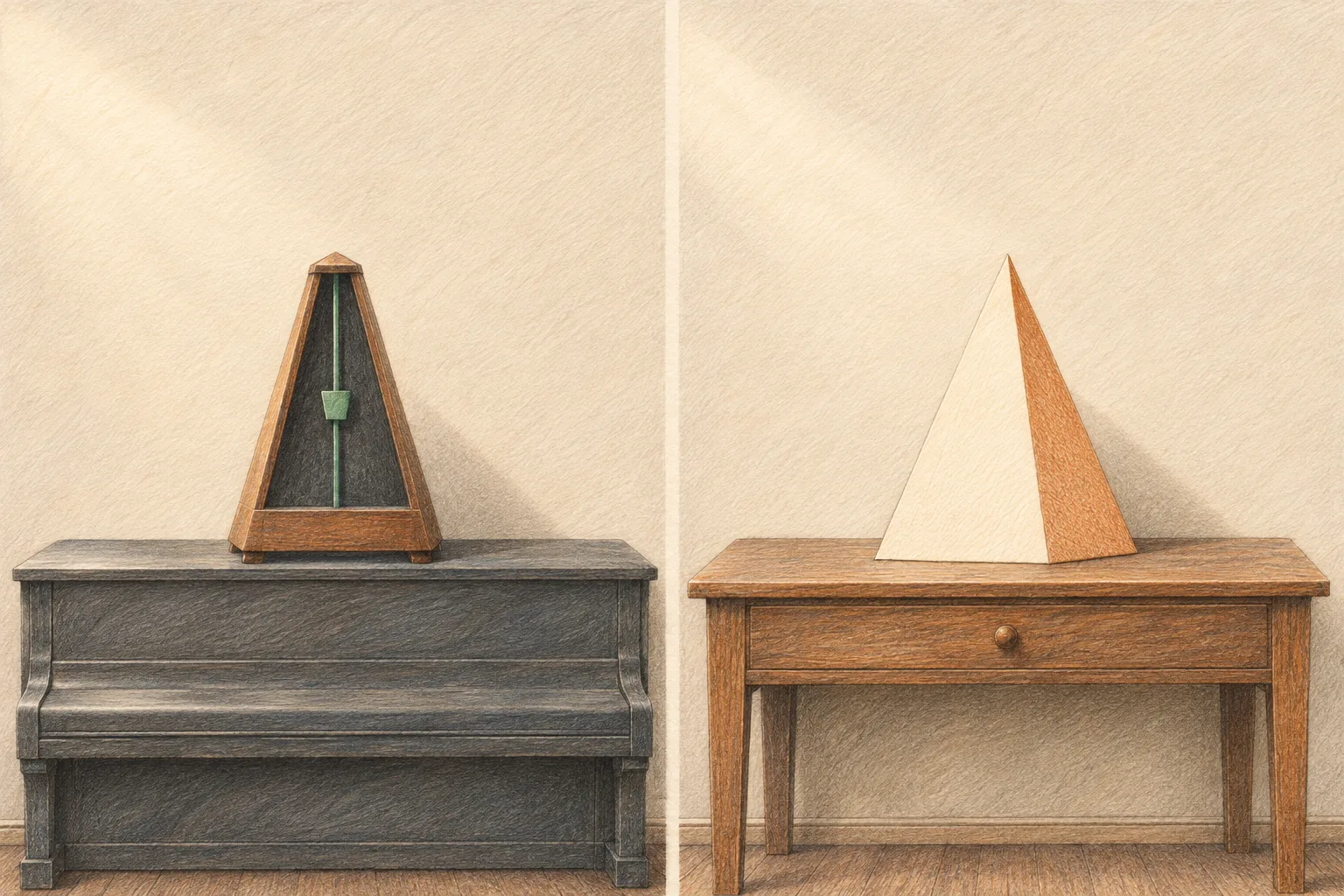
Illustration: Feedback & Forgetting. Generated schematic illustration — not a photograph or historical record. © Feedback & Forgetting, all rights reserved.
Two kinds of learning myth: some began with a study that found something real, and some, like the learning pyramid's retention rates, have numbers this page could not trace to any study. A scene illustration; neither side stands for more or better.
Three rows began with a study that found something real. The myth came when the finding was stretched past what was measured.
Ten thousand hours, rechecked
In 2008, Malcolm Gladwell’s book Outliers described the 10,000-hour rule: with that much deliberate practice, a person becomes an expert. That summary comes from a 2019 paper by Brooke Macnamara and Megha Maitra; the book was read only as a citation. The rule traces to a 1993 study of student violinists by K. Anders Ericsson, Ralf Krampe and Clemens Tesch-Römer.
Macnamara and Maitra repeated that study with 39 violin students in Cleveland, 13 in each of three skill groups. They registered the plan in advance and ran the interviews double-blind. Practice still mattered, since the least accomplished group had practiced less. But the best violinists had not practiced more than the good ones: by age 18 they averaged 8,224 hours of practice alone, against 9,844 for the good group, a gap that was not significant (p = 0.364).
By age 20, both top groups had passed 10,000 hours on average, yet they sat at different skill levels. In the replication, practice explained 26% of the variance across three skill groups; the 1993 study, pooling the top two, reported 48%. The authors add that 26% is not a small amount.
Replication tag: [mixed] Conservatory and university violin students, practice estimated up to age 18: practice separated the least accomplished group from the top two but not the best from the good. The 1993 study was read as a citation only, so its results are as reported in the 2019 replication. Based on full text. Checked 2026-11-06.
A 2014 meta-analysis led by Macnamara pooled studies across fields. According to its abstract, deliberate practice explained 26% of the variance in performance for games, 21% for music, 18% for sports, 4% for education and less than 1% for professions.
[status not assigned] (correction) Deliberate practice and performance, studies pooled across five fields. Based on the abstract; a 2018 correction is on record, not read, so this page cannot say whether it changed these percentages. Checked 2026-11-06.
Left brain, right brain
Some brain functions do lean to one side. Kelly Macdonald and colleagues note that the left-brained and right-brained myth partly grew from findings that skills such as language are lateralized. In 2013, Jared Nielsen and colleagues tested the stronger claim with resting brain scans of 1,011 people aged 7 to 29, taken from public data sets.
They found 9 left-leaning and 11 right-leaning hubs, with language areas among the left ones. But a person whose connections leaned left in one network did not lean left across the whole brain. The authors conclude that lateralization is a local property, not a trait that makes someone left-brained or right-brained. The scans did not measure learning or personality.
Replication tag: [single study] No whole-brain left- or right-dominant pattern across 1,011 people aged 7 to 29; resting brain scans; learning and personality not measured. No independent replication was read for this page. Based on full text. Checked 2026-11-06.
Adults and new languages
The claim that adults cannot learn a new language stretches a narrower result. In a 1989 study, Jacqueline Johnson and Elissa Newport tested 46 native speakers of Korean or Chinese who had arrived in the United States between the ages of 3 and 39. According to the abstract, earlier arrivals did better on English grammar. This site’s review of the critical period hypothesis tags that narrower finding as replicated; neither study tested whether adults can learn a language at all.
Replication tag: [replicated] Earlier starters reaching higher English grammar scores: immigrant and immersion learners of English, grammar-judgment tests, after years of residence. Based on the abstract (1989) and on full text of a 2018 study read on the linked page. Checked 2026-11-06.
The Mozart effect, by title only
In a US survey run in 2014 and 2015, 59% of adults and 55% of educators agreed that listening to classical music increases children’s reasoning ability. Macdonald and colleagues call the Mozart effect a prominent US neuromyth, citing a 1999 paper by Christopher Chabris and a 2010 meta-analysis by Jakob Pietschnig and colleagues.
Frances Rauscher, first author of a 1993 paper with Gordon Shaw and Catherine Ky titled “Music and spatial task performance,” published a 1999 paper under the same title as Chabris’s. The 1993 title speaks of a spatial task, not of children or reasoning. No abstract of these papers could be read, so this page gives no verdict on what the music did.
[status not assigned] Listening to music and later task scores. Citation only for the 1993 study, the two 1999 papers and the 2010 meta-analysis. Checked 2026-11-06.
Myths with no study found behind them
Two rows have numbers that this page could not trace to any study.
The learning pyramid gives a retention rate for each way of learning. A 2020 review by Ken Masters, read here as an abstract, says the pyramid is usually credited to Edgar Dale or to the National Training Laboratories. By its account, a 2013 review had flagged the pyramid in medical education, yet citations kept climbing.
His new search, covering September 2012 to April 2018, found 992 documents, 41 of which cited the pyramid and met the review’s criteria. Some even used refutations of the pyramid to support it. The abstract states that the statistics do not come from Dale, and that the version credited to the National Training Laboratories should not be trusted until the original research is produced.
Source status: not found Earliest readable source on its origin: the 2020 review’s abstract; the earliest version of the pyramid was not read. Searched Crossref and Europe PMC; no study behind the retention rates found as of 2026-11-06, which does not mean none exists. Checked 2026-11-06.
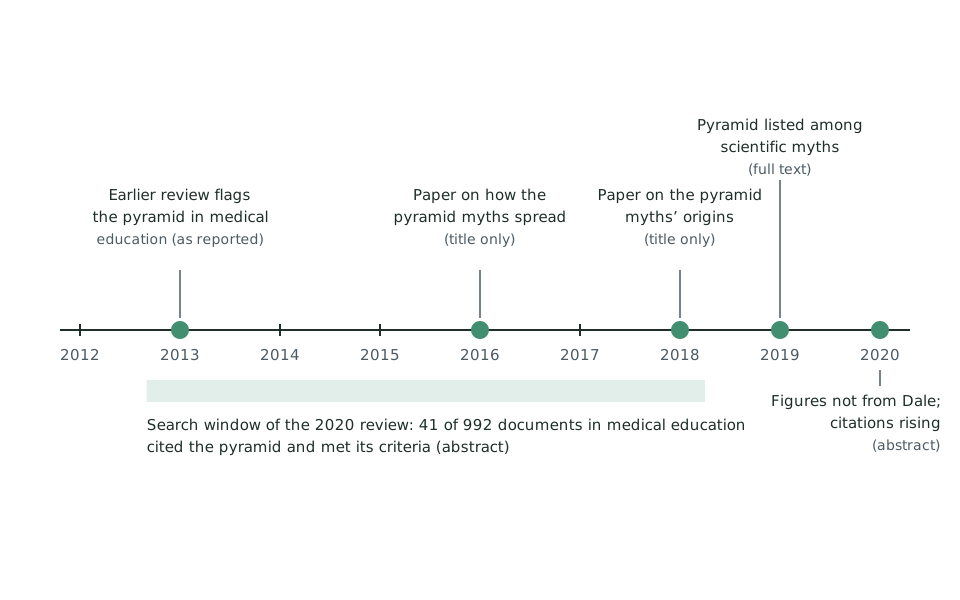
Diagram: Feedback & Forgetting, CC BY 4.0
Copy the credit line
"The learning pyramid in the research record, 2012 to 2020" by Feedback & Forgetting, https://feedbackandforgetting.com/learning-memory/learning-myths/, licensed under CC BY 4.0, https://creativecommons.org/licenses/by/4.0/Data: Masters, K. (2020). Edgar Dale's Pyramid of Learning in medical education: Further expansion of the myth. Medical Education 54(1): 22-32, doi:10.1111/medu.13813, abstract (figures quoted from the abstract); Letrud, K., & Hernes, S. (2019). Affirmative citation bias in scientific myth debunking: A three-in-one case study. PLOS ONE 14(9): e0222213, doi:10.1371/journal.pone.0222213, Introduction, CC BY 4.0 (https://creativecommons.org/licenses/by/4.0/); Letrud, K., & Hernes, S. (2016). Journal of Curriculum Studies 48(3): 291-302, doi:10.1080/00220272.2015.1088063, and Letrud, K., & Hernes, S. (2018). Cogent Education 5(1): 1518638, doi:10.1080/2331186x.2018.1518638, titles only
What the readable record shows about the learning pyramid from 2012 to 2020, with how much of each source could be read. The same points are in the table below.
| Year | Record | Read as |
|---|---|---|
| 2013 | A literature review flags the pyramid in medical education | as reported in the 2020 abstract |
| 2012–2018 | 41 of 992 documents found cite the pyramid and meet the 2020 review’s criteria | abstract |
| 2016 | Letrud and Hernes, “The diffusion of the learning pyramid myths in academia” | citation only |
| 2018 | Letrud and Hernes, “Excavating the origins of the learning pyramid myths” | citation only |
| 2019 | Letrud and Hernes list learning pyramid models among claims with basic flaws | full text |
| 2020 | Masters: the figures do not come from Dale; citations rising | abstract |
The second row comes from a University of Waterloo counseling page, archived in 2017. It said that by day 30 without review you keep “about 2%-3%” of a one-hour lecture, and it cites no study. This site’s forgetting curve study file sets that figure beside Ebbinghaus’s curve and a 2015 replication, which both sit higher but measure relearning time, not recall.
Source status: not found The archived 2017 page cites no study, and none of its numbers could be traced to one as of 2026-11-06. Checked 2026-11-06.
How widely neuromyths are believed
In the survey published in 2012, Sanne Dekker and colleagues gave 242 UK and Dutch teachers 32 statements, 15 of them neuromyths. The teachers believed 49% of the myths, on average. A statement that differences in hemispheric dominance help explain differences among learners was believed by 91% of UK and 86% of Dutch teachers.
Macdonald and colleagues ran a similar online survey in the United States from August 2014 to April 2015, with 3,045 members of the public, 598 educators and 234 people with high exposure to neuroscience. On average, the public endorsed 68% of seven classic neuromyths, educators 56% and the high-exposure group 46%.
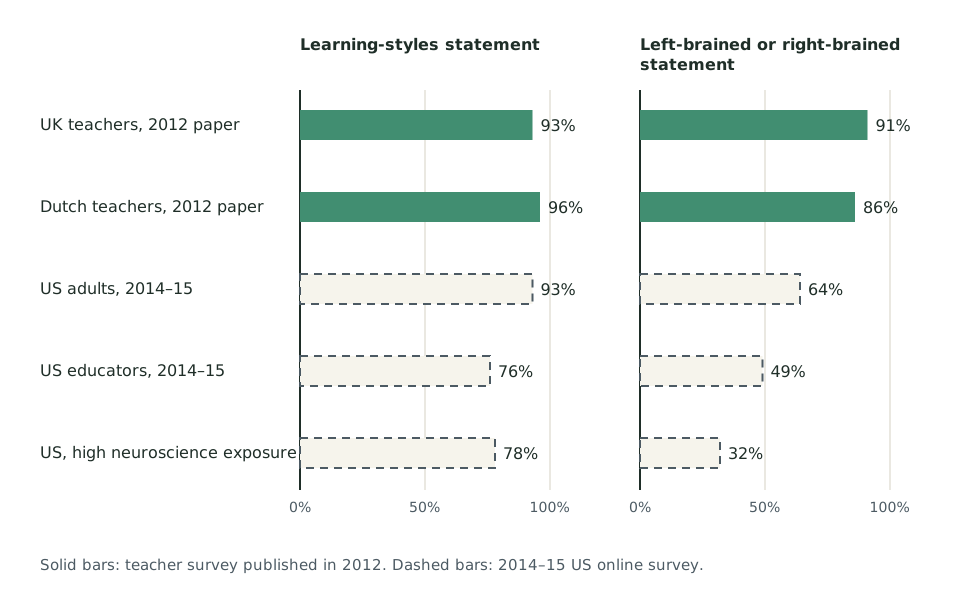
Diagram: Feedback & Forgetting, CC BY 4.0
Copy the credit line
"Who believed two neuromyths in two surveys" by Feedback & Forgetting, https://feedbackandforgetting.com/learning-memory/learning-myths/, licensed under CC BY 4.0, https://creativecommons.org/licenses/by/4.0/Data: Dekker, S., Lee, N. C., Howard-Jones, P., & Jolles, J. (2012). Neuromyths in education: Prevalence and predictors of misconceptions among teachers. Frontiers in Psychology 3: 429, doi:10.3389/fpsyg.2012.00429, Table 1, Creative Commons Attribution License (version not stated); Macdonald, K., Germine, L., Anderson, A., Christodoulou, J., & McGrath, L. M. (2017). Dispelling the myth: Training in education or neuroscience decreases but does not eliminate beliefs in neuromyths. Frontiers in Psychology 8: 1314, doi:10.3389/fpsyg.2017.01314, Table 5, CC BY 4.0 (https://creativecommons.org/licenses/by/4.0/)
Share of each group that believed or endorsed two statements in two surveys. The wording of the statements differs between the surveys, so compare groups within a survey.
These are counts of belief, not tests of an effect, so they carry no tag. The 2017 paper’s title says training in education or neuroscience reduces such beliefs but does not eliminate them.
What to use instead
Some study methods have evidence on delayed tests. In classrooms, a 2025 meta-analysis by Rhys Mawson and Sean Kang, read in full, found that spaced practice beat massed practice by d = 0.54 (95% CI 0.31 to 0.77), though the size varied widely. This site’s spaced repetition review takes those studies one at a time, and this site’s review of active recall covers closing the book and recalling.
When a handout shows a pyramid of retention rates or calls you left-brained, look for the study behind it. For your next session, close your notes a day after you first study the material and write down what you can recall.
Data: Values behind the scorecard
| Claim | Study | Value (quoted) | Value (recomputed) | Read as | Status |
|---|---|---|---|---|---|
| Teachers who believed the learning-styles statement, UK | Dekker, Lee, Howard-Jones & Jolles 2012 | 93% of teachers | — | full text | — |
| Teachers who believed the learning-styles statement, Netherlands | Dekker, Lee, Howard-Jones & Jolles 2012 | 96% of teachers | — | full text | — |
| Teachers who believed the hemispheric-dominance statement, UK | Dekker, Lee, Howard-Jones & Jolles 2012 | 91% of teachers | — | full text | — |
| Teachers who believed the hemispheric-dominance statement, Netherlands | Dekker, Lee, Howard-Jones & Jolles 2012 | 86% of teachers | — | full text | — |
| Teachers who believed the hemispheric-dominance statement, both countries | Dekker, Lee, Howard-Jones & Jolles 2012 | — | about 88.8% of teachers ((91 x 137 + 86 x 105) / 242; assumes every teacher answered this statement) | full text | — |
| Teachers who believed the critical-periods statement, UK | Dekker, Lee, Howard-Jones & Jolles 2012 | 33% of teachers | — | full text | — |
| Teachers who believed the critical-periods statement, Netherlands | Dekker, Lee, Howard-Jones & Jolles 2012 | 52% of teachers | — | full text | — |
| Average share of the survey’s 15 neuromyths that teachers believed | Dekker, Lee, Howard-Jones & Jolles 2012 | 49% of myths | — | full text | — |
| US adults who endorsed the learning-styles statement | Macdonald, Germine, Anderson, Christodoulou & McGrath 2017 | 93% of group | — | full text | — |
| US educators who endorsed the learning-styles statement | Macdonald, Germine, Anderson, Christodoulou & McGrath 2017 | 76% of group | — | full text | — |
| People with high neuroscience exposure who endorsed the learning-styles statement | Macdonald, Germine, Anderson, Christodoulou & McGrath 2017 | 78% of group | — | full text | — |
| US adults who endorsed the left-brained or right-brained statement | Macdonald, Germine, Anderson, Christodoulou & McGrath 2017 | 64% of group | — | full text | — |
| US educators who endorsed the left-brained or right-brained statement | Macdonald, Germine, Anderson, Christodoulou & McGrath 2017 | 49% of group | — | full text | — |
| People with high neuroscience exposure who endorsed the left-brained or right-brained statement | Macdonald, Germine, Anderson, Christodoulou & McGrath 2017 | 32% of group | — | full text | — |
| US adults who endorsed the classical-music statement | Macdonald, Germine, Anderson, Christodoulou & McGrath 2017 | 59% of group | — | full text | — |
| US educators who endorsed the classical-music statement | Macdonald, Germine, Anderson, Christodoulou & McGrath 2017 | 55% of group | — | full text | — |
| People with high neuroscience exposure who endorsed the classical-music statement | Macdonald, Germine, Anderson, Christodoulou & McGrath 2017 | 43% of group | — | full text | — |
| People in the replication whose accumulated practice was compared across three skill groups | Macnamara & Maitra 2019 | 39 violinists | — | full text | — |
| Share of variance in skill group explained by accumulated practice alone to age 18, all three groups compared, replication | Macnamara & Maitra 2019 | 26% of variance | — | full text | Replication tag: [mixed] |
| Share of variance explained by practice in the 1993 violinist study, best and good groups combined vs. the least accomplished | Macnamara & Maitra 2019 | 48% of variance; as reported by Macnamara & Maitra 2019 | — | full text | — |
| Accumulated practice alone to age 18, best violinists | Macnamara & Maitra 2019 | 8,224 hours (mean); 95% CI 6,400 to 10,048 | — | full text | — |
| Accumulated practice alone to age 18, good violinists | Macnamara & Maitra 2019 | 9,844 hours (mean); 95% CI 6,937 to 12,751 | — | full text | — |
| Mean accumulated practice, good minus best violinists, to age 18 | Macnamara & Maitra 2019 | — | 1,620 hours (9844 - 8224; difference not significant in the paper (p = 0.364)) | full text | — |
| Practice alone accumulated by age 20, best and good violinists, on average | Macnamara & Maitra 2019 | more than 10,000 hours | — | full text | — |
| Variance in performance explained by deliberate practice, games | Macnamara, Hambrick & Oswald 2014 | 26% of variance | — | abstract | [status not assigned] (correction) |
| Variance in performance explained by deliberate practice, music | Macnamara, Hambrick & Oswald 2014 | 21% of variance | — | abstract | [status not assigned] (correction) |
| Variance in performance explained by deliberate practice, sports | Macnamara, Hambrick & Oswald 2014 | 18% of variance | — | abstract | [status not assigned] (correction) |
| Variance in performance explained by deliberate practice, education | Macnamara, Hambrick & Oswald 2014 | 4% of variance | — | abstract | [status not assigned] (correction) |
| Variance in performance explained by deliberate practice, professions | Macnamara, Hambrick & Oswald 2014 | less than 1% of variance | — | abstract | [status not assigned] (correction) |
| Articles citing the three critical papers | Letrud & Hernes 2019 | 613 articles | — | full text | — |
| Of those, articles that affirmed the criticized idea | Letrud & Hernes 2019 | 468 articles | — | full text | — |
| Share of citing articles that affirmed the criticized idea | Letrud & Hernes 2019 | — | about 76.3% of articles (468 / 613 x 100) | full text | — |
| Documents found in the search for learning pyramid citations | Masters 2020 | 992 documents | — | abstract | — |
| Documents that cited the learning pyramid and met the review’s criteria | Masters 2020 | 41 documents | — | abstract | — |
| People whose resting brain scans were analyzed for left-right lateralization | Nielsen, Zielinski, Ferguson, Lainhart & Anderson 2013 | 1,011 people | — | full text | — |
Download the data (CSV, learning-myths-values.csv) · Where each value comes from (JSON) Data: Dekker, S., Lee, N. C., Howard-Jones, P., & Jolles, J. (2012). Frontiers in Psychology 3: 429, doi:10.3389/fpsyg.2012.00429, Creative Commons Attribution License (version not stated); Macdonald, K., Germine, L., Anderson, A., Christodoulou, J., & McGrath, L. M. (2017). Frontiers in Psychology 8: 1314, doi:10.3389/fpsyg.2017.01314, CC BY 4.0 (https://creativecommons.org/licenses/by/4.0/); Nielsen, J. A., Zielinski, B. A., Ferguson, M. A., Lainhart, J. E., & Anderson, J. S. (2013). PLOS ONE 8(8): e71275, doi:10.1371/journal.pone.0071275, CC BY 4.0 (https://creativecommons.org/licenses/by/4.0/); Macnamara, B. N., & Maitra, M. (2019). Royal Society Open Science 6(8): 190327, doi:10.1098/rsos.190327, CC BY 4.0 (https://creativecommons.org/licenses/by/4.0/); Macnamara, B. N., Hambrick, D. Z., & Oswald, F. L. (2014). Psychological Science 25(8): 1608-1618, doi:10.1177/0956797614535810, abstract (quoted figures only); Letrud, K., & Hernes, S. (2019). PLOS ONE 14(9): e0222213, doi:10.1371/journal.pone.0222213, CC BY 4.0 (https://creativecommons.org/licenses/by/4.0/); Masters, K. (2020). Medical Education 54(1): 22-32, doi:10.1111/medu.13813, abstract (quoted figures only)
The replication scorecard at the top of this page, as a CSV file · Where each value comes from (JSON) Data: Dekker, S., Lee, N. C., Howard-Jones, P., & Jolles, J. (2012). Frontiers in Psychology 3: 429, doi:10.3389/fpsyg.2012.00429, Creative Commons Attribution License (version not stated); Macdonald, K., Germine, L., Anderson, A., Christodoulou, J., & McGrath, L. M. (2017). Frontiers in Psychology 8: 1314, doi:10.3389/fpsyg.2017.01314, CC BY 4.0 (https://creativecommons.org/licenses/by/4.0/); Nielsen, J. A., Zielinski, B. A., Ferguson, M. A., Lainhart, J. E., & Anderson, J. S. (2013). PLOS ONE 8(8): e71275, doi:10.1371/journal.pone.0071275, CC BY 4.0 (https://creativecommons.org/licenses/by/4.0/); Macnamara, B. N., & Maitra, M. (2019). Royal Society Open Science 6(8): 190327, doi:10.1098/rsos.190327, CC BY 4.0 (https://creativecommons.org/licenses/by/4.0/); Mawson, R. D., & Kang, S. H. K. (2025). Behavioral Sciences 15(6): 771, doi:10.3390/bs15060771, CC BY 4.0 (https://creativecommons.org/licenses/by/4.0/); Aslaksen, K., & Lorås, H. (2018). Frontiers in Psychology 9: 1538, doi:10.3389/fpsyg.2018.01538, CC BY 4.0 (https://creativecommons.org/licenses/by/4.0/); Paulus, P. B., Baruah, J., & Kenworthy, J. B. (2018). Frontiers in Psychology 9: 2024, doi:10.3389/fpsyg.2018.02024, CC BY 4.0 (https://creativecommons.org/licenses/by/4.0/); Letrud, K., & Hernes, S. (2019). PLOS ONE 14(9): e0222213, doi:10.1371/journal.pone.0222213, CC BY 4.0 (https://creativecommons.org/licenses/by/4.0/); Masters, K. (2020). Medical Education 54(1): 22-32, doi:10.1111/medu.13813, abstract (quoted figures only); Cepeda, N. J., Pashler, H., Vul, E., Wixted, J. T., & Rohrer, D. (2006). Psychological Bulletin 132(3): 354-380, doi:10.1037/0033-2909.132.3.354, abstract (quoted figures only); Johnson, J. S., & Newport, E. L. (1989). Cognitive Psychology 21(1): 60-99, doi:10.1016/0010-0285(89)90003-0, abstract (quoted figures only)
Retrieval check
Answer from memory first, then follow the link to the passage and check.
- In the 2019 violinist replication, which two groups did practice fail to separate? Back to the passage
- Which two rows have numbers with no study found behind them? Back to the passage · Where the 2–3% figure meets the measured curve
- Why does a narrow, real finding not prove the myth built on it? Back to the passage
Sources
- Letrud, K., & Hernes, S. (2019). Affirmative citation bias in scientific myth debunking: A three-in-one case study. PLOS ONE, 14(9), e0222213. doi:10.1371/journal.pone.0222213 https://doi.org/10.1371/journal.pone.0222213
- Dekker, S., Lee, N. C., Howard-Jones, P., & Jolles, J. (2012). Neuromyths in education: Prevalence and predictors of misconceptions among teachers. Frontiers in Psychology, 3, 429. doi:10.3389/fpsyg.2012.00429 https://doi.org/10.3389/fpsyg.2012.00429
- Aslaksen, K., & Lorås, H. (2018). The modality-specific learning style hypothesis: A mini-review. Frontiers in Psychology, 9, 1538. doi:10.3389/fpsyg.2018.01538 https://doi.org/10.3389/fpsyg.2018.01538
- Pashler, H., McDaniel, M., Rohrer, D., & Bjork, R. (2008). Learning styles: Concepts and evidence. Psychological Science in the Public Interest, 9(3), 105–119. doi:10.1111/j.1539-6053.2009.01038.x https://doi.org/10.1111/j.1539-6053.2009.01038.x
- Macdonald, K., Germine, L., Anderson, A., Christodoulou, J., & McGrath, L. M. (2017). Dispelling the myth: Training in education or neuroscience decreases but does not eliminate beliefs in neuromyths. Frontiers in Psychology, 8, 1314. doi:10.3389/fpsyg.2017.01314 https://doi.org/10.3389/fpsyg.2017.01314
- Nielsen, J. A., Zielinski, B. A., Ferguson, M. A., Lainhart, J. E., & Anderson, J. S. (2013). An evaluation of the left-brain vs. right-brain hypothesis with resting state functional connectivity magnetic resonance imaging. PLOS ONE, 8(8), e71275. doi:10.1371/journal.pone.0071275 https://doi.org/10.1371/journal.pone.0071275
- Gladwell, M. (2008). Outliers: The story of success. New York: Little, Brown. As reported by Macnamara & Maitra (2019). https://doi.org/10.1098/rsos.190327
- Ericsson, K. A., Krampe, R. T., & Tesch-Römer, C. (1993). The role of deliberate practice in the acquisition of expert performance. Psychological Review, 100(3), 363–406. doi:10.1037/0033-295x.100.3.363 https://doi.org/10.1037/0033-295x.100.3.363
- Macnamara, B. N., & Maitra, M. (2019). The role of deliberate practice in expert performance: Revisiting Ericsson, Krampe & Tesch-Römer (1993). Royal Society Open Science, 6(8), 190327. doi:10.1098/rsos.190327 https://doi.org/10.1098/rsos.190327
- Rauscher, F. H., Shaw, G. L., & Ky, C. N. (1993). Music and spatial task performance. Nature, 365(6447), 611. doi:10.1038/365611a0 https://doi.org/10.1038/365611a0
- Chabris, C. F. (1999). Prelude or requiem for the ‘Mozart effect’? Nature, 400, 826–827. doi:10.1038/23608 https://doi.org/10.1038/23608
- Rauscher, F. H. (1999). Prelude or requiem for the ‘Mozart effect’? Nature, 400. doi:10.1038/23614 https://doi.org/10.1038/23614
- Pietschnig, J., Voracek, M., & Formann, A. K. (2010). Mozart effect–Shmozart effect: A meta-analysis. Intelligence, 38(3), 314–323. doi:10.1016/j.intell.2010.03.001 https://doi.org/10.1016/j.intell.2010.03.001
- Masters, K. (2020). Edgar Dale's Pyramid of Learning in medical education: Further expansion of the myth. Medical Education, 54(1), 22–32. doi:10.1111/medu.13813 https://doi.org/10.1111/medu.13813
- Letrud, K., & Hernes, S. (2016). The diffusion of the learning pyramid myths in academia: An exploratory study. Journal of Curriculum Studies, 48(3), 291–302. doi:10.1080/00220272.2015.1088063 https://doi.org/10.1080/00220272.2015.1088063
- Letrud, K., & Hernes, S. (2018). Excavating the origins of the learning pyramid myths. Cogent Education, 5(1), 1518638. doi:10.1080/2331186x.2018.1518638 https://doi.org/10.1080/2331186x.2018.1518638
- University of Waterloo Counselling Services. “Curve of Forgetting.” Archived copy of 2017-03-29. https://web.archive.org/web/20170329184930/https://uwaterloo.ca/counselling-services/curve-forgetting
- Johnson, J. S., & Newport, E. L. (1989). Critical period effects in second language learning: The influence of maturational state on the acquisition of English as a second language. Cognitive Psychology, 21(1), 60–99. doi:10.1016/0010-0285(89)90003-0 https://doi.org/10.1016/0010-0285(89)90003-0
- Cepeda, N. J., Pashler, H., Vul, E., Wixted, J. T., & Rohrer, D. (2006). Distributed practice in verbal recall tasks: A review and quantitative synthesis. Psychological Bulletin, 132(3), 354–380. doi:10.1037/0033-2909.132.3.354 https://doi.org/10.1037/0033-2909.132.3.354
- Mawson, R. D., & Kang, S. H. K. (2025). The Distributed Practice Effect on Classroom Learning: A Meta-Analytic Review of Applied Research. Behavioral Sciences, 15(6), 771. doi:10.3390/bs15060771 https://doi.org/10.3390/bs15060771
- Paulus, P. B., Baruah, J., & Kenworthy, J. B. (2018). Enhancing collaborative ideation in organizations. Frontiers in Psychology, 9, 2024. doi:10.3389/fpsyg.2018.02024 https://doi.org/10.3389/fpsyg.2018.02024
- Macnamara, B. N., Hambrick, D. Z., & Oswald, F. L. (2014). Deliberate practice and performance in music, games, sports, education, and professions: A meta-analysis. Psychological Science, 25(8), 1608–1618. doi:10.1177/0956797614535810 https://doi.org/10.1177/0956797614535810
- Crossref. Update searches (corrections, retractions, expressions of concern) for the 20 DOIs cited on this page. https://api.crossref.org/works?filter=updates:10.1177/0956797614535810
Cite this page
Feedback & Forgetting. (2026-11-06). Learning Myths and Neuromyths: Some Began as Real Findings. https://feedbackandforgetting.com/learning-memory/learning-myths/ (accessed [date you read it])
No DOI is assigned to this page; cite the address above with the date you read it.
Related reading
-
Learning & Memory
Forgetting Curve: It Measured Relearning, Not Recall
Picture credit
"Zeitschrift fur Psychologie, 1909: Herman Ebbinghaus" by Wellcome Collection — https://commons.wikimedia.org/wiki/File:Zeitschrift_fur_Psychologie,_1909;_Herman_Ebbinghaus._Wellcome_L0003734.jpg — CC BY 4.0 (https://creativecommons.org/licenses/by/4.0/); modifications: cropped mount, padded
-

Learning & Memory
Spaced Repetition: Should Review Gaps Grow? Studies Disagree
Picture credit
Illustration: Feedback & Forgetting. Generated schematic illustration — not a photograph or historical record. © Feedback & Forgetting, all rights reserved.
-
Learning & Memory
Active Recall: Quizzing Beat Rereading Later in a 2006 Study
Picture credit
"Mental Arithmetic. In Public School of S. A. Rachinsky" by Nikolay Bogdanov-Belsky — https://commons.wikimedia.org/wiki/File:Bogdanov-Belsky_Ustny_Schet_(Tretyakov).jpg — Public domain (PD-Art; painter d. 1945 (EU: from 2016; US: published before 1931, per the Commons file page)); modifications: cropped