Active Recall: Quizzing Beat Rereading Later in a 2006 Study
Method deep read Feedback & Forgetting Published
Short answer. Active recall means pulling material out of memory, for example by answering questions with your notes closed, instead of reading it again. Researchers call it retrieval practice, and they call the gain on a later test the testing effect. In the 2006 study with prose passages, rereading won on a test five minutes later, but students who had been tested recalled more two days and a week later, according to the paper’s abstract. A 2021 review of 222 classroom studies reported a medium average benefit from quizzing, also read here through its abstract.
In one sentence: Quizzing yourself beat rereading on delayed tests in a 2006 study, where rereading still left students more confident, and helped on average in classroom studies, according to the abstracts read here.
Outline6 sections
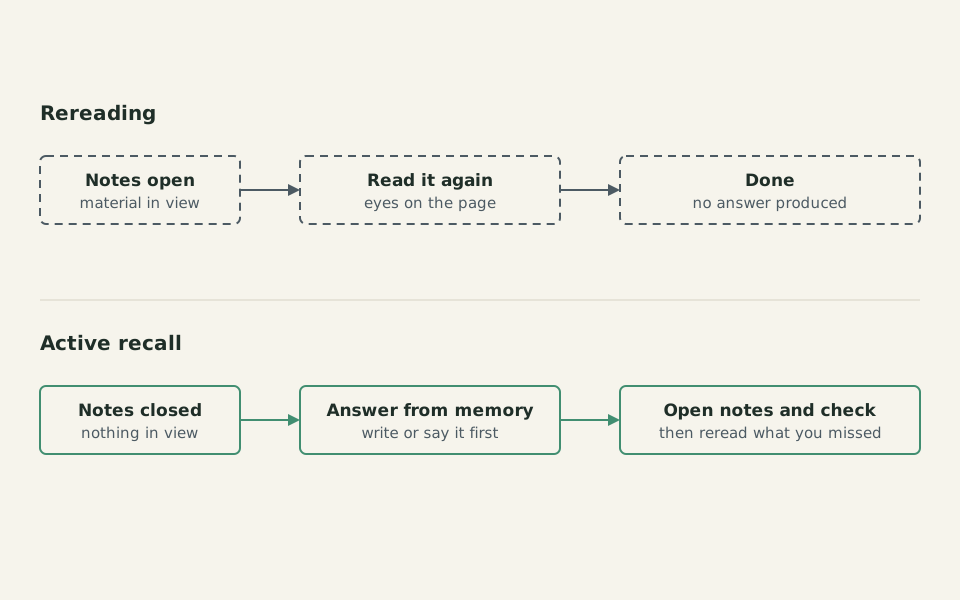
Diagram: Feedback & Forgetting, CC BY 4.0
Copy the credit line
"Rereading versus active recall" by Feedback & Forgetting, https://feedbackandforgetting.com/learning-memory/active-recall/, licensed under CC BY 4.0, https://creativecommons.org/licenses/by/4.0/Two ways to spend a second pass over the same notes. The steps are a schematic, not the procedure of any one study.
In 1890, William James claimed that recalling a text from memory fixes it better than looking at it again. “A curious peculiarity of our memory is that things are impressed better by active than by passive repetition,” he wrote in The Principles of Psychology (volume 1, page 686). He gave no experiment, only advice: when you almost know a passage, wait and recall it “by an effort from within” instead of opening the book. Did the experiments that came later bear him out, and how should you use the idea?
The main reviews follow one at a time, each at the level it could be read: full text, abstract, or citation only. The page ends with a one-week plan built from the conditions those studies used.
An old idea, stated in 1890
"William James" by Alice Boughton — https://commons.wikimedia.org/wiki/File:William_James_by_Alice_M._Boughton,_c._1907,_platinum_print,_from_the_National_Portrait_Gallery_-_NPG-NPG_87_37James-000001_(cropped).jpg — CC0 1.0 (https://creativecommons.org/publicdomain/zero/1.0/); modifications: resized
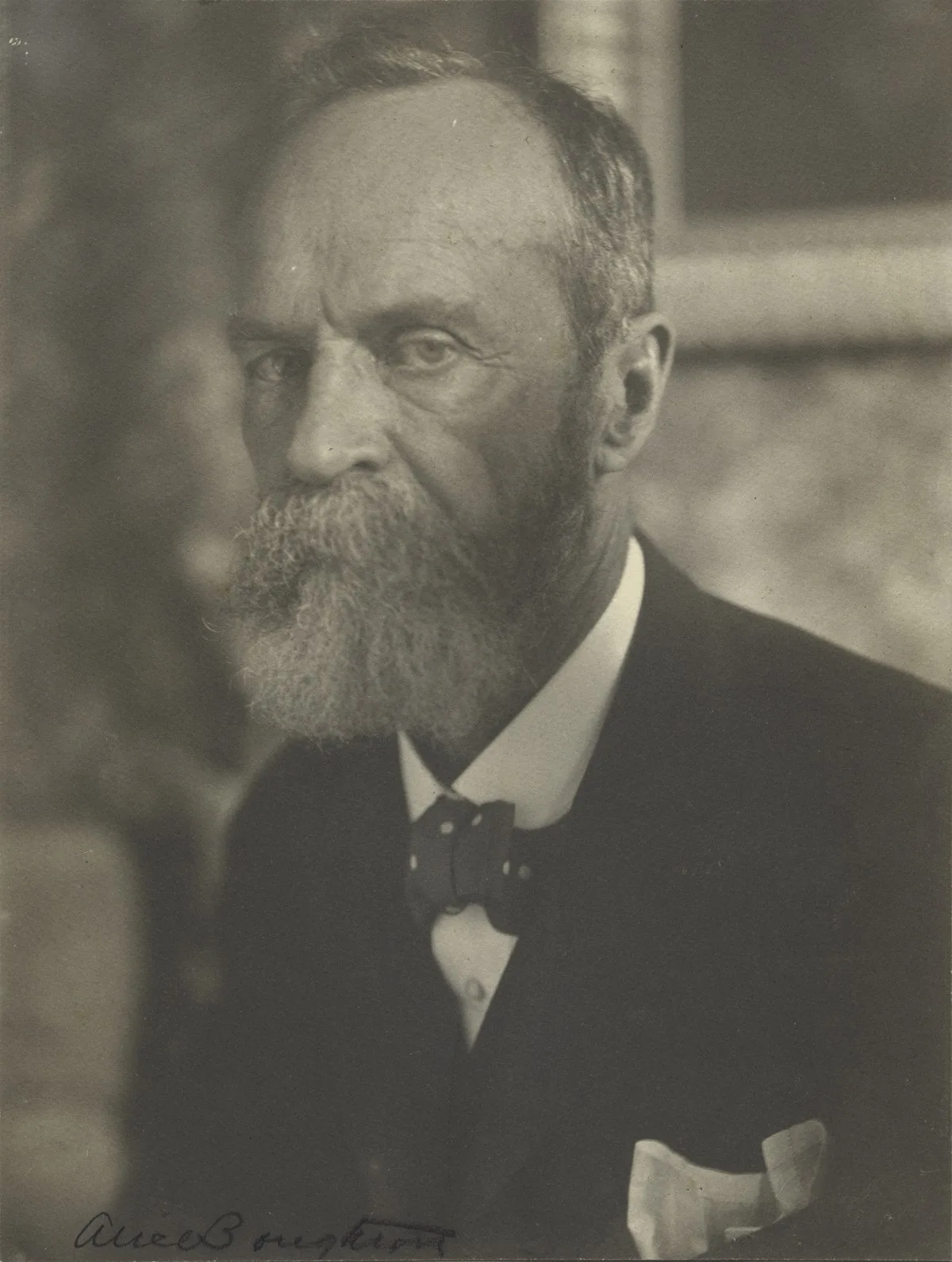
William James, photographed by Alice Boughton about 1907 (National Portrait Gallery, Smithsonian Institution).
James took his example from learning by heart. If you recover the words by effort, he wrote, “we shall probably know them the next time”; if you look them up, “we shall very likely need the book once more.” He explained the effect with a guess about how the brain links one word to the next. Nothing in his chapter tested that guess.
Experiments came later. A 2025 review led by Michael Serra, read in full here, credits the first ones to Edwina Abbott, in a master’s thesis from 1909. The review says the topic then came up only now and then during the 20th century. One of those papers, by H. F. Spitzer in 1939, is titled “Studies in retention”; only its citation was read for this page.
The same review explains why one method has several names. In the 2000s, papers spoke of the testing effect, or test-enhanced learning, and stressed that people who were tested remembered more than people who reread. The term retrieval practice puts the stress on the act of retrieving and on what shapes it, such as feedback and the format of the questions. According to the review, cognitive psychologists tend to say retrieval practice, while the testing effect is still common outside the field, in education.
The memory experiments that Hermann Ebbinghaus published five years before James wrote did not settle the question either. They timed how long relearning took rather than counting what could be recalled; this site’s study file on the forgetting curve explains why savings and recall can come apart.
What the pooled studies found
When many experiments ask the same question, a meta-analysis pools them into one estimate. Five reviews of self-testing follow. Only some of their contents could be read, and the diagram sums up what each one could offer this page.
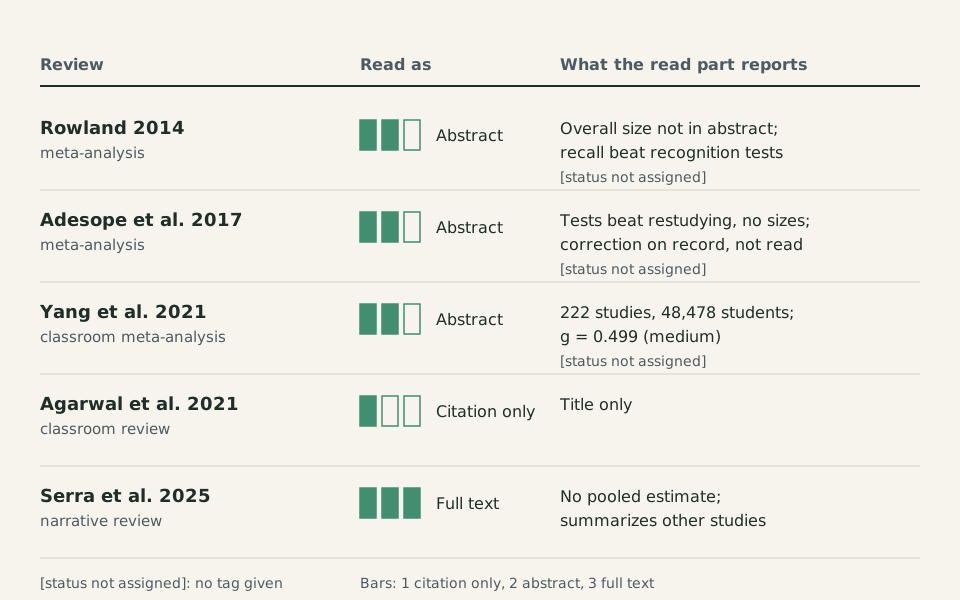
Diagram: Feedback & Forgetting, CC BY 4.0
Copy the credit line
"Five reviews of self-testing, by how much could be read" by Feedback & Forgetting, https://feedbackandforgetting.com/learning-memory/active-recall/, licensed under CC BY 4.0, https://creativecommons.org/licenses/by/4.0/Data: Rowland, C. A. (2014). The effect of testing versus restudy on retention: A meta-analytic review of the testing effect. Psychological Bulletin 140(6): 1432–1463, doi:10.1037/a0037559, abstract; Yang, C., Luo, L., Vadillo, M. A., Yu, R., & Shanks, D. R. (2021). Testing (quizzing) boosts classroom learning: A systematic and meta-analytic review. Psychological Bulletin 147(4): 399–435, doi:10.1037/bul0000309, abstract (figures quoted); Adesope, O. O., Trevisan, D. A., & Sundararajan, N. (2017). Rethinking the Use of Tests: A Meta-Analysis of Practice Testing. Review of Educational Research 87(3): 659–701, doi:10.3102/0034654316689306, abstract (no figures quoted); Agarwal, P. K., Nunes, L. D., & Blunt, J. R. (2021), doi:10.1007/s10648-021-09595-9: citation record only; Serra, M. J., et al. (2025). The Use of Retrieval Practice in the Health Professions: A State-of-the-Art Review. Behavioral Sciences 15(7): 974, doi:10.3390/bs15070974, CC BY 4.0 (https://creativecommons.org/licenses/by/4.0/)
The five reviews this page draws on, by how much of each could be read and what that part reports. The same information is in the first table under Data below.
A 2014 meta-analysis by Christopher Rowland pooled experiments that compared taking a test with restudying the same material. Its abstract does not give the overall size of the benefit. It reports that recall tests, where you produce the answer yourself, gave larger testing benefits than recognition tests, where you pick the answer out. Rowland reads that as support for effortful processing as one cause of the effect.
A 2017 meta-analysis by Olusola Adesope, Dominic Trevisan and Narayankripa Sundararajan compared practice tests with learning conditions that involved no test. Its abstract, which the publisher supplies in the paper’s Crossref record, reports that practice tests were more beneficial for learning than restudying and every other comparison condition. It adds that the mean effects depended on features of the tests, the participants and studies, the outcomes measured and the study methods. It gives no effect sizes, so none appear here.
A correction to the 2017 paper is on record from the same year. Its content was not read, so this page cannot say whether it changed any figure.
[status not assigned] (correction) Practice tests versus restudying, in the studies pooled by meta-analyses from 2014 and 2017. Only the abstracts were read; neither gives an overall effect size or a bias-corrected estimate, and the 2017 correction is on record, not read. Based on abstracts. Checked 2026-11-06.
The other two reviews deal with classrooms and come up in the classroom section below. None of the parts read here reports an estimate corrected for publication bias, the tendency of positive results to get published more often. For that reason the main claims on this page carry “status not assigned” instead of a replication tag. The abstracts point the same way, but the size and the bias correction could not be checked.
Feedback and the timing of the final test
The experiment most often cited for the testing effect was published in 2006 by Henry Roediger and Jeffrey Karpicke. In two experiments, students studied prose passages. Some then took one or three free-recall tests right away, without feedback; others restudied the passage the same number of times.
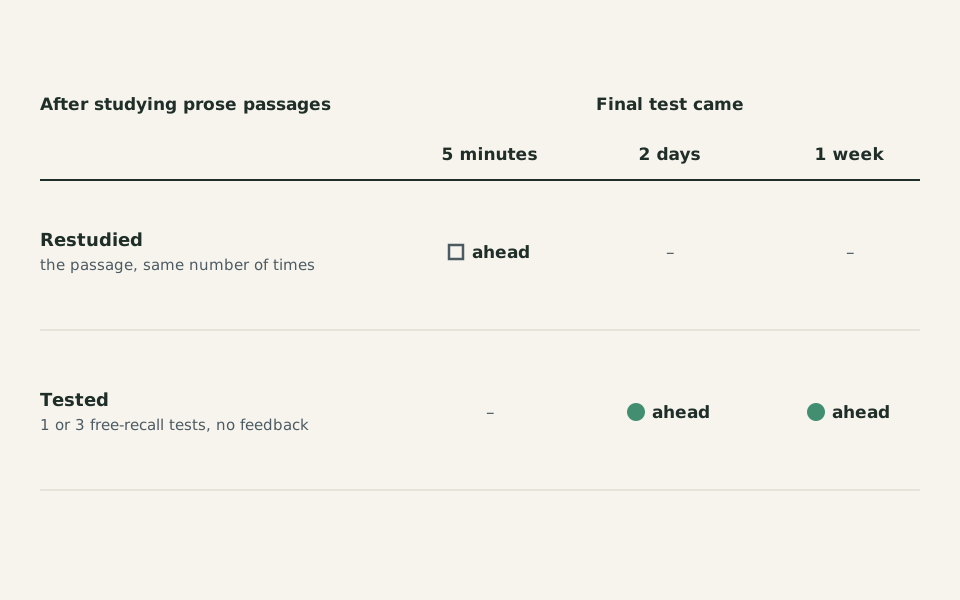
Diagram: Feedback & Forgetting, CC BY 4.0
Copy the credit line
"Restudying versus testing at three test delays, 2006" by Feedback & Forgetting, https://feedbackandforgetting.com/learning-memory/active-recall/, licensed under CC BY 4.0, https://creativecommons.org/licenses/by/4.0/The 2006 design and results as the abstract describes them. The abstract gives no percentages, so the diagram marks only which group was ahead at each delay.
The final test came 5 minutes, 2 days or 1 week later. At 5 minutes, repeated studying beat repeated testing. On the tests 2 days and 1 week later, the students who had been tested retained substantially more, according to the abstract. The same abstract gives no percentages, so none are given here.
[status not assigned] Testing versus restudying: students, prose passages, final tests 5 minutes to 1 week later. Two experiments in one paper; the reviews that pool such studies could be read only as abstracts or citations, which is not enough to judge replication. Based on the abstract. Checked 2026-11-06.
Consider the 5-minute result. A check made minutes after studying favored the method that lost later on. With an exam days away, how well you do right after rereading is a poor guide to which method is working.
On this site’s learning pages, feedback means telling a learner whether an answer was right. The 2006 tests came without feedback, and testing still won at the two longer delays. The 2021 classroom review lists corrective feedback among the factors that changed the size of the benefit, but its abstract does not say in which direction or by how much.
That leaves a practical question: whether to check your answers. The evidence read here supports trying before you look. The 2025 review cites a 2024 study in which students sometimes looked up the answer when they felt unsure, and it says that habit limits the benefit.
The same review says retrieval practice works better when the retrieval succeeds. It adds, citing another 2024 study, that a learner who scores poorly on a practice test still benefits, as long as the score is not close to zero. A low first score is not a sign that the method is failing you. A blank page might be, and then you need more study before the next attempt.
These sources do not settle how much checking afterward adds. The plan below therefore checks after each attempt, never before it.
Why rereading feels like it works
The 2006 abstract adds one more result. Repeated studying increased students’ confidence in their ability to remember the material. The method that felt surer was the one that did worse on the delayed tests.
The 2025 review offers possible reasons, drawn from other studies. Retrieval takes more effort than rereading, and people tend to read ease as a sign of learning, so students may pick the easier method. These are explanations from other work; the 2006 study did not test them.
Whether a method feels right to you is a separate question from whether it works. This site’s review of learning styles looks at the related idea of matching teaching to the way people say they prefer to learn.
A term this site uses
The lecture mirage
This site calls the pattern the lecture mirage: across study methods, the order of how confident learners feel after studying runs opposite to the order of how they score on a delayed test. In the 2006 study, restudying ranked first on confidence, while testing ranked first on the delayed tests. The name comes from the smooth feel of listening to a lecture or rereading notes, but the 2006 study tested rereading, not lectures.
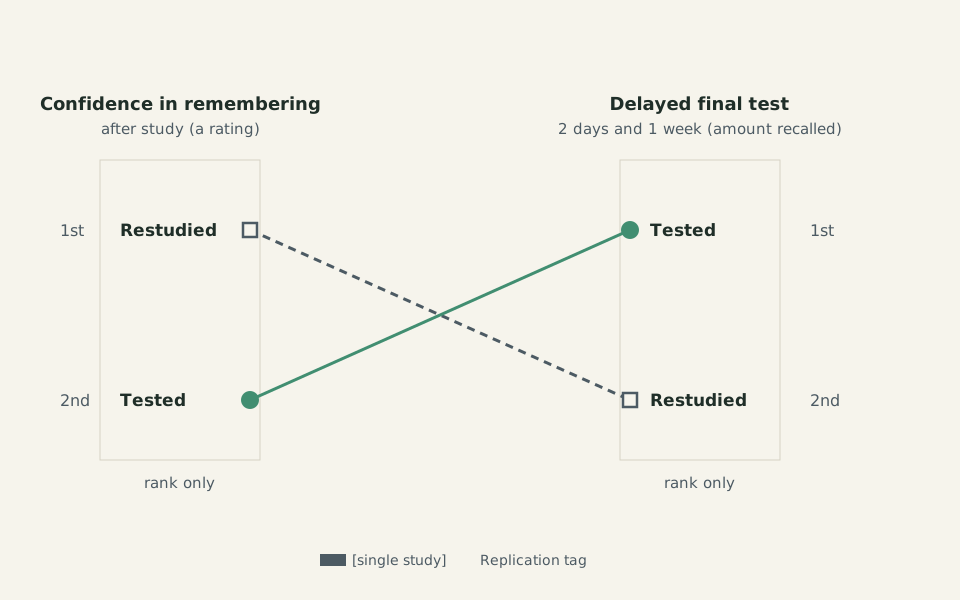
Diagram: Feedback & Forgetting, CC BY 4.0
Copy the credit line
"Two rank orders in the 2006 experiments" by Feedback & Forgetting, https://feedbackandforgetting.com/learning-memory/active-recall/, licensed under CC BY 4.0, https://creativecommons.org/licenses/by/4.0/The two orderings in the 2006 study, as the abstract describes them. The panels use different measures and share no scale.
The two measures are on different scales: a rating of confidence and an amount recalled. They cannot be subtracted from each other, so the pattern says nothing about how much anyone overestimated. That question needs studies in which predictions and scores share one scale, and none was read for this page. The term names an observed ordering, not its cause; ease is one possible reason, not the only one.
Replication tag: [single study] Confidence higher after restudying, delayed recall higher after testing: students, prose passages, recall on final tests 2 days and 1 week later. The abstract does not say in which of the paper’s two experiments, or when, confidence was rated, and no independent replication on the same measures was read for this page. Based on the abstract. Checked 2026-11-06.
In classrooms

"Mental Arithmetic. In Public School of S. A. Rachinsky" by Nikolay Bogdanov-Belsky — https://commons.wikimedia.org/wiki/File:Bogdanov-Belsky_Ustny_Schet_(Tretyakov).jpg — Public domain (PD-Art; painter d. 1945 (EU: from 2016; US: published before 1931, per the Commons file page)); modifications: cropped
Nikolay Bogdanov-Belsky, Mental Arithmetic. In Public School of S. A. Rachinsky, 1895 (Tretyakov Gallery, Moscow).
The painting shows boys working out a sum in their heads, with nothing to look up. It is a scene from 1895, not a test of the method. A result from a lab can look different in a real classroom, so reviews of classroom studies are a separate check.
A 2021 meta-analysis led by Chunliang Yang pooled data from 48,478 students in 222 independent classroom studies. Its abstract reports that quizzing raised achievement to a medium extent, g = 0.499, compared with control conditions. The g is a standardized difference in test scores; it is not a count of extra days remembered.
The abstract also lists what changed the size of that benefit: what the comparison group did, whether the quiz matched the final test in format and material, corrective feedback, the number of quizzes, where and when they were given, how long the program ran and the study design. The abstract does not report a bias-corrected estimate.
As for why quizzing helps in a classroom, the abstract names three explanations that its results support: extra exposure to the material, practice that resembles the final test, and motivation. They are the authors’ readings of the pooled results. This page did not see the analyses behind them.
[status not assigned] Quizzing versus control conditions in classrooms: 222 studies, 48,478 students; subjects and test delays not stated in the abstract. Pooled effect positive and medium; no bias-corrected estimate in the abstract. Based on the abstract. Checked 2026-11-06.
A 2021 review by Pooja Agarwal, Ludmila Nunes and Janell Blunt is titled “Retrieval Practice Consistently Benefits Student Learning: a Systematic Review of Applied Research in Schools and Classrooms.” Only its citation could be read, so its title is all this page reports from it.
A week of active recall
The plan below is this site’s design, built from the conditions in the studies above. It has not been tested as a package. It promises no score.
- Day 1: study, then close your notes. Read the material once, then write down everything you remember, a free-recall attempt like the tests in the 2006 study. Then open the notes and mark what you missed.
- Day 3: recall before you reread. Start with the notes closed. Answer questions in your own words rather than picking from options, since the 2014 abstract reports larger benefits from recall than from recognition. Check your answers, then reread only the parts you missed.
- Days 4 to 9: leave it. The plan schedules no session here. The spacing study behind the gap in step 4 gave one review and then the final test, and the plan copies that shape.
- Day 10: the test. The day-3 review sits two days after first study, inside the best gap of about 1.4 to 2.8 days that this site’s spaced repetition review works out for a test a week after the review.
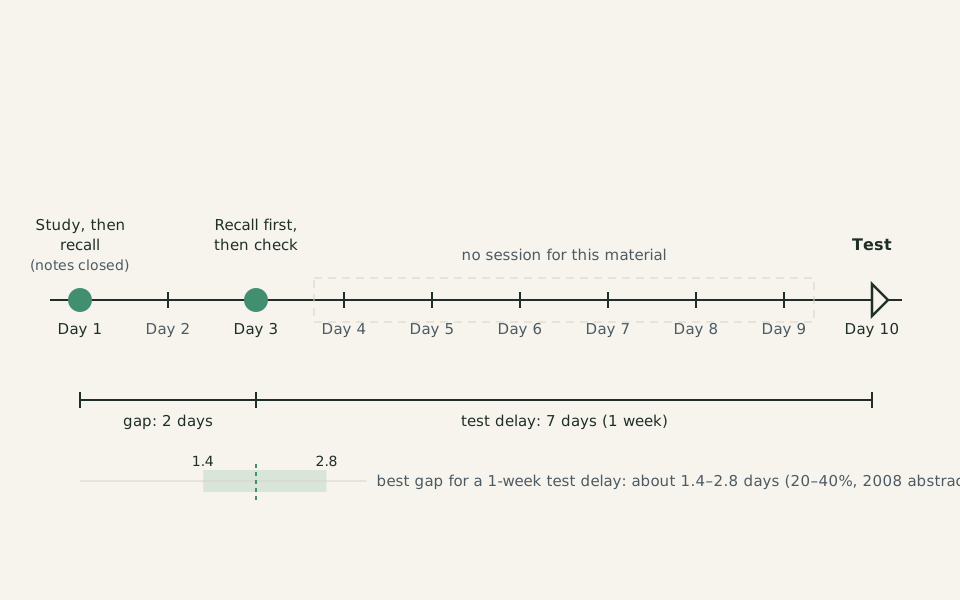
Diagram: Feedback & Forgetting, CC BY 4.0
Copy the credit line
"A week of active recall as a timeline" by Feedback & Forgetting, https://feedbackandforgetting.com/learning-memory/active-recall/, licensed under CC BY 4.0, https://creativecommons.org/licenses/by/4.0/Data: Cepeda, N. J., Vul, E., Rohrer, D., Wixted, J. T., & Pashler, H. (2008). Spacing effects in learning: A temporal ridgeline of optimal retention. Psychological Science 19(11): 1095–1102, doi:10.1111/j.1467-9280.2008.02209.x, abstract (shares quoted; days computed by Feedback & Forgetting)
The week plan as a timeline. The two-day gap falls inside about 20–40% of a seven-day test delay, the best-gap range for that delay in the abstract of a 2008 spacing study in which people learned a set of facts.
Make your questions look like the test. The 2021 abstract lists matching format and material among the factors that changed the size of the benefit, and the 2025 review says practice helps most when it calls for the same kind of thinking as the exam. If your recall takes the form of explaining the material aloud, this site’s page on the Feynman technique covers what research has tested under other names.
Where self-quizzing goes wrong
The 2025 review, which deals with medical, nursing and dental students, lists several ways that self-quizzing loses its value. They come from the review’s reading of other studies, so treat them as warnings rather than measured effects.
The first is quizzing too late. Some students save practice questions for a check shortly before the exam, which turns them into a measure of what you know instead of a way to learn it. Stopping too early is the second: the review says students often drop a flashcard after answering it correctly once, and that several retrievals work far better than one.
Then there is recall that has stopped being recall. A deck you have seen many times can feel so familiar that you glance at a card and move on without producing the answer. Saying or writing the answer before you turn the card keeps the attempt real.
Last comes practice on the wrong kind of question. Cards that drill single facts may not prepare you for an exam that asks you to apply those facts to a new case. The review’s advice is to make the practice ask for the same kind of thinking that the exam will.
Before your next study session ends, close your notes and write down what you remember. Then open them, mark what you missed, and put your next recall session two days later.
Data: Reviews and studies read for this page
| Claim | Source | Read as | Status |
|---|---|---|---|
| Things are impressed better by active than by passive repetition | James 1890, p. 686 | full text | no tag: a claim, not a test |
| Testing versus restudying, pooled experiments | Rowland 2014, meta-analysis | abstract | [status not assigned] |
| Recall tests gave larger testing benefits than recognition tests | Rowland 2014, meta-analysis | abstract | no tag: size not in the abstract |
| Practice tests beat restudying and all other comparison conditions; correction on record, not read | Adesope et al. 2017, meta-analysis | abstract | [status not assigned] |
| Testing beat restudying at 2 days and 1 week; restudying led at 5 minutes | Roediger & Karpicke 2006, 2 experiments | abstract | [status not assigned] |
| Restudying raised confidence while testing led on delayed tests | Roediger & Karpicke 2006, 2 experiments | abstract | Replication tag: [single study] |
| Quizzing raised classroom achievement, g = 0.499 | Yang et al. 2021, 222 studies | abstract | [status not assigned] |
| Review titled “Retrieval Practice Consistently Benefits Student Learning” | Agarwal et al. 2021 | citation only | no tag: citation only |
| Retrieval works better when it succeeds (citing Chan et al. 2024) | Serra et al. 2025, narrative review | full text | no tag: a review’s summary of other studies |
| Looking up answers when unsure limits the benefit (citing Sheehy et al. 2024) | Serra et al. 2025, narrative review | full text | no tag: a review’s summary of other studies |
Download the data (CSV, active-recall-reviews.csv) · Where each value comes from (JSON) Data: Roediger, H. L., III, & Karpicke, J. D. (2006). Psychological Science 17(3): 249–255, doi:10.1111/j.1467-9280.2006.01693.x, abstract; Rowland, C. A. (2014). Psychological Bulletin 140(6): 1432–1463, doi:10.1037/a0037559, abstract; Adesope, O. O., Trevisan, D. A., & Sundararajan, N. (2017). Review of Educational Research 87(3): 659–701, doi:10.3102/0034654316689306, abstract (no figures quoted); Yang, C., Luo, L., Vadillo, M. A., Yu, R., & Shanks, D. R. (2021). Psychological Bulletin 147(4): 399–435, doi:10.1037/bul0000309, abstract (figures quoted); Serra, M. J., et al. (2025). Behavioral Sciences 15(7): 974, doi:10.3390/bs15070974, CC BY 4.0 (https://creativecommons.org/licenses/by/4.0/), Sections 1.1, 4.1.2, 4.1.3, 4.3; James, W. (1890). The Principles of Psychology, vol. 1, p. 686. Public domain (author d. 1910)
Data: A week of active recall
| Day | What to do | Based on | Read as |
|---|---|---|---|
| 1 | Study, then write down what you remember; check against notes | Roediger & Karpicke 2006 (free recall after study) | abstract |
| 3 | Recall first in your own words; check; reread only what you missed | Rowland 2014 (recall over recognition); 2-day gap set by this plan, within about 1.4–2.8 days (recomputed from Cepeda et al. 2008) | abstract |
| 4–9 | No session for this material | Cepeda et al. 2008 (one review, then the test) | abstract |
| 10 | Test, 7 days after the review | Cepeda et al. 2008 (best gap about 20–40% of a 1-week test delay, quoted) | abstract |
Download the data (CSV, active-recall-week.csv) · Where each value comes from (JSON) Data: Cepeda, N. J., Vul, E., Rohrer, D., Wixted, J. T., & Pashler, H. (2008). Psychological Science 19(11): 1095–1102, doi:10.1111/j.1467-9280.2008.02209.x, abstract (shares quoted); Roediger, H. L., III, & Karpicke, J. D. (2006), doi:10.1111/j.1467-9280.2006.01693.x, and Rowland, C. A. (2014), doi:10.1037/a0037559: abstracts, no figures quoted
Retrieval check
Answer from memory first, then follow the link to the passage and check.
- Which two orderings does the lecture mirage set side by side, and why can’t they be subtracted? Back to the passage
- The 2006 tests came without feedback. Which group did better on the five-minute test, and which on the tests two days and a week later? Back to the passage
- In the week plan, why does the recall review fall on day 3 for a test on day 10? Back to the passage · Why the best gap depends on the test date
Sources
- James, W. (1890). The Principles of Psychology (Vol. 1). New York: Henry Holt. Chapter XVI, Memory, p. 686. https://archive.org/details/theprinciplesofp01jameuoft
- Serra, M. J., Kaminske, A. N., Nebel, C., & Coppola, K. M. (2025). The Use of Retrieval Practice in the Health Professions: A State-of-the-Art Review. Behavioral Sciences, 15(7), 974. doi:10.3390/bs15070974 https://doi.org/10.3390/bs15070974
- Spitzer, H. F. (1939). Studies in retention. Journal of Educational Psychology, 30(9), 641–656. doi:10.1037/h0063404 https://doi.org/10.1037/h0063404
- Rowland, C. A. (2014). The effect of testing versus restudy on retention: A meta-analytic review of the testing effect. Psychological Bulletin, 140(6), 1432–1463. doi:10.1037/a0037559 https://doi.org/10.1037/a0037559
- Adesope, O. O., Trevisan, D. A., & Sundararajan, N. (2017). Rethinking the Use of Tests: A Meta-Analysis of Practice Testing. Review of Educational Research, 87(3), 659–701. doi:10.3102/0034654316689306 https://doi.org/10.3102/0034654316689306
- Corrigendum (2017). Review of Educational Research, 87(3), NP1. doi:10.3102/0034654317700823 (correction to Adesope, Trevisan & Sundararajan 2017) https://doi.org/10.3102/0034654317700823
- Roediger, H. L., III, & Karpicke, J. D. (2006). Test-enhanced learning: Taking memory tests improves long-term retention. Psychological Science, 17(3), 249–255. doi:10.1111/j.1467-9280.2006.01693.x https://doi.org/10.1111/j.1467-9280.2006.01693.x
- Yang, C., Luo, L., Vadillo, M. A., Yu, R., & Shanks, D. R. (2021). Testing (quizzing) boosts classroom learning: A systematic and meta-analytic review. Psychological Bulletin, 147(4), 399–435. doi:10.1037/bul0000309 https://doi.org/10.1037/bul0000309
- Agarwal, P. K., Nunes, L. D., & Blunt, J. R. (2021). Retrieval Practice Consistently Benefits Student Learning: a Systematic Review of Applied Research in Schools and Classrooms. Educational Psychology Review, 33(4), 1409–1453. doi:10.1007/s10648-021-09595-9 https://doi.org/10.1007/s10648-021-09595-9
- Cepeda, N. J., Vul, E., Rohrer, D., Wixted, J. T., & Pashler, H. (2008). Spacing effects in learning: A temporal ridgeline of optimal retention. Psychological Science, 19(11), 1095–1102. doi:10.1111/j.1467-9280.2008.02209.x https://doi.org/10.1111/j.1467-9280.2008.02209.x
- Crossref. Work records and update searches (corrections, retractions, expressions of concern) for doi:10.3390/bs15070974, doi:10.1037/h0063404, doi:10.1037/a0037559, doi:10.3102/0034654316689306, doi:10.1111/j.1467-9280.2006.01693.x, doi:10.1037/bul0000309, doi:10.1007/s10648-021-09595-9 and doi:10.1111/j.1467-9280.2008.02209.x. https://api.crossref.org/works/10.3102/0034654316689306
Cite this page
Feedback & Forgetting. (2026-11-06). Active Recall: Quizzing Beat Rereading Later in a 2006 Study. https://feedbackandforgetting.com/learning-memory/active-recall/ (accessed [date you read it])
No DOI is assigned to this page; cite the address above with the date you read it.
Related reading
-
Learning & Memory
Forgetting Curve: It Measured Relearning, Not Recall
Picture credit
"Zeitschrift fur Psychologie, 1909: Herman Ebbinghaus" by Wellcome Collection — https://commons.wikimedia.org/wiki/File:Zeitschrift_fur_Psychologie,_1909;_Herman_Ebbinghaus._Wellcome_L0003734.jpg — CC BY 4.0 (https://creativecommons.org/licenses/by/4.0/); modifications: cropped mount, padded
-

Learning & Memory
Spaced Repetition: Should Review Gaps Grow? Studies Disagree
Picture credit
Illustration: Feedback & Forgetting. Generated schematic illustration — not a photograph or historical record. © Feedback & Forgetting, all rights reserved.
-
Learning & Memory
Do Learning Styles Work? A 2008 Review Found Few Fair Tests
Picture credit
Illustration: Feedback & Forgetting. Generated schematic illustration — not a photograph or historical record. © Feedback & Forgetting, all rights reserved.