Spaced Repetition: Should Review Gaps Grow? Studies Disagree
Method deep read Feedback & Forgetting Published
Short answer. Spaced repetition means reviewing material in several sessions with gaps between them, instead of all at once. In a 2025 meta-analysis of 22 classroom studies, spaced practice beat massed practice on average, though the size of the benefit varied widely between studies. Whether the gaps should grow is less settled. In one lab’s experiments, read here through their abstracts, growing gaps between recall tests did not beat equal gaps on delayed tests, and the total spacing mattered more than the pattern; another lab, repeating study sessions across days instead, found growing gaps did best or tied for best.
In one sentence: Spaced reviews beat massed study on average in classroom studies, but the popular rule of making every gap longer didn’t beat equal gaps on delayed tests in one lab’s recall-test experiments, read through their abstracts.
Outline5 sections
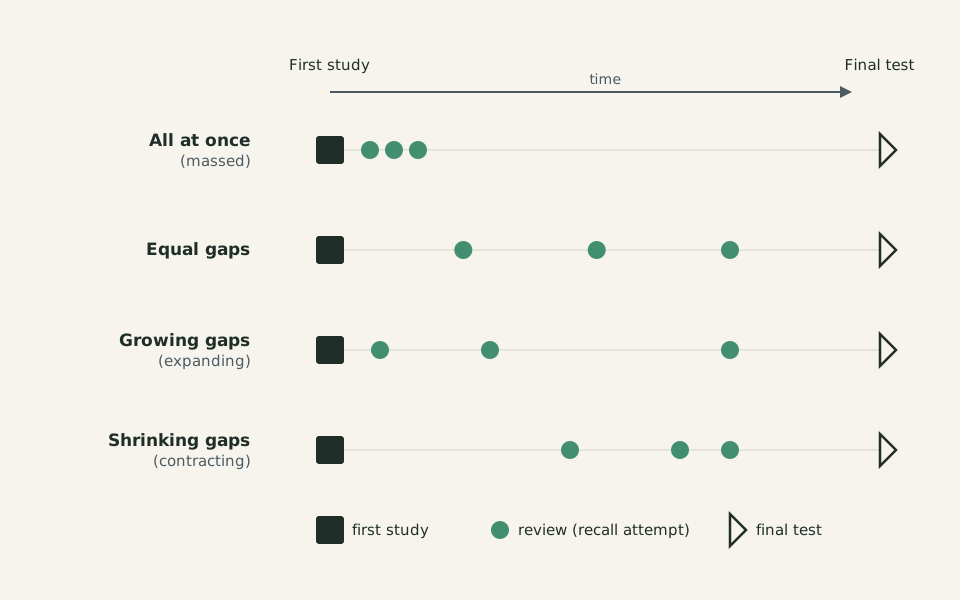
Diagram: Feedback & Forgetting, CC BY 4.0
Copy the credit line
"Four ways to place three reviews" by Feedback & Forgetting, https://feedbackandforgetting.com/learning-memory/spaced-repetition/, licensed under CC BY 4.0, https://creativecommons.org/licenses/by/4.0/Four ways to place three reviews between a first study session and a final test. The experiments below compared versions of these schedules; the positions here are illustrative, not the intervals any study used.
In experiments published in 2007, Jeffrey Karpicke and Henry Roediger had learners practice recalling vocabulary word pairs on two schedules. In one, the gaps between recall attempts grew; in the other, they stayed equal. The growing schedule led on a test 10 minutes after learning, but the equal schedule led two days later, according to the paper’s abstract. This page asks whether the gaps between your reviews should grow, and how long they should be.
Karpicke and Roediger’s abstract also notes that growing gaps, called expanding retrieval practice, had been regarded as the better technique for long-term retention. Below, the spacing studies come one at a time, each at the level it could be read: full text, abstract, or citation only. The last section is a schedule built only from what those studies measured.
What does spacing beat?
Spacing is measured against massed practice: the same number of repetitions, packed back to back in one sitting. Spaced practice puts those repetitions in separate sessions. Spaced repetition is the everyday name for planning reviews this way.
The largest lab review read here is a 2006 meta-analysis led by Nicholas Cepeda. It found 839 assessments of distributed practice in 317 experiments from 184 articles on verbal recall. Its abstract says that the gap giving the best retention grew as the final test moved further away. The review also looked at expanding gaps, but the abstract does not say what that analysis found.
[status not assigned] Spaced versus massed study in verbal recall tasks. Only the review’s abstract was read, and it reports neither the size of the spacing effect nor a bias-corrected estimate. Checked 2026-11-06.
Lab tasks often use word lists and short delays, so a classroom review is a useful check. A 2025 meta-analysis by Rhys Mawson and Sean Kang, read in full, kept only classroom studies that used course material, put at least a day between sessions and gave the massed group equal study time.
Across 22 studies with 31 effect sizes and more than 3,000 learners, spaced practice beat massed practice by d = 0.54 (95% CI 0.31 to 0.77). In the authors’ words (Section 3.3.2), that puts the spaced groups’ mean retention “over half a standard deviation higher” than the massed groups’. That is a difference in test scores, not a count of extra days remembered.
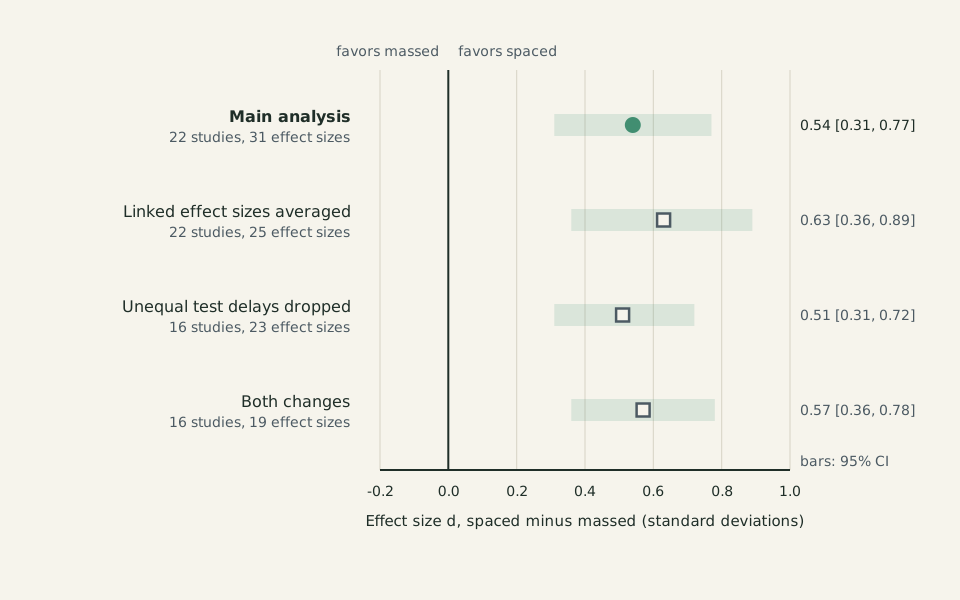
Diagram: Feedback & Forgetting, CC BY 4.0
Copy the credit line
"Spaced versus massed practice in classrooms" by Feedback & Forgetting, https://feedbackandforgetting.com/learning-memory/spaced-repetition/, licensed under CC BY 4.0, https://creativecommons.org/licenses/by/4.0/Data: Mawson, R. D., & Kang, S. H. K. (2025). The Distributed Practice Effect on Classroom Learning: A Meta-Analytic Review of Applied Research. Behavioral Sciences 15(6): 771, doi:10.3390/bs15060771, CC BY 4.0 (https://creativecommons.org/licenses/by/4.0/), Table 2
Pooled effect of spaced over massed practice in four versions of the 2025 classroom meta-analysis. The versions differ in whether studies with unequal test delays were kept and whether linked effect sizes from one study were averaged. Values above zero favor spacing.
Two features of the included studies could have inflated that number. The authors checked both. Some studies tested the spaced group sooner after its last session than the massed group, and some contributed several linked effect sizes. Dropping the first kind or averaging the second kept the estimate between 0.51 and 0.63.
The studies disagreed a lot about how big the benefit was. The authors attribute more than 92% of the variation between studies to real differences rather than chance. Primary school studies produced the most results that favored massed practice, and no included study tested retention more than 42 days later. Egger’s test also flagged a lopsided spread of results, which the authors read as small-study bias, and the review reports no bias-corrected estimate.
Replication tag: [mixed] Spaced versus massed practice in classrooms: primary, secondary and university students, course material, gaps of at least a day, tests up to 42 days later. Pooled effect positive; size varied widely, and primary school studies gave the most results favoring massed practice. Based on full text. Checked 2026-11-06.
A 2013 monograph led by John Dunlosky rated ten study techniques for students. According to its abstract, distributed practice and practice testing received its high utility rating, while rereading and highlighting were rated low. The monograph rated published studies rather than running a new test, so it carries no tag here.
What counts as spacing?
The classroom review also shows what spacing is not. Several language studies it screened out had students review groups of words in one long session or in several shorter ones, without meeting any one word again. The authors call that a common misconception: spreading new material over more days is not distributed practice unless the same material comes back.
The review also left out studies that compared spacing with ordinary teaching, in which students did neither massed nor spaced practice, and studies with gaps shorter than a day. Every included study therefore set spaced sessions against a massed version of the same material.
Within the included studies, the authors sorted results by a few features and saw tendencies they could not test statistically. Fixed gaps of seven days gave the most consistently positive effects, and studies with fewer repeat sessions tended to show larger effects. Secondary school studies were more consistently positive than primary school ones. Treat these as patterns still to be tested, not settled results.
Should the gaps grow?
The 2007 paper by Karpicke and Roediger ran three experiments. In the first two, learners practiced recalling vocabulary word pairs with either growing or equal gaps between attempts. The growing schedule was ahead on a test 10 minutes after learning. Two days later the equal schedule was ahead, and the pattern held with or without feedback after each attempt, by the abstract’s account.
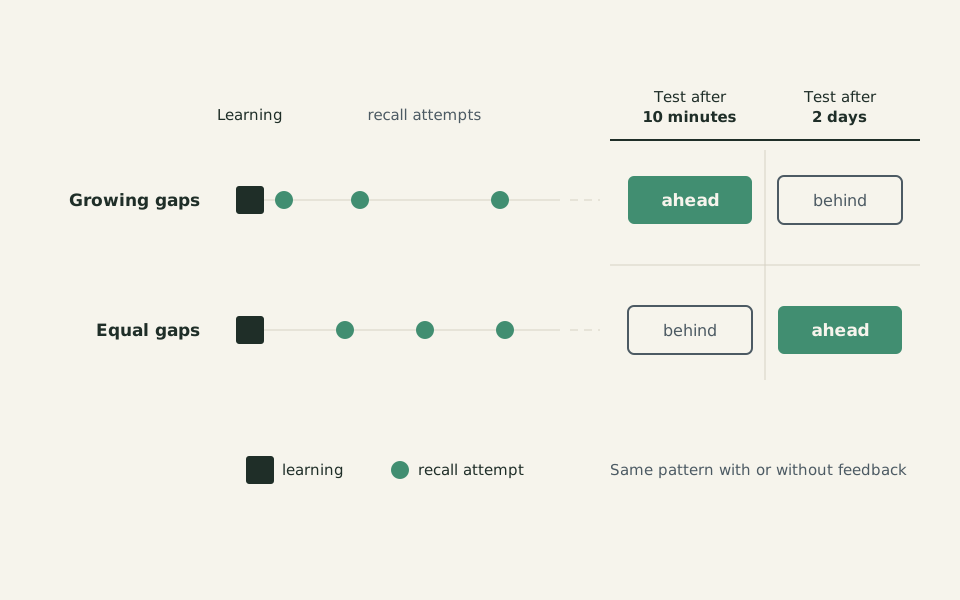
Diagram: Feedback & Forgetting, CC BY 4.0
Copy the credit line
"Growing versus equal gaps, tested at 10 minutes and 2 days" by Feedback & Forgetting, https://feedbackandforgetting.com/learning-memory/spaced-repetition/, licensed under CC BY 4.0, https://creativecommons.org/licenses/by/4.0/The comparison in the first two 2007 experiments, as the paper’s abstract describes it. The number and positions of the recall attempts are illustrative.
In the third experiment, the first recall attempt came either right away or after a short delay, and the later attempts were spaced in a growing or an equal pattern. Delaying that first attempt improved retention on the later test, however the remaining attempts were spaced. The authors conclude that what helps long-term retention is making the first retrieval come later and harder, which equal spacing does and growing spacing does not. That is their reading of the results; the abstract reports that expanding the gaps between repeated tests had little effect on long-term retention across the three experiments.
Replication tag: [single study] Growing versus equal gaps between recall attempts, and delaying the first attempt: vocabulary word pairs and tests 10 minutes and 2 days after learning in Experiments 1 and 2, while the abstract gives neither for Experiment 3; population not stated in the abstract. Three experiments from one lab; no independent replication read for this page. Based on the abstract. Checked 2026-11-06.
For your own reviews, the 10-minute result is a warning. A schedule that wins on a test minutes after practice can still lose on a test days later. If your exam is days or weeks away, the short-delay lead of growing gaps is not the one you want.
What the 2011 study changed
A schedule has two separate features: how far apart the recall attempts are in total, and whether the gaps grow. In a 2011 experiment, Jeffrey Karpicke and Althea Bauernschmidt varied both. Subjects first studied and were tested on items until they could recall each one. Then each item got three more recall tests, placed on one of several schedules.
Some schedules changed the total spacing, from no gaps between the three tests to long gaps between each. Others changed the pattern of the gaps: expanding, equal or contracting.
The total mattered a great deal. By the abstract’s account, tests with long gaps between them produced a 200% improvement in long-term retention over tests with no gaps. A 200% improvement means retention three times as high, though the abstract gives neither the underlying scores nor the delay before the long-term test.
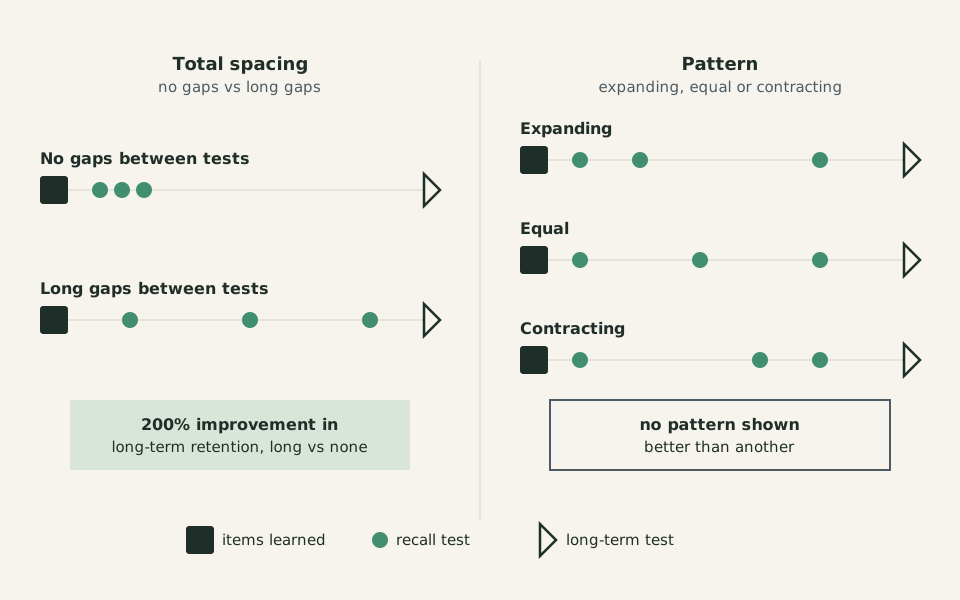
Diagram: Feedback & Forgetting, CC BY 4.0
Copy the credit line
"Total spacing versus the pattern of spacing" by Feedback & Forgetting, https://feedbackandforgetting.com/learning-memory/spaced-repetition/, licensed under CC BY 4.0, https://creativecommons.org/licenses/by/4.0/The 2011 design, as the abstract describes it. Left: no gaps versus long gaps between the three tests. Right: expanding, equal and contracting patterns. Positions are illustrative.
The pattern made no discernible difference. No schedule, whether expanding, equal or contracting, was shown to do better than another for long-term retention. Expanding schedules did make the tests grow harder one after another, but that did not turn into better retention.
Replication tag: [single study] Total spacing of three recall tests mattered, and the expanding, equal or contracting pattern made no discernible difference; population, materials and the delay before the long-term test not stated in the abstract. One experiment, from the same lab as the 2007 paper. Based on the abstract. Checked 2026-11-06.
Both papers come from one lab, so neither is an independent replication of the other. In the 2025 classroom review, effects for growing gaps tended to be smaller than for fixed gaps, and one was negative. The authors warn that most of those growing-gap results came from the same study procedure, so this is not a head-to-head test either.
Other labs have tested growing gaps across days, read here through their abstracts, but they repeated study sessions rather than recall tests, so they do not replicate the 2007 and 2011 designs and the single-study tags above stand. In 2012, Emilie Gerbier and Olivier Koenig showed pseudoword-word pairs four times in a week and tested recall on day 9: growing gaps scored highest in one experiment and tied with equal gaps in the other. Their 2015 follow-up with Thomas Toppino spread three study sessions of vocabulary pairs over 13 days, and the growing schedule generally did best on recall tests 2, 6 or 13 days later. A 2014 study led by Carolina Küpper-Tetzel, with paired associates studied and restudied, found contracting gaps best for tests up to 7 days later, but equal and growing gaps better at 35 days.
A 2021 paper by Alice Latimier, Hugo Peyre and Franck Ramus is titled “A Meta-Analytic Review of the Benefit of Spacing out Retrieval Practice Episodes on Retention.” Only its citation could be read for this page, so its findings are not reported here.
How far ahead is your test?
In a 2008 study led by Nicholas Cepeda, more than 1,350 people were taught a set of facts, reviewed them after a gap of up to 3.5 months, and took a final test up to a year after the review. For any given test delay, lengthening the gap first raised final scores and then slowly lowered them, according to the abstract.
Two intervals matter in that design. The gap is the time between first study and the review, and the test delay is the time from the review to the final test. A one-week test delay with a two-day gap means studying on day 0, reviewing on day 2 and testing on day 9.
The best gap grew as the test moved further away. As a share of the test delay, though, it shrank: about 20–40% for a test a week after the review, and about 5–10% for a test a year after it. The abstract gives no shares for test delays in between.
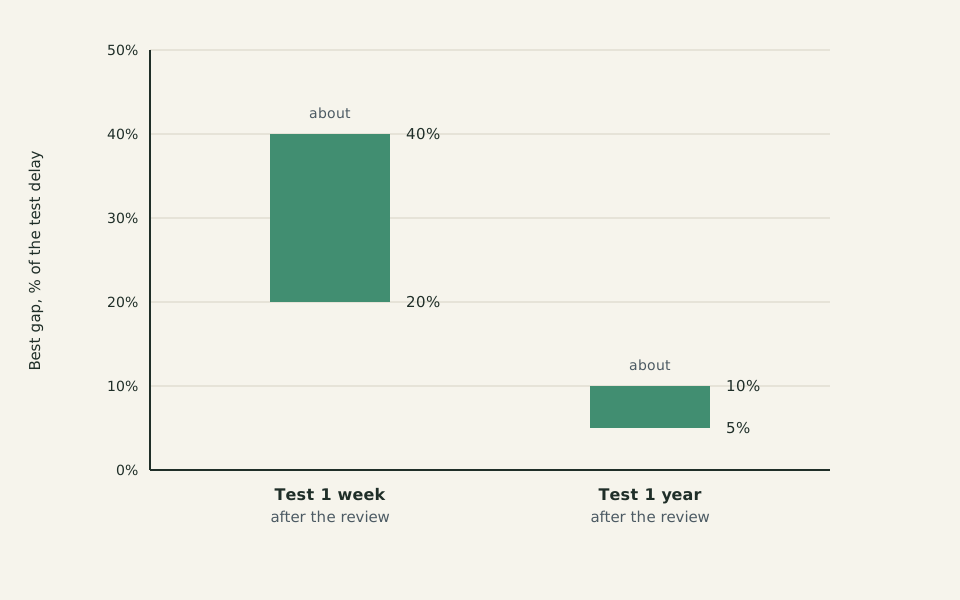
Diagram: Feedback & Forgetting, CC BY 4.0
Copy the credit line
"Best review gap as a share of the test delay" by Feedback & Forgetting, https://feedbackandforgetting.com/learning-memory/spaced-repetition/, licensed under CC BY 4.0, https://creativecommons.org/licenses/by/4.0/Data: Cepeda, N. J., Vul, E., Rohrer, D., Wixted, J. T., & Pashler, H. (2008). Spacing effects in learning: A temporal ridgeline of optimal retention. Psychological Science 19(11): 1095–1102, doi:10.1111/j.1467-9280.2008.02209.x, abstract (figures quoted)
The gap between first study and the review that gave the best final score, as a share of the time from review to test, from the 2008 study’s abstract. Nothing is drawn between the two delays because the abstract gives no values there.
Replication tag: [single study] People taught a set of facts, one review, final test up to a year later. No independent replication found (search of 2026-11-06). Based on the abstract. Checked 2026-11-06.
This is why the forgetting curve on its own cannot set your review dates. That curve follows a single learning session left alone, so it says nothing about when a second session works best. The 2008 study asked that second question directly, and in its data the best gap moved with the test date.
A term this site uses
The forgetting dividend
Spacing results like these have a name on this site: the forgetting dividend. In spacing experiments, a successful retrieval after a gap often leaves more on a delayed test than an immediate repeat does. The term labels that observation; it is not a mechanism. How large the gain is depends on how long you need to remember and on the practice conditions, such as whether you can recall the material and whether you get feedback.
Why a gap helps is a separate question. The 2025 classroom review lists possible explanations, such as spaced repeats being stored in more varied ways, or a later repeat prompting you to retrieve the earlier one. It presents these as theories, and none of the studies on this page tested them.

Illustration: Feedback & Forgetting. Generated schematic illustration — not a photograph or historical record. © Feedback & Forgetting, all rights reserved.
The same notes at three moments: studied, set aside for a gap, then reopened with a blank card for recalling before rereading. A scene illustration; the panels are evenly spaced and do not stand for any number of days.
It does not mean that the closer you get to forgetting, the better. In the 2008 study, gaps longer than the best one slowly lowered final scores, and the best gap itself changed with the test delay. Think of the gap like rest between sets in training: some rest helps the next set, but the comparison is only a memory aid, and the right amount comes from the studies, not from the gym.
A schedule you can use
These steps stay inside what the studies above tested. The day counts below come from the 2008 abstract’s shares, multiplied out by this site, so treat them as rough ranges rather than exact targets.
- Pick the test date first. Count the days from your planned review to the test, since the best gap depends on that delay.
- Set the gap before the review. For a test about a week after the review, the 2008 shares give a gap of about 1.4 to 2.8 days between first study and review. For a test a year after the review, they give about 18 to 37 days. For delays in between, the abstract gives no share, so there is no figure to compute.
- Recall before you reread. At each review, close your notes and try to retrieve the material first. This site’s review of active recall covers what self-quizzing did to delayed test scores compared with rereading.
- Don’t force every gap to be longer than the last. In one lab’s recall-test studies, growing gaps did not beat equal ones on delayed tests, and the total spacing mattered more than the pattern. Other labs’ study-session experiments leaned toward growing gaps, so neither pattern has a clear edge.
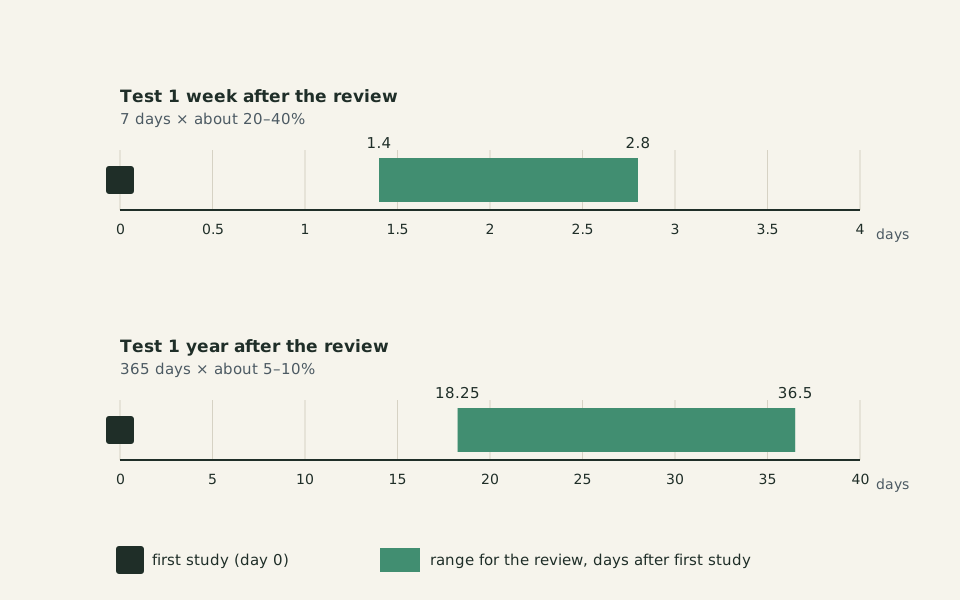
Diagram: Feedback & Forgetting, CC BY 4.0
Copy the credit line
"Best review gap in days" by Feedback & Forgetting, https://feedbackandforgetting.com/learning-memory/spaced-repetition/, licensed under CC BY 4.0, https://creativecommons.org/licenses/by/4.0/Data: Cepeda, N. J., Vul, E., Rohrer, D., Wixted, J. T., & Pashler, H. (2008). Spacing effects in learning: A temporal ridgeline of optimal retention. Psychological Science 19(11): 1095–1102, doi:10.1111/j.1467-9280.2008.02209.x, abstract (shares quoted; days computed by Feedback & Forgetting)
The best-gap shares from the 2008 abstract multiplied out into days, for the two test delays the abstract reports. A week is taken as 7 days and a year as 365. The two panels use different scales.
If your reviews consist of explaining the material aloud rather than answering questions, this site’s page on the Feynman technique looks at what research has tested under other names.
What this schedule leaves out
The 2008 study gave one review, so its shares say nothing direct about a third or fourth session. The classroom review stopped at 42 days, and its studies used course material such as accounting, math and spelling rather than the facts taught in 2008. The 2007 and 2011 lab experiments on growing gaps used word pairs and items learned to a set standard, and their abstracts do not describe the learners.
None of these studies tested a particular flashcard app, and this page does not compare apps. If you use one, the evidence above bears on two of its settings: how far apart your reviews are in total, and whether each gap has to grow.
For your next exam, put the date on the calendar first. If the test is about a week after your planned review, schedule that review roughly one and a half to three days after you first study, and start it with your notes closed.
Data: Best review gap for two test delays
| Test delay after the review | Best gap, % of test delay (quoted) | Best gap, days (this site’s calculation) | Study (read as) |
|---|---|---|---|
| 1 week (7 days) | about 20–40 | about 1.4–2.8 | Cepeda et al. 2008 (abstract) |
| 1 year (365 days) | about 5–10 | about 18.25–36.5 | Cepeda et al. 2008 (abstract) |
Download the data (CSV, spaced-repetition-schedule.csv) · Where each value comes from (JSON) Data: Cepeda, N. J., Vul, E., Rohrer, D., Wixted, J. T., & Pashler, H. (2008). Spacing effects in learning: A temporal ridgeline of optimal retention. Psychological Science 19(11): 1095–1102, doi:10.1111/j.1467-9280.2008.02209.x (abstract figures quoted)
Data: Spacing studies read for this page
| Claim | Study | Read as | Status |
|---|---|---|---|
| Spaced versus massed study in verbal recall tasks | Cepeda et al. 2006, 839 assessments | abstract | [status not assigned] |
| Spaced beat massed practice in classrooms on average, d = 0.54 (95% CI 0.31 to 0.77) | Mawson & Kang 2025, 22 studies | full text | Replication tag: [mixed] |
| Growing gaps led at 10 minutes; equal gaps led 2 days later | Karpicke & Roediger 2007, 3 experiments | abstract | Replication tag: [single study] |
| Delaying the first recall test helped later retention | Karpicke & Roediger 2007, Experiment 3 | abstract | Replication tag: [single study] |
| Long gaps between three recall tests gave a 200% retention gain over no gaps | Karpicke & Bauernschmidt 2011 | abstract | Replication tag: [single study] |
| No gap pattern (expanding, equal or contracting) was shown to do better than another | Karpicke & Bauernschmidt 2011 | abstract | Replication tag: [single study] |
| Best gap fell from about 20–40% of a 1-week to about 5–10% of a 1-year test delay | Cepeda et al. 2008, more than 1,350 people | abstract | Replication tag: [single study] |
| Distributed practice rated high utility, rereading low | Dunlosky et al. 2013 | abstract | no tag: a rating, not a test |
Download the data (CSV, spaced-repetition-studies.csv) · Where each value comes from (JSON) Data: Mawson, R. D., & Kang, S. H. K. (2025). The Distributed Practice Effect on Classroom Learning: A Meta-Analytic Review of Applied Research. Behavioral Sciences 15(6): 771, doi:10.3390/bs15060771, CC BY 4.0 (https://creativecommons.org/licenses/by/4.0/); Cepeda et al. (2006), doi:10.1037/0033-2909.132.3.354; Dunlosky et al. (2013), doi:10.1177/1529100612453266; Karpicke & Roediger (2007), doi:10.1037/0278-7393.33.4.704; Karpicke & Bauernschmidt (2011), doi:10.1037/a0023436; Cepeda et al. (2008), doi:10.1111/j.1467-9280.2008.02209.x (abstract figures quoted)
Retrieval check
Answer from memory first, then follow the link to the passage and check.
- In the 2007 experiments, which schedule led on the 10-minute test, and which led two days later? Back to the passage
- Why can’t the forgetting curve alone tell you when to review? Back to the passage · What the forgetting curve measured
- What does the forgetting dividend name, and what does it not mean? Back to the passage
Sources
- Karpicke, J. D., & Roediger, H. L. (2007). Expanding retrieval practice promotes short-term retention, but equally spaced retrieval enhances long-term retention. Journal of Experimental Psychology: Learning, Memory, and Cognition, 33(4), 704–719. doi:10.1037/0278-7393.33.4.704 https://doi.org/10.1037/0278-7393.33.4.704
- Cepeda, N. J., Pashler, H., Vul, E., Wixted, J. T., & Rohrer, D. (2006). Distributed practice in verbal recall tasks: A review and quantitative synthesis. Psychological Bulletin, 132(3), 354–380. doi:10.1037/0033-2909.132.3.354 https://doi.org/10.1037/0033-2909.132.3.354
- Mawson, R. D., & Kang, S. H. K. (2025). The Distributed Practice Effect on Classroom Learning: A Meta-Analytic Review of Applied Research. Behavioral Sciences, 15(6), 771. doi:10.3390/bs15060771 https://doi.org/10.3390/bs15060771
- Dunlosky, J., Rawson, K. A., Marsh, E. J., Nathan, M. J., & Willingham, D. T. (2013). Improving students' learning with effective learning techniques: Promising directions from cognitive and educational psychology. Psychological Science in the Public Interest, 14(1), 4–58. doi:10.1177/1529100612453266 https://doi.org/10.1177/1529100612453266
- Karpicke, J. D., & Bauernschmidt, A. (2011). Spaced retrieval: Absolute spacing enhances learning regardless of relative spacing. Journal of Experimental Psychology: Learning, Memory, and Cognition, 37(5), 1250–1257. doi:10.1037/a0023436 https://doi.org/10.1037/a0023436
- Gerbier, E., & Koenig, O. (2012). Influence of multiple-day temporal distribution of repetitions on memory: A comparison of uniform, expanding, and contracting schedules. Quarterly Journal of Experimental Psychology, 65(3), 514–525. doi:10.1080/17470218.2011.600806 https://doi.org/10.1080/17470218.2011.600806
- Gerbier, E., Toppino, T. C., & Koenig, O. (2015). Optimising retention through multiple study opportunities over days: The benefit of an expanding schedule of repetitions. Memory, 23(6), 943–954. doi:10.1080/09658211.2014.944916 https://doi.org/10.1080/09658211.2014.944916
- Küpper-Tetzel, C. E., Kapler, I. V., & Wiseheart, M. (2014). Contracting, equal, and expanding learning schedules: The optimal distribution of learning sessions depends on retention interval. Memory & Cognition, 42(5), 729–741. doi:10.3758/s13421-014-0394-1 https://doi.org/10.3758/s13421-014-0394-1
- Latimier, A., Peyre, H., & Ramus, F. (2021). A meta-analytic review of the benefit of spacing out retrieval practice episodes on retention. Educational Psychology Review, 33(3), 959–987. doi:10.1007/s10648-020-09572-8 https://doi.org/10.1007/s10648-020-09572-8
- Cepeda, N. J., Vul, E., Rohrer, D., Wixted, J. T., & Pashler, H. (2008). Spacing effects in learning: A temporal ridgeline of optimal retention. Psychological Science, 19(11), 1095–1102. doi:10.1111/j.1467-9280.2008.02209.x https://doi.org/10.1111/j.1467-9280.2008.02209.x
- Crossref. Work records and update searches (corrections, retractions, expressions of concern) for doi:10.1037/0278-7393.33.4.704, doi:10.1037/0033-2909.132.3.354, doi:10.3390/bs15060771, doi:10.1177/1529100612453266, doi:10.1037/a0023436, doi:10.1007/s10648-020-09572-8, doi:10.1111/j.1467-9280.2008.02209.x, doi:10.1080/17470218.2011.600806, doi:10.1080/09658211.2014.944916 and doi:10.3758/s13421-014-0394-1. https://api.crossref.org/works/10.3390/bs15060771
Cite this page
Feedback & Forgetting. (2026-11-06). Spaced Repetition: Should Review Gaps Grow? Studies Disagree. https://feedbackandforgetting.com/learning-memory/spaced-repetition/ (accessed [date you read it])
No DOI is assigned to this page; cite the address above with the date you read it.
Related reading
-
Learning & Memory
Forgetting Curve: It Measured Relearning, Not Recall
Picture credit
"Zeitschrift fur Psychologie, 1909: Herman Ebbinghaus" by Wellcome Collection — https://commons.wikimedia.org/wiki/File:Zeitschrift_fur_Psychologie,_1909;_Herman_Ebbinghaus._Wellcome_L0003734.jpg — CC BY 4.0 (https://creativecommons.org/licenses/by/4.0/); modifications: cropped mount, padded
-

Learning & Memory
Active Recall: Quizzing Beat Rereading Later in a 2006 Study
Picture credit
"Mental Arithmetic. In Public School of S. A. Rachinsky" by Nikolay Bogdanov-Belsky — https://commons.wikimedia.org/wiki/File:Bogdanov-Belsky_Ustny_Schet_(Tretyakov).jpg — Public domain (PD-Art; painter d. 1945 (EU: from 2016; US: published before 1931, per the Commons file page)); modifications: cropped
-
Learning & Memory
Do Learning Styles Work? A 2008 Review Found Few Fair Tests
Picture credit
Illustration: Feedback & Forgetting. Generated schematic illustration — not a photograph or historical record. © Feedback & Forgetting, all rights reserved.