Critical Period Hypothesis: Does Grammar Learning Ebb at 17?
Method deep read Feedback & Forgetting Published
Short answer. The critical period hypothesis says that the ability to learn a language falls off after a certain age. In a 2018 study of 669,498 people who took an online English grammar quiz, a model fitted to their scores kept grammar-learning ability high until about age 17.4, after which it declined. Reaching native-like grammar took starting by about age 10 to 12. That is one research team's model of one large data set from a written grammar test; accent and speaking were not tested.
In one sentence: A 2018 study of nearly 670,000 grammar-quiz takers put the drop in grammar-learning ability near age 17, not in early childhood, though that is one model of one data set.
Outline6 sections
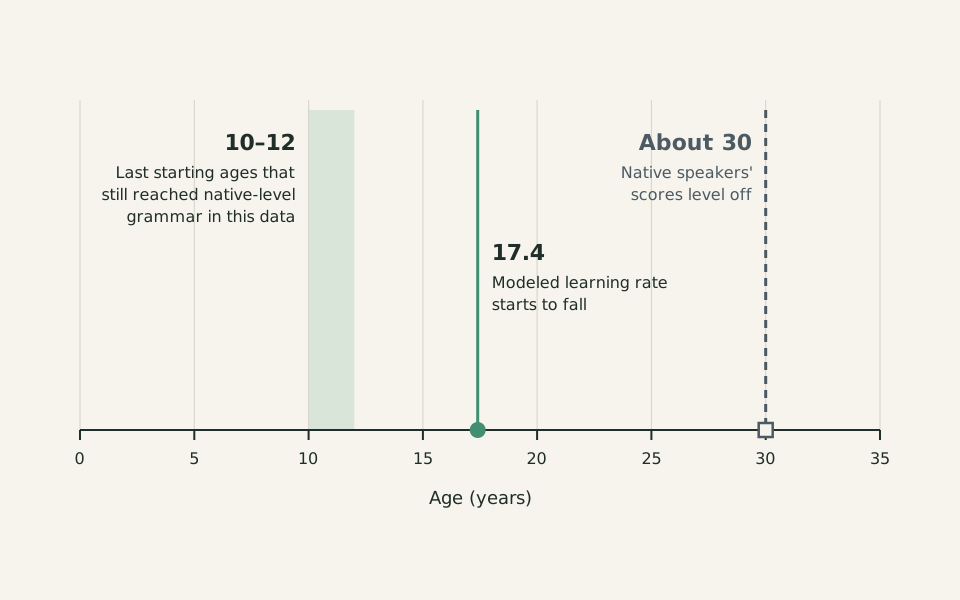
Diagram: Feedback & Forgetting, CC BY 4.0
Copy the credit line
"Three ages from the 2018 grammar-quiz study" by Feedback & Forgetting, https://feedbackandforgetting.com/language-minds/critical-period-hypothesis/, licensed under CC BY 4.0, https://creativecommons.org/licenses/by/4.0/Data: Hartshorne, J. K., Tenenbaum, J. B., & Pinker, S. (2018). A critical period for second language acquisition: Evidence from 2/3 million English speakers. Cognition 177: 263–277, doi:10.1016/j.cognition.2018.04.007, author manuscript, sections 3.1, 3.3 and 3.4.1 (quoted figures only)
Three ages from the 2018 grammar-quiz study by Hartshorne, Tenenbaum and Pinker, on one age scale. They are estimates from one model and one data set, not fixed limits.
You take a short online grammar quiz, and at the end it guesses your native language. Then it asks at what age you started learning English and how many years you have lived in an English-speaking country. In a study published in 2018, Joshua Hartshorne, Joshua Tenenbaum and Steven Pinker used 669,498 sets of those answers to estimate when the ability to learn a new grammar starts to fall. This page asks whether the window for learning a language closes in early childhood, and what this one large study actually measured.
The study is read here in full, in the author manuscript, and set next to the older studies it was answering. Most of those older papers could be read only as abstracts or as citations, and the wording here follows that.
Where the critical period idea came from

Illustration: Feedback & Forgetting. Generated schematic illustration — not a photograph or historical record. © Feedback & Forgetting, all rights reserved.
Two identical desks that differ only in the chair: a scene illustration for this section. It does not show any study, age limit or result.
A critical period is a stretch of life when some kind of learning comes easily, followed by a time when it comes much harder. For language, both studies on this page cite Eric Lenneberg's 1967 book Biological Foundations of Language. According to the abstract of a 1989 paper by Jacqueline Johnson and Elissa Newport, Lenneberg proposed that language could be acquired only within a critical period running from early infancy until puberty. The book itself was not read for this page.
Johnson and Newport asked whether such a period also applies to learning a second language. Their abstract describes 46 native speakers of Korean or Chinese who had arrived in the United States between the ages of 3 and 39. By the time of testing they had lived there for 3 to 26 years. Each judged whether English sentences covering many grammar structures were correct.
The earlier arrivals clearly did better. By the abstract, test scores fell in a straight line with age of arrival up to puberty. After puberty, scores were low and varied a lot, and they were no longer related to age of arrival. The authors report that the age effect was not explained by years of English, motivation, self-consciousness or identifying as American.
Hartshorne's team uses the term critical period in a looser sense: lower achievement by adult learners, whatever the cause. Their introduction lists many proposed causes: a more flexible young brain, the extra years an early start gives, less interference from a first language, and a greater chance of living among native speakers. Their study was built to separate a change in learning ability itself from the extra years that an early start gives.
The 2018 grammar quiz
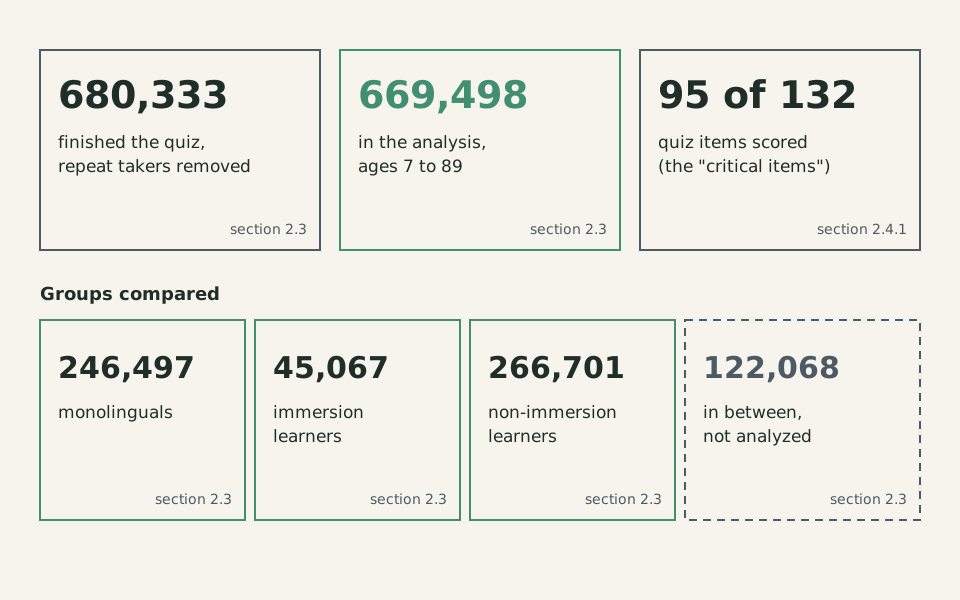
Diagram: Feedback & Forgetting, CC BY 4.0
Copy the credit line
"Key counts from the 2018 grammar quiz" by Feedback & Forgetting, https://feedbackandforgetting.com/language-minds/critical-period-hypothesis/, licensed under CC BY 4.0, https://creativecommons.org/licenses/by/4.0/Data: Hartshorne, J. K., Tenenbaum, J. B., & Pinker, S. (2018). A critical period for second language acquisition: Evidence from 2/3 million English speakers. Cognition 177: 263–277, doi:10.1016/j.cognition.2018.04.007, author manuscript, sections 2.3 and 2.4.1 (quoted figures only)
Key counts from the 2018 study, with the section of the author manuscript where each appears. The full data set is not reproduced here.
To separate starting age from years of practice, the team needed several hundred thousand people of many ages and language backgrounds. Lab subject pools are far too small for that, so they built a quiz people would want to share. It took less than 10 minutes, and at the end it guessed the taker's native language and dialect of English. The quiz was shared more than 300,000 times on Facebook.
The quiz had 132 items. Some asked whether a sentence was grammatical; others asked takers to match a sentence to a picture. Only 95 items were scored.
These were the critical items, where at least 70% of native English-speaking adults aged 18 to 70 gave the same answer in each of 13 English dialects. The scored items had high internal consistency, with Cronbach's alpha at 0.86, a measure of how closely scores on the items vary together.
After repeat takers were removed, 680,333 people had finished the quiz. The team then dropped people with impossible answers, such as a current age lower than the age they started English, and anyone under 7 or over 89. That left 669,498. Each person took the quiz once, so the study compares different people at different ages rather than following anyone over time.
The analysis compared three groups. Monolinguals (246,497 people) grew up with English only. Immersion learners (45,067) had lived in an English-speaking country for at least 90% of their life since they started English. This group also included people raised with English and another language from birth.
Non-immersion learners (266,701) had spent at most 10% of that time, and no more than a year in total, in an English-speaking country. Another 122,068 people fell in between and were left out. Those four counts add up to 680,333, the total before the last exclusions (a sum computed for this page); the paper does not explain the difference from 669,498.
The team posted its data set on the Open Science Framework. Its license could not be checked for this page, so the data are not reproduced here.
Plateau, then decline
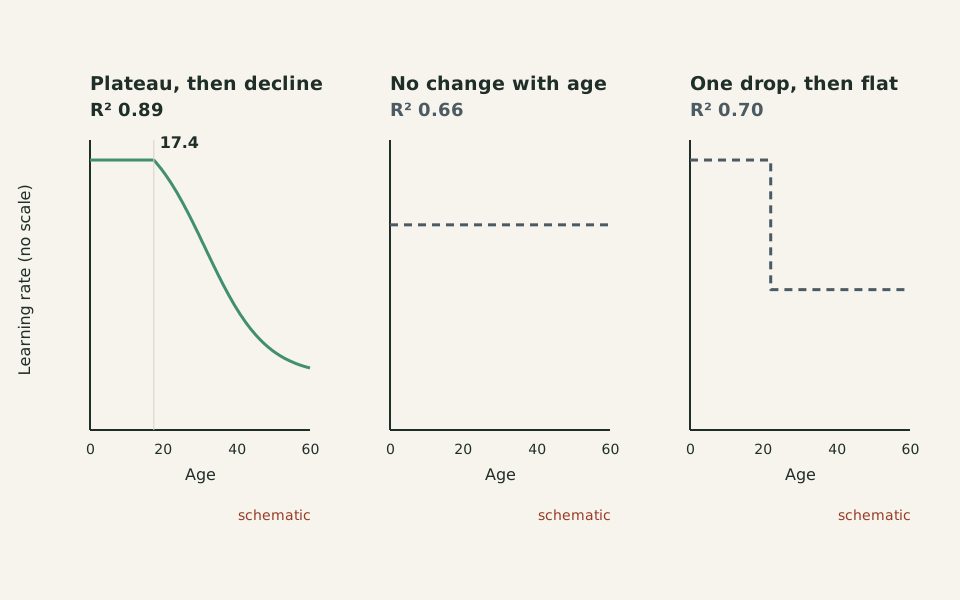
Diagram: Feedback & Forgetting, CC BY 4.0
Copy the credit line
"Learning-rate shapes compared in the 2018 model (schematic)" by Feedback & Forgetting, https://feedbackandforgetting.com/language-minds/critical-period-hypothesis/, licensed under CC BY 4.0, https://creativecommons.org/licenses/by/4.0/Data: Hartshorne, J. K., Tenenbaum, J. B., & Pinker, S. (2018). A critical period for second language acquisition: Evidence from 2/3 million English speakers. Cognition 177: 263–277, doi:10.1016/j.cognition.2018.04.007, author manuscript, section 3.1 (quoted figures only; curve shapes schematic)
Shapes compared in the 2018 model, drawn as sketches rather than fitted curves. Apart from the change age and the R² values, the main text gives no fitted values, so none are drawn.
You cannot watch a learning rate directly. Hartshorne's team inferred it with a model they called exponential learning with sigmoidal decay. In plain terms, each person's grammar score rises with years of English, at a rate that stays constant from birth up to some age and then can fall along an S-shaped curve. The model let that change age, the steepness of the fall and where its midpoint sits all vary, and then found the values that best fit the three groups at once.
The best-fitting model had the learning rate start to fall at 17.4 years. It explained much of the pattern in the data, with a cross-validated R² of 0.89, where R² is the share of the variation the model accounts for and 1 would be a perfect fit. A model with no change in learning rate reached 0.66, and one with a single sudden drop and no further decline reached 0.70. In the abstract's words, grammar-learning ability is “preserved almost to the crux of adulthood” and then declines steadily.
The estimate barely moved with the kind of grammar tested. For the 47 items that the youngest native speakers had already mastered, the rate began to slow at 17.3; for the 48 items mastered only by older native speakers, at 18.2.
Grammar-learning rate staying high through childhood and starting to fall at about 17 to 18 years old: Replication tag: [single study] 669,498 English speakers aged 7 to 89, written English grammar items, one quiz session each; a model estimate. Based on full text (author manuscript). Checked 2026-11-06.
A 2022 reanalysis of the same quiz data exists, but a second look at the same data is not an independent replication. The authors themselves called “confirmation and extension of the present results” crucial (section 4.2).
Why the drop might come so late
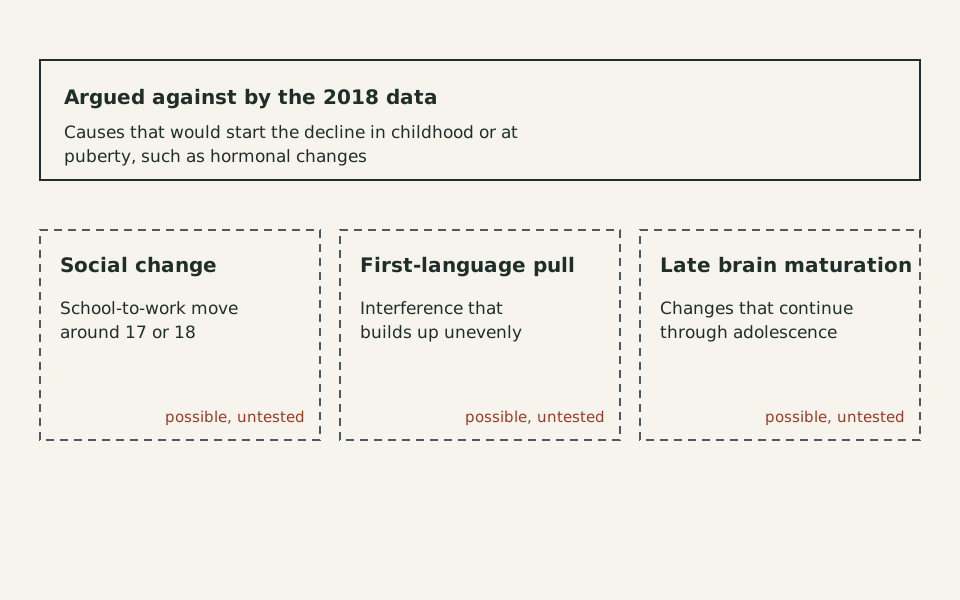
Diagram: Feedback & Forgetting, CC BY 4.0
Copy the credit line
"Possible explanations for a late drop in learning rate" by Feedback & Forgetting, https://feedbackandforgetting.com/language-minds/critical-period-hypothesis/, licensed under CC BY 4.0, https://creativecommons.org/licenses/by/4.0/Explanations the 2018 authors discuss. The study tests none of the three possible ones.
Hartshorne's team argues that a drop in the late teens rules out explanations that put the decline in childhood or at puberty, such as hormonal changes. They then list possible causes without testing them.
One is social: in many cultures, 17 or 18 marks the move from school to work or further study, which may change how much chance or motivation people have to learn a new language. Another is interference from a first language that builds up in a nonlinear way. A third is brain maturation that continues through adolescence. The data in this study do not pick among them.
Starting age versus years of exposure
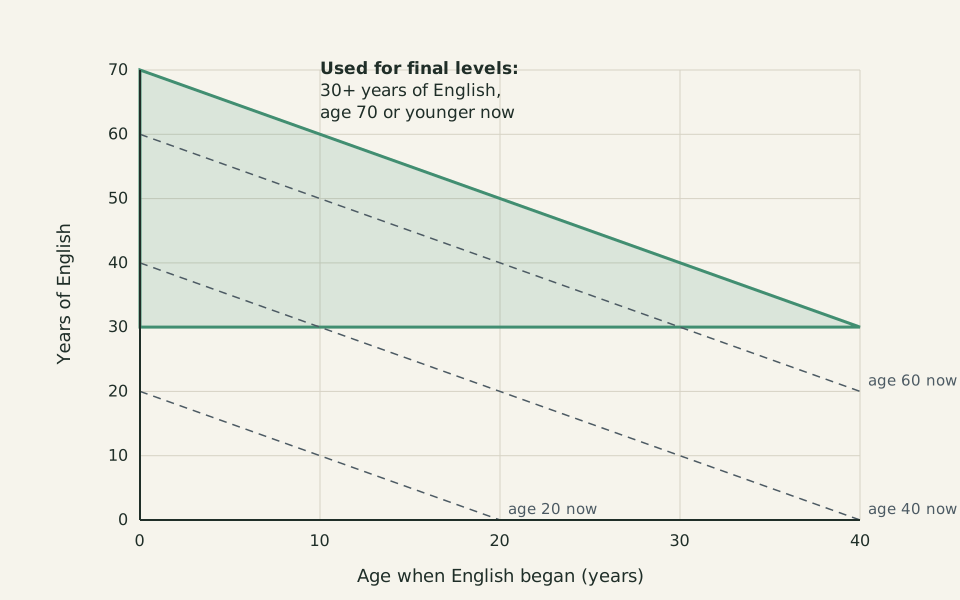
Diagram: Feedback & Forgetting, CC BY 4.0
Copy the credit line
"Starting age, years of English and current age" by Feedback & Forgetting, https://feedbackandforgetting.com/language-minds/critical-period-hypothesis/, licensed under CC BY 4.0, https://creativecommons.org/licenses/by/4.0/How the 2018 study separated starting age from years of experience. Current age is start age plus years of English, so a large sample with many combinations is needed to pull the three apart. The shaded band marks the people used for the final-level analysis.
The 2018 paper separates two questions that are easy to confuse. One is how fast you can learn at a given age. The other is how good you can eventually get if you start at a given age, which researchers call ultimate attainment. The authors give an example: if learning ability plummeted at 15 but mastering a language took 10 years, then final scores would start to fall for people who began at 5, years before the ability itself changed.
That is why the time it takes to finish learning matters. In the 2018 data, native speakers' scores kept rising until about age 30, though most of the gain came in the first 10 to 20 years. The authors estimate that native and non-native learners both needed around 30 years to level off, at least for learners immersed in English.
To estimate final levels, the team used 11,371 immersion learners and 29,708 non-immersion learners who had at least 30 years of English and were no older than 70. For immersion learners, final scores barely declined with starting age up to a start at 12, then fell more steeply. For non-immersion learners, there was no decline for starts between 4 and 9, then a steep one. By the authors' account, learners had to start by 10 to 12 years old to reach native-level proficiency, because later starters ran out of time before the learning rate dropped at about 17 to 18.
Even people who grew up with English and another language from birth did not quite reach the scores of monolinguals in this data set. The model accounts for that as less English input, though the authors note other possible explanations.
Learners who began English younger reaching higher grammar scores after many years of English: Replication tag: [replicated] Immigrant and immersion learners of English, grammar-judgment tests, after at least 3 years (1989 study) or at least 30 years (2018 study). Based on the abstract (1989) and full text (2018). Checked 2026-11-06.
The 2018 team is independent of the 1989 team and used a different test. Its final-level analysis also had a far larger sample: 11,371 immersion learners, against 46 learners in the 1989 abstract. The direction matched. An earlier start went with higher final scores.
Other readings of the same data
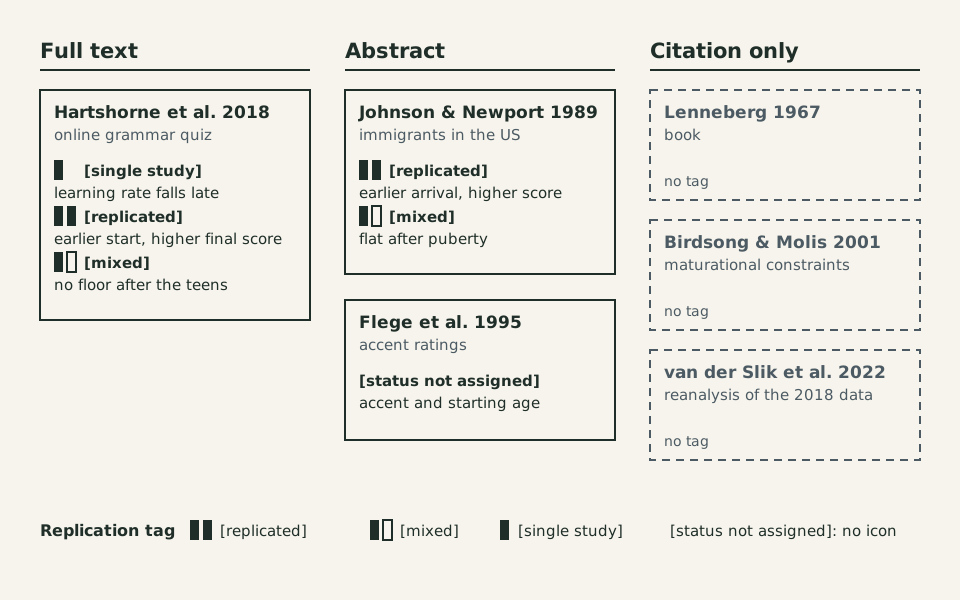
Diagram: Feedback & Forgetting, CC BY 4.0
Copy the credit line
"Studies of age and second-language learning, by read level" by Feedback & Forgetting, https://feedbackandforgetting.com/language-minds/critical-period-hypothesis/, licensed under CC BY 4.0, https://creativecommons.org/licenses/by/4.0/Each study placed by how much of it could be read for this page, with the replication tags given in the text. Citation-only entries carry no tag.
The two big studies disagree on what happens after the early teens. Johnson and Newport reported, by their abstract, that scores after puberty no longer depended on age of arrival. As reported by Hartshorne's team, the 1989 correlation between starting age and final score was r = −0.87 before age 16 and r = −0.16 after. In the 2018 data, final scores kept falling with later starts, with no sign of the relationship stopping at a particular age.
Hartshorne's team argues that small samples explain much of the earlier disagreement. They simulated running studies of different sizes by resampling their own data. At the size of the 1989 study, a wide range of results would be expected from chance alone; they concluded that a reliable estimate of final levels needs more than 10,000 people.
As Hartshorne's team reports, later studies that looked for the same sharp change found much weaker effects or none, among them a 2001 study by David Birdsong and Michelle Molis. That study was read here only as a citation.
Starting age stopping to matter after about puberty, for final grammar scores in a second language: Replication tag: [mixed] Immigrant and immersion learners of English, grammar-judgment tests, after years of residence. Based on the abstract (1989) and full text (2018); later studies as reported in the 2018 paper. Checked 2026-11-06.
The same 2018 data have also been reanalyzed by another team. Frans van der Slik, Job Schepens, Theo Bongaerts and Roeland van Hout published a paper in Language Learning in 2022 titled “Critical Period Claim Revisited: Reanalysis of Hartshorne, Tenenbaum, and Pinker (2018) Suggests Steady Decline and Learner‐Type Differences.” Only its citation could be read for this page, so its methods and results are not described here, and it carries no tag.
If you start as an adult
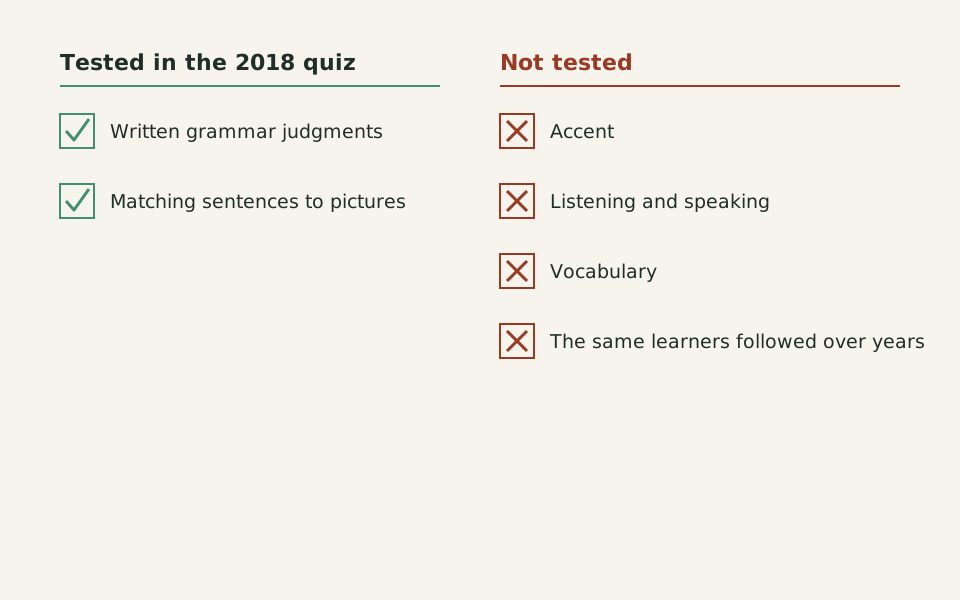
Diagram: Feedback & Forgetting, CC BY 4.0
Copy the credit line
"What the 2018 grammar quiz tested and left out" by Feedback & Forgetting, https://feedbackandforgetting.com/language-minds/critical-period-hypothesis/, licensed under CC BY 4.0, https://creativecommons.org/licenses/by/4.0/What the 2018 grammar quiz measured and what it left out. The same list appears in the table below.
| Part of language | Tested in the 2018 quiz? | What this page read about it |
|---|---|---|
| Written grammar judgments | Yes | The full 2018 study |
| Matching sentences to pictures | Yes | The full 2018 study |
| Accent | No | One 1995 study, abstract only |
| Listening and speaking | No | Not read for this page |
| Vocabulary | No | Not read for this page |
| The same learners followed over years | No | Not read for this page |
The 2018 quiz was a written test of grammar. The authors point out that listening depends on sound systems they did not test, and they mention in passing that accent is something “which likely has a critical period distinct from that of syntax” (section 4.1.4). Vocabulary was not tested either; what vocabulary tests count is a separate question, taken up in this site's look at how vocabulary size tests count words.
For accent, the one study read here is a 1995 paper by James Flege, Murray Munro and Ian MacKay, and only its abstract could be read.
It tested 240 native speakers of Italian who began learning English in Canada between the ages of 2 and 23 and had lived there for an average of 32 years. Native English listeners' estimates of the starting age at which an accent appeared ranged from 3.1 to 11.6 years (mean 7.4). Very few speakers who started after 15 were rated in the native range. Starting age accounted for an average of 59% of the variance in accent ratings, and language use for another 15%.
Accent in a second language growing stronger with later starting age: [status not assigned] 240 native Italian speakers who had lived in Canada for an average of 32 years, sentences rated by native English listeners. One study, read as an abstract only. Abstract-level evidence only. Checked 2026-11-06.
None of this says adults cannot learn a language. The 2018 authors write that the research question was never whether adults can learn, which they obviously can, but why they rarely reach native-like mastery. In their data, immersion learners who started English in their late twenties eventually outscored the youngest native speakers in the sample, who were about 7 years old. The idea that adults simply cannot learn languages is one of the rows checked in this site's scorecard of learning myths.
Whether growing up with two languages changes attention or self-control is a different claim, with its own evidence, in this site's review of the benefits of being bilingual.
If you are starting a language as an adult, note that the 2018 data describe groups of English learners, not what will happen to one person or in another language. In that sample, later starters scored higher the more years of English they had, but leveled off lower than early starters. For your next study session, practice a grammar point you can check: write five new sentences using a construction you often get wrong, check them against a grammar reference, and a week later test yourself on five different sentences of the same kind.
Data: Values and tags from the 1989 and 1995 abstracts
| Claim | Study | Value (quoted) | Read as | Tag |
|---|---|---|---|---|
| Lenneberg (1967) proposed that language could be acquired only within a critical period from early infancy until puberty | Lenneberg 1967, as summarized in the abstract of Johnson & Newport 1989 | — | Abstract | — |
| Second-language learners tested | Johnson & Newport 1989 | 46 people | Abstract | — |
| Youngest age of arrival in the United States | Johnson & Newport 1989 | 3 years | Abstract | — |
| Oldest age of arrival in the United States | Johnson & Newport 1989 | 39 years | Abstract | — |
| Shortest residence in the United States at testing | Johnson & Newport 1989 | 3 years | Abstract | — |
| Longest residence in the United States at testing | Johnson & Newport 1989 | 26 years | Abstract | — |
| Earlier arrivals reached higher English grammar scores than later arrivals | Johnson & Newport 1989 | — | Abstract | Replication tag: [replicated] (immigrant and immersion learners of English, grammar-judgment tests, after years of residence; based on the abstract (1989) and full text of a 2018 online-quiz study; checked 2026-11-06) |
| After puberty, scores were low, varied widely and were unrelated to age of arrival | Johnson & Newport 1989 | — | Abstract | Replication tag: [mixed] (immigrant and immersion learners of English, grammar-judgment tests, after years of residence; based on the abstract (1989) and full text of a 2018 online-quiz study, later studies as reported there; checked 2026-11-06) |
| A 2001 study titled “On the Evidence for Maturational Constraints in Second-Language Acquisition” | Birdsong & Molis 2001 | — | Citation only | — |
| Second-language speakers tested | Flege, Munro & MacKay 1995 | 240 people | Abstract | — |
| Youngest age at which they began learning English | Flege, Munro & MacKay 1995 | 2 years | Abstract | — |
| Oldest age at which they began learning English | Flege, Munro & MacKay 1995 | 23 years | Abstract | — |
| Time lived in Canada | Flege, Munro & MacKay 1995 | 32 years (average) | Abstract | — |
| Listeners' estimates of the starting age at which an accent appeared: lowest listener | Flege, Munro & MacKay 1995 | 3.1 years | Abstract | — |
| Listeners' estimates of the starting age at which an accent appeared: highest listener | Flege, Munro & MacKay 1995 | 11.6 years | Abstract | — |
| Listeners' estimates of the starting age at which an accent appeared: mean | Flege, Munro & MacKay 1995 | 7.4 years | Abstract | — |
| Starting age after which very few speakers were rated within the native English range | Flege, Munro & MacKay 1995 | 15 years | Abstract | — |
| Variance in accent ratings accounted for by starting age | Flege, Munro & MacKay 1995 | 59% (average) | Abstract | — |
| Additional variance in accent ratings accounted for by language-use factors | Flege, Munro & MacKay 1995 | 15% | Abstract | — |
| Accent in a second language grows stronger with later starting age | Flege, Munro & MacKay 1995 | — | Abstract | [status not assigned] (native Italian speakers who had lived in Canada for an average of 32 years, sentences rated by native English listeners; one study read as an abstract only; abstract-level evidence only; checked 2026-11-06) |
Download the data (CSV, critical-period-hypothesis-studies.csv) · Where each value comes from (JSON) Data: Johnson, J. S., & Newport, E. L. (1989). Cognitive Psychology 21(1): 60–99, doi:10.1016/0010-0285(89)90003-0, abstract (quoted figures only); Flege, J. E., Munro, M. J., & MacKay, I. R. A. (1995). The Journal of the Acoustical Society of America 97(5): 3125–3134, doi:10.1121/1.413041, abstract (quoted figures only); Birdsong, D., & Molis, M. (2001). Journal of Memory and Language 44(2): 235–249, doi:10.1006/jmla.2000.2750 (title only)
How the table was built. Quoted values come from the abstracts of the 1989 and 1995 studies, one row per value or claim. The 2018 study's figures are left out of the table and the CSV: its manuscript may be used only for text mining and fair use, so its figures and its own tag appear only in the text above. The [replicated] and [mixed] tags in the table also rest on its full text, as their scope notes say.
Retrieval check
Answer from memory first, then follow the link to the passage and check.
- What did the people in the 2018 study do, and which extra answers made their scores usable for the question of age? Back to the passage
- In the 2018 model, what does age 17.4 refer to, and what does starting by about 10 to 12 refer to? Back to the passage
- Which parts of language did the 2018 quiz leave untested? Back to the passage · The learning-myths scorecard row on adults and languages
Sources
- Hartshorne, J. K., Tenenbaum, J. B., & Pinker, S. (2018). A critical period for second language acquisition: Evidence from 2/3 million English speakers. Cognition, 177, 263–277. doi:10.1016/j.cognition.2018.04.007 https://doi.org/10.1016/j.cognition.2018.04.007
- Johnson, J. S., & Newport, E. L. (1989). Critical period effects in second language learning: The influence of maturational state on the acquisition of English as a second language. Cognitive Psychology, 21(1), 60–99. doi:10.1016/0010-0285(89)90003-0 https://doi.org/10.1016/0010-0285(89)90003-0
- van der Slik, F., Schepens, J., Bongaerts, T., & van Hout, R. (2022). Critical Period Claim Revisited: Reanalysis of Hartshorne, Tenenbaum, and Pinker (2018) Suggests Steady Decline and Learner‐Type Differences. Language Learning, 72(1), 87–112. doi:10.1111/lang.12470 https://doi.org/10.1111/lang.12470
- Birdsong, D., & Molis, M. (2001). On the evidence for maturational constraints in second-language acquisition. Journal of Memory and Language, 44(2), 235–249. doi:10.1006/jmla.2000.2750 https://doi.org/10.1006/jmla.2000.2750
- Flege, J. E., Munro, M. J., & MacKay, I. R. A. (1995). Factors affecting strength of perceived foreign accent in a second language. The Journal of the Acoustical Society of America, 97(5), 3125–3134. doi:10.1121/1.413041 https://doi.org/10.1121/1.413041
- Crossref. Work records and update searches (corrections, retractions, expressions of concern) for doi:10.1016/j.cognition.2018.04.007, doi:10.1016/0010-0285(89)90003-0, doi:10.1111/lang.12470, doi:10.1006/jmla.2000.2750 and doi:10.1121/1.413041. https://api.crossref.org/works/10.1016/j.cognition.2018.04.007
Cite this page
Feedback & Forgetting. (2026-11-06). Critical Period Hypothesis: Does Grammar Learning Ebb at 17?. https://feedbackandforgetting.com/language-minds/critical-period-hypothesis/ (accessed [date you read it])
No DOI is assigned to this page; cite the address above with the date you read it.
Related reading
-

Language Minds
Bilingual Advantage: Mixed Evidence on Adult Mental Control
Picture credit
"The Tower of Babel" by Pieter Bruegel the Elder — https://commons.wikimedia.org/wiki/File:Pieter_Bruegel_d._%C3%84.,_Kunsthistorisches_Museum_Wien,_Gem%C3%A4ldegalerie_-_Turmbau_zu_Babel_-_GG_1026_-_Kunsthistorisches_Museum.jpg — Public domain (painter d. 1569; oil on oak panel, 1563, Kunsthistorisches Museum Vienna GG 1026; public domain in the EU (70 years after the author's death) and in the US (published long before 1931); faithful photographic reproduction of a two-dimensional work (PD-Art); photograph supplied by the Kunsthistorisches Museum (file page source field))
-

Language Minds
Vocabulary Size Test: What Counts as a Word Sets the Score
Picture credit
Illustration: Feedback & Forgetting. Generated schematic illustration — not a photograph or historical record. © Feedback & Forgetting, all rights reserved.