Forgetting Curve: It Measured Relearning, Not Recall
Study File Feedback & Forgetting Published
Short answer. Hermann Ebbinghaus's forgetting curve (1885) tracks savings: how much less time he needed to relearn lists of nonsense syllables after a delay. He saved 58% of his first learning time after about 20 minutes, 34% after a day and 21% after a month. The curve does not count how many syllables he could still recite. A 2015 one-person replication found a closely similar steep-then-slow shape, but a much lower one-month value.
In one sentence: The famous forgetting curve came from one man timing how fast he could relearn nonsense syllables, and the claim that you keep only 2–3% after a month is not in his data.
Outline5 sections
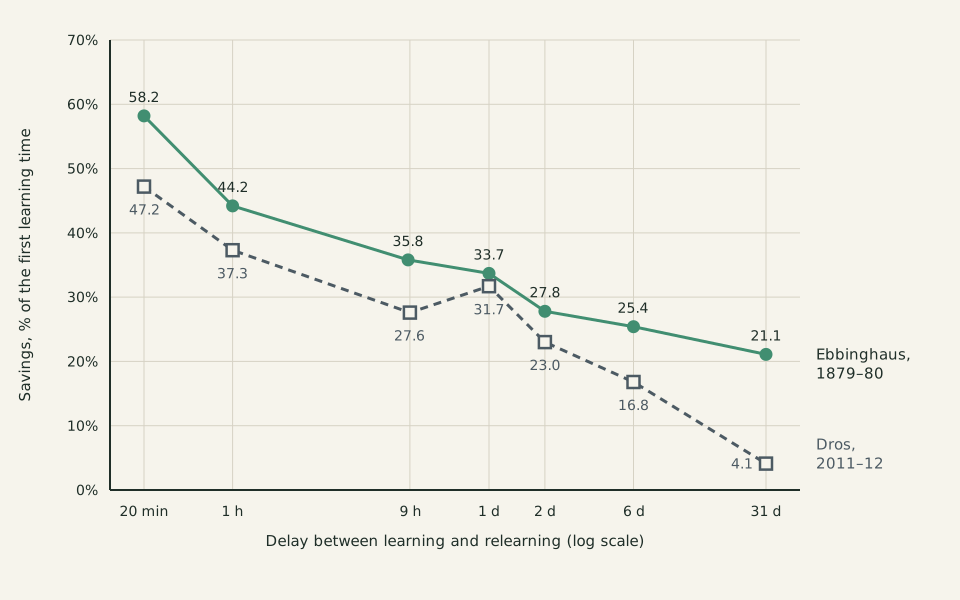
Diagram: Feedback & Forgetting, CC BY 4.0
Copy the credit line
"The forgetting curve is a savings curve" by Feedback & Forgetting, https://feedbackandforgetting.com/learning-memory/forgetting-curve/, licensed under CC BY 4.0, https://creativecommons.org/licenses/by/4.0/Data: Ebbinghaus, H. (1885). Über das Gedächtnis. Leipzig: Duncker & Humblot. Public domain (author d. 1909), ch. 7; Murre, J. M. J., & Dros, J. (2015). Replication and analysis of Ebbinghaus' forgetting curve. PLOS ONE 10(7): e0120644, doi:10.1371/journal.pone.0120644, CC BY 4.0 (https://creativecommons.org/licenses/by/4.0/), Table 3
Figure 1. The forgetting curve is a savings curve: the share of the first learning time saved when relearning, at seven delays on a log scale. It is not a recall score. Each curve is one adult learner who learned rows of 13 nonsense syllables and relearned them to criterion; lines join the points only for readability.
A month after memorizing nonsense syllables, Hermann Ebbinghaus relearned them and saved 21% of his original learning time. That figure and six others, taken at delays from about 20 minutes to 31 days, make up the forgetting curve. Each point is time saved on relearning. This article looks at what exactly the curve measured and what it can tell you about when to review.
Savings were 58.2% after about 20 minutes, 44.2% after an hour, 33.7% after a day and 21.1% after 31 days. The only learner was Ebbinghaus himself, in 1879 and 1880. A university counseling page gives very different numbers, such as “about 2%-3%” kept after 30 days.
Study File
- Experiment
- Retention over time, measured by relearning (Über das Gedächtnis, ch. 7)
- Researcher and year
- Hermann Ebbinghaus; run 1879–80, published 1885
- Subjects
- 1 (Ebbinghaus, then 29)
- Materials and delays
- Series of 13 nonsense syllables, relearned after about 20 minutes, 1 hour, about 9 hours, 1 day, 2 days, 6 days or 31 days
- Design
- Learn to two errorless recitations, wait, relearn to the same standard, compare times.
- Main finding
- Savings fell from 58.2% to 21.1% across the seven delays (163 tests).
- Replication status
- Shape Replication tag: [replicated]; 31-day value Replication tag: [mixed]. Scope: one adult per curve, nonsense syllables, savings on relearning to criterion. Based on full text. Checked 2026-11-06.
- Validity
- Crossref lists no correction, retraction or expression of concern for Murre & Dros 2015 (checked 2026-11-06). The 1885 source is a book.
- Meaning for learners, within these conditions
- For one adult relearning meaningless lists, a pass one day later took about two-thirds as long as the first learning.
This card as a spreadsheet (CSV, forgetting-curve-study-file.csv) · Where each value comes from (JSON)
Data: Ebbinghaus, H. (1885). Über das Gedächtnis. Leipzig: Duncker & Humblot. Public domain (author d. 1909); Murre, J. M. J., & Dros, J. (2015). Replication and analysis of Ebbinghaus' forgetting curve. PLOS ONE 10(7): e0120644, doi:10.1371/journal.pone.0120644, CC BY 4.0 (https://creativecommons.org/licenses/by/4.0/)
"Zeitschrift fur Psychologie, 1909: Herman Ebbinghaus" by Wellcome Collection — https://commons.wikimedia.org/wiki/File:Zeitschrift_fur_Psychologie,_1909;_Herman_Ebbinghaus._Wellcome_L0003734.jpg — CC BY 4.0 (https://creativecommons.org/licenses/by/4.0/); modifications: cropped mount, padded
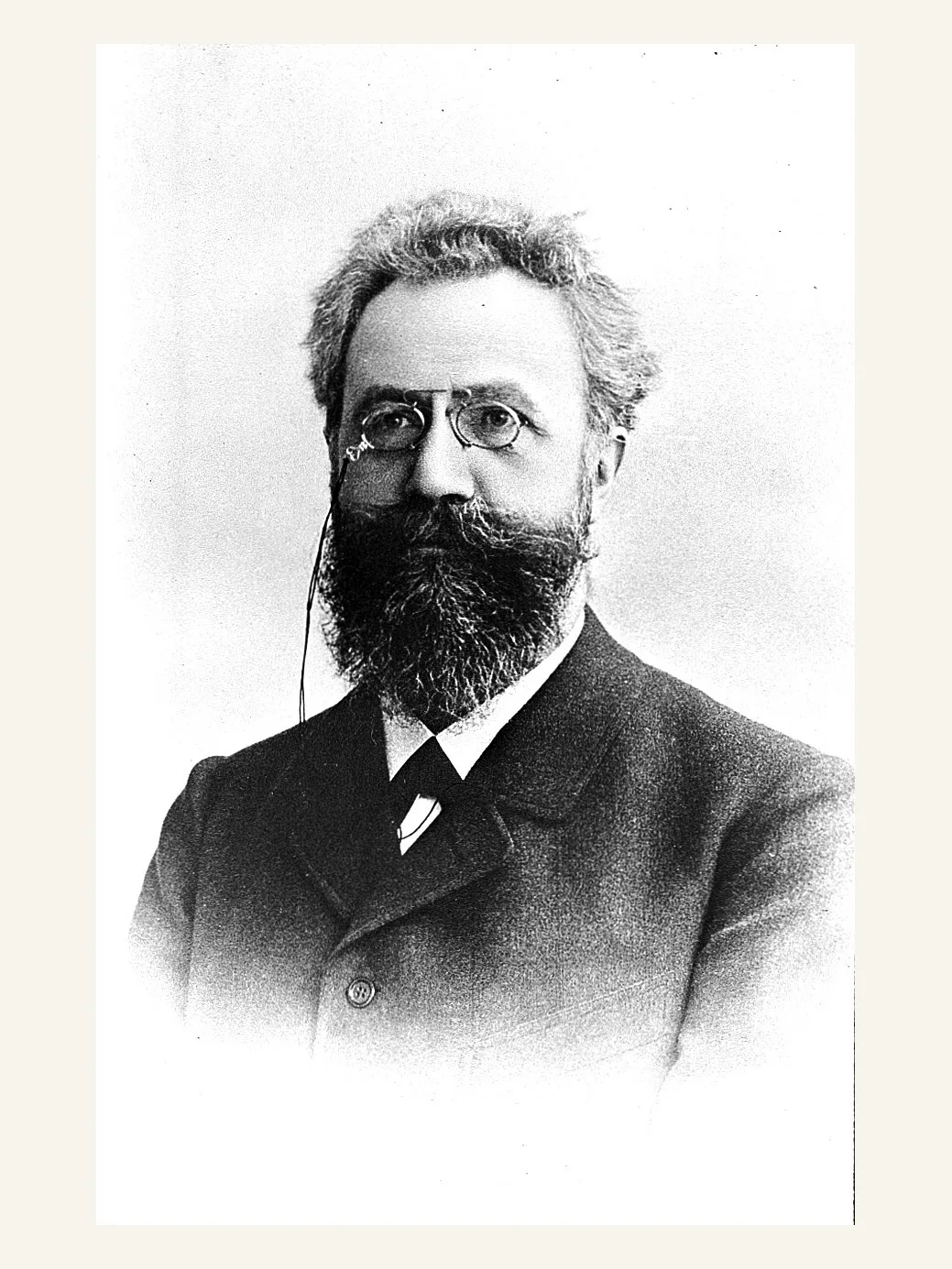
Hermann Ebbinghaus. The Wellcome Collection catalogs this portrait as “Zeitschrift fur Psychologie, 1909: Herman Ebbinghaus.”
What did Ebbinghaus actually measure?
By Murre and Dros's account, Ebbinghaus tried tones, digits and stanzas of Byron's Don Juan before settling on nonsense syllables. In this experiment he repeated each 13-syllable series until he could recite it twice without error, waited one of seven delays, then relearned it to the same standard.
His score was savings: time saved on relearning, as a share of the first learning time. If a list takes 30 minutes to learn and 20 minutes to relearn, the savings is one third. He called savings “the equivalent of the amount remembered” (1913 translation, p. 77). His results table labels the remainder, 66.3% at one day, as “the amount forgotten … in terms of time of learning” (p. 76).
That last phrase is easy to drop. Read as recall, the table says he forgot two-thirds of the material in a day. Read as he defined it, relearning a day later took about two-thirds of the original time. In this experiment he did not score his first try at relearning; Murre and Dros added that measure in 2015.
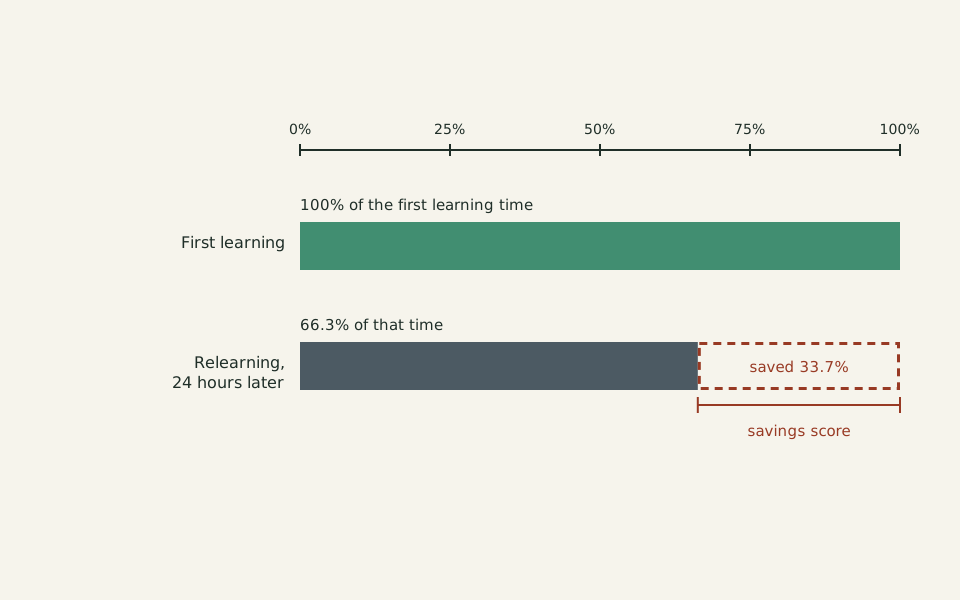
Diagram: Feedback & Forgetting, CC BY 4.0
Copy the credit line
"What a savings score measures" by Feedback & Forgetting, https://feedbackandforgetting.com/learning-memory/forgetting-curve/, licensed under CC BY 4.0, https://creativecommons.org/licenses/by/4.0/Data: Ebbinghaus, H. (1885). Über das Gedächtnis. Leipzig: Duncker & Humblot. Public domain (author d. 1909), ch. 7
Figure 2. What a savings score measures, drawn to scale at the 1-day delay. Savings is the first learning time minus the relearning time, divided by the first learning time; that saved share is the point plotted on the forgetting curve.
"Über das Gedächtnis (1885), Fig. 2" by Hermann Ebbinghaus — https://commons.wikimedia.org/wiki/File:%C3%9Cber_das_Ged%C3%A4chtnis._Untersuchungen_zur_experimentellen_Psychologie,_Fig_2.png — Public domain (author d. 1909; published Leipzig: Duncker & Humblot, 1885; public domain in the EU (70 years after the author's death) and in the US (published before 1931); scan of the Library of Congress copy by the Internet Archive)
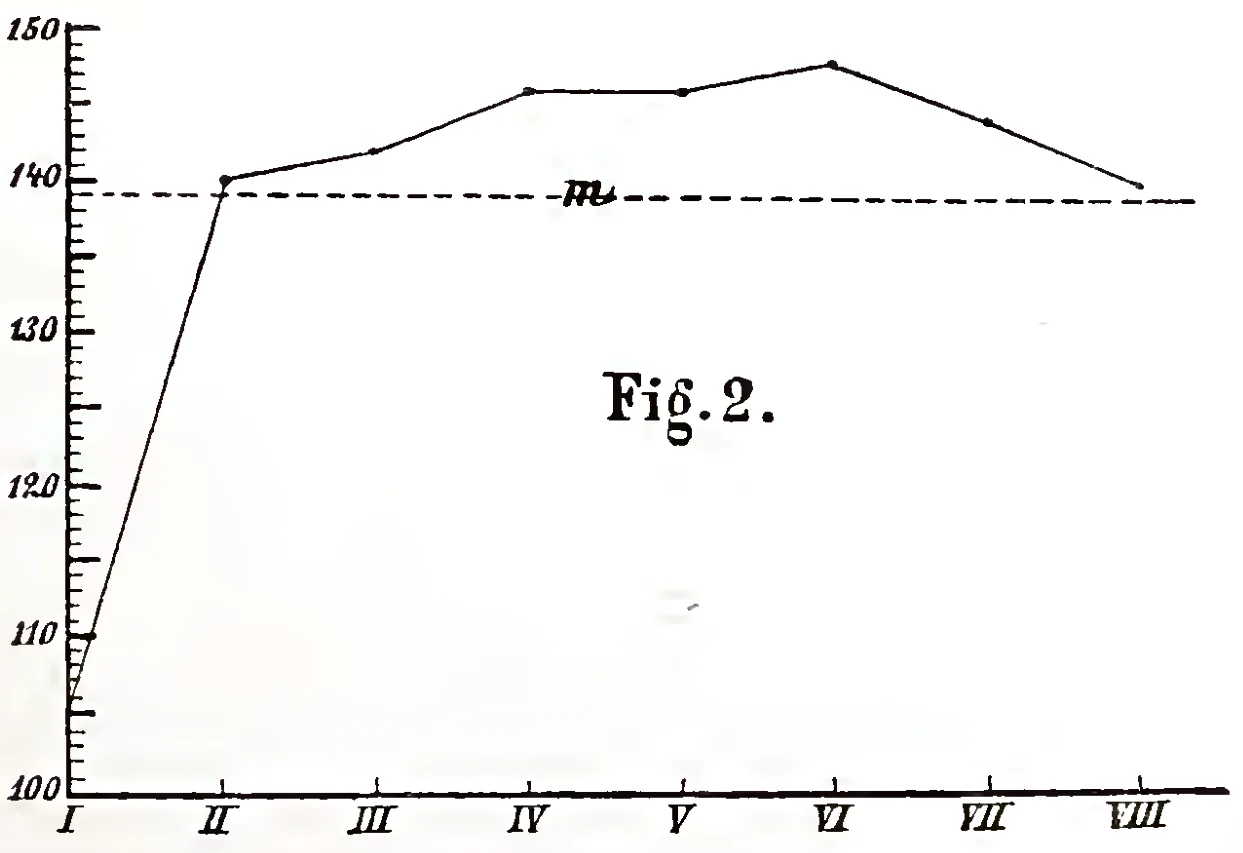
Fig. 2 of the 1885 German edition (p. 58), as printed. It plots the mean seconds he needed to learn each of eight 13-syllable series studied one after another (I to VIII), over 92 tests; a dashed line is marked m. Learning time in seconds is the raw measure from which his savings were computed.
What does the forgetting curve show?
Most of the drop came early. Savings fell 14 points between the 20-minute and one-hour tests, then took a month to fall another 23. In his words, after a month “fully one fifth of the first work persisted in effect” (p. 76).
Ebbinghaus called his numbers “special, individual, and uncertain” (p. 77). He fit them with a formula, b = 100k / ((log t)^c + k), with t in minutes, k = 1.84 and c = 1.25. But he called it only “a shorthand statement” of results “found but once” (p. 79).
His formula, recomputed, matches his printed “calculated” values within 0.1 point at all seven delays (see the CSV). Murre and Dros refit his equations by computer and got nearly the same constants. The equations fit some replication curves worse, including the 2015 one.
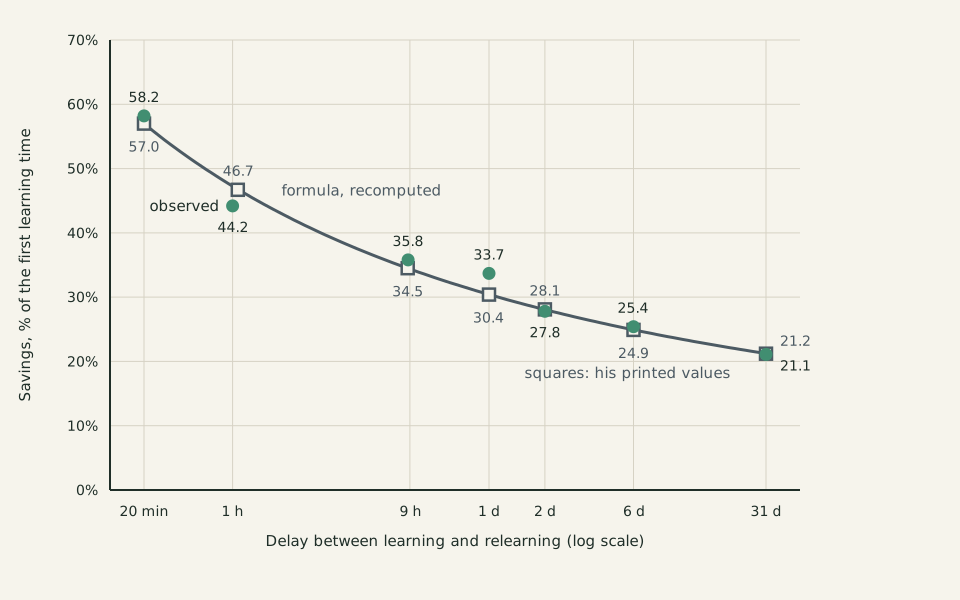
Diagram: Feedback & Forgetting, CC BY 4.0
Copy the credit line
"Ebbinghaus's forgetting formula, recomputed" by Feedback & Forgetting, https://feedbackandforgetting.com/learning-memory/forgetting-curve/, licensed under CC BY 4.0, https://creativecommons.org/licenses/by/4.0/Data: Ebbinghaus, H. (1885). Über das Gedächtnis. Leipzig: Duncker & Humblot. Public domain (author d. 1909), ch. 7
Figure 3. His formula recomputed as a continuous curve, against the values he printed as “calculated” (squares) and his observed savings (dots). The constants are his: k = 1.84 and c = 1.25, with t in minutes.
He also doubted one value. The 33.7% at 24 hours looked “somewhat too large” to him (p. 77). Seven later tests with 12-syllable series gave 33.4% (p. 80), which he said upheld the value, though he left the question open.
Does the forgetting curve show 2–3% kept after a month?
A University of Waterloo counseling page called “Curve of Forgetting,” archived in 2017, described a one-hour lecture. It said a student who did nothing would lose “50%-80%” by day 2 and keep “about 2%-3%” by day 30. It also said 10 minutes of review within 24 hours would raise the curve “almost to 100%.” The page cites no study, and its university address returned a 404 error on 2026-11-06.
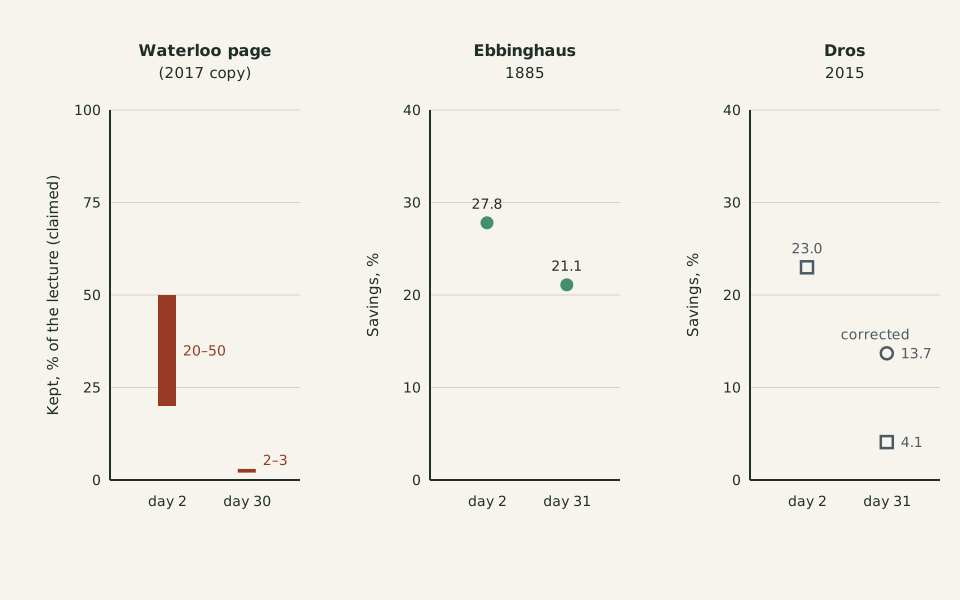
Diagram: Feedback & Forgetting, CC BY 4.0
Copy the credit line
"Three sources, three measures" by Feedback & Forgetting, https://feedbackandforgetting.com/learning-memory/forgetting-curve/, licensed under CC BY 4.0, https://creativecommons.org/licenses/by/4.0/Data: University of Waterloo Counselling Services, “Curve of Forgetting”, archived copy of 2017-03-29 (quoted figures only); Ebbinghaus, H. (1885). Über das Gedächtnis. Leipzig: Duncker & Humblot. Public domain (author d. 1909), ch. 7; Murre, J. M. J., & Dros, J. (2015). Replication and analysis of Ebbinghaus' forgetting curve. PLOS ONE 10(7): e0120644, doi:10.1371/journal.pone.0120644, CC BY 4.0 (https://creativecommons.org/licenses/by/4.0/), Table 3 and Results
Figure 4. Three sources, three measures, each on its own vertical axis: the archived Waterloo page's claims about a lecture (share kept, no study cited), Ebbinghaus's savings and Dros's savings, at day 2 and day 30 or 31. The circle in the right panel is Dros's 31-day value after the authors' correction.
Claim vs. record
| Waterloo page (archived 2017) | Ebbinghaus, 1885 | Dros, 2015 | |
|---|---|---|---|
| What was measured | A lecture; method not stated | Savings on relearning nonsense syllables | Same as Ebbinghaus |
| Day 2 | “50%-80%” lost | 27.8% savings | 23.0% savings |
| Day 30–31 | “about 2%-3%” retained | 21.1% savings | 4.1% savings (13.7% after the authors' correction) |
| Data behind it | None cited | 163 tests, one learner | 69 lists, one learner |
The page's day-30 figure is lower than both measured curves. It also describes lecture content rather than relearning time, and none of its numbers could be traced to a study. The 2–3% figure has its own row in this site's scorecard of learning myths and neuromyths.
Has the forgetting curve been replicated?
Yes, for its shape, and again with one person. Jaap Murre and Joeri Dros of the University of Amsterdam had Dros, then 22, learn and relearn 69 lists from December 2011 to February 2012. He used Dutch-sounding syllables and the same seven delays.
His savings fell from 47.2% at 20 minutes to 23.0% at two days. The authors called the resemblance to Ebbinghaus's curve, and to the two learners of a 1991 German replication by Heller, Mack and Seitz (as reported by Murre and Dros), “remarkable.”
Replication tag: [replicated] Shape: steep fall in the first hour, slow decline to 31 days. One adult per curve, nonsense syllables, relearning to criterion. Based on full text. Checked 2026-11-06.
The curves part at 31 days. Dros saved 4.1%; Ebbinghaus saved 21.1%. Dros's learning times crept upward over the experiment, and correcting for that raised his figure only to 13.7%. All his 31-day lists were learned early and close together, which the authors suggest may have mattered.
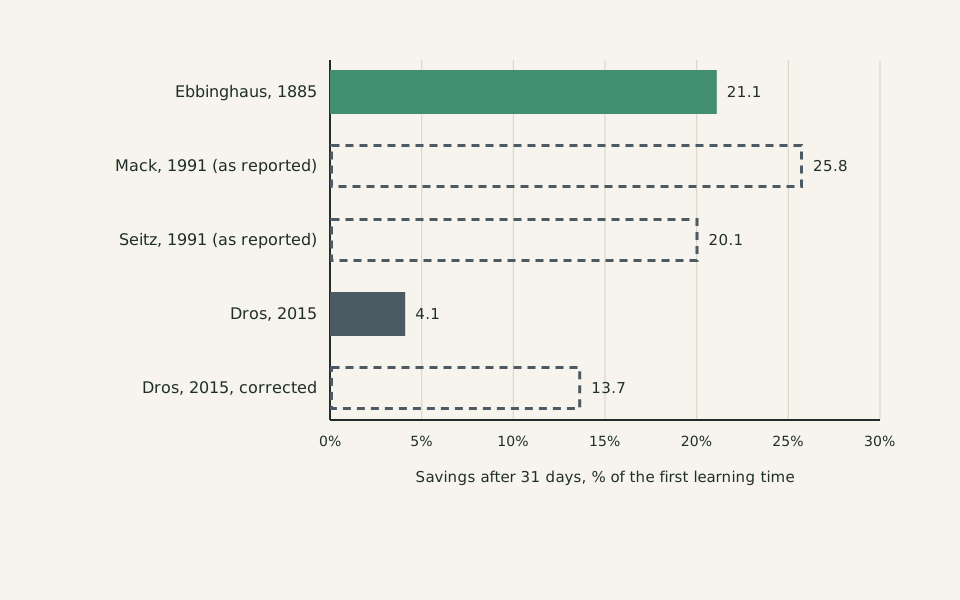
Diagram: Feedback & Forgetting, CC BY 4.0
Copy the credit line
"Savings after 31 days in four one-person curves" by Feedback & Forgetting, https://feedbackandforgetting.com/learning-memory/forgetting-curve/, licensed under CC BY 4.0, https://creativecommons.org/licenses/by/4.0/Data: Ebbinghaus, H. (1885). Über das Gedächtnis. Leipzig: Duncker & Humblot. Public domain (author d. 1909), ch. 7; Murre, J. M. J., & Dros, J. (2015). Replication and analysis of Ebbinghaus' forgetting curve. PLOS ONE 10(7): e0120644, doi:10.1371/journal.pone.0120644, CC BY 4.0 (https://creativecommons.org/licenses/by/4.0/), Table 3 and Results; 1991 values as reported there
Figure 5. Savings after 31 days for each one-person curve. Dashed outlines mark the two 1991 values, taken from Table 3 of the 2015 paper, and Dros's value after the authors' correction for learning times that rose during his experiment.
Replication tag: [mixed] Size of the 31-day value. One adult per curve, nonsense syllables, savings measure. The 25.8% and 20.1% for the two 1991 learners are as reported by Murre & Dros (2015); the 1991 paper was not read. Based on full text. Checked 2026-11-06.
Why do savings and recall come apart?
Murre and Dros also scored Dros's first attempt to reproduce each row at relearning. That recall score fell with delay too, but its curve was “much shallower” than the savings curve. The first two and last three syllables in a row showed almost no forgetting; the middle ones carried most of it.
The authors add a warning: if material can be learned in one pass, savings can look perfect even when a recall test would show nothing. For what practicing recall does to later test scores, see this site's review of active recall.
Is there a bump at 24 hours?
In all four curves the paper compares, savings at one or two days sat above a smooth fitted curve. A “boost” term fitted from one day onward was small for Ebbinghaus (0.030) and large for one German learner (0.131); Dros's data showed no evidence of one. The authors called the results “mixed.” They note that Jenkins and Dallenbach (1924) read the 24-hour value as a sleep effect, but say that for this kind of experiment the link “remains to be established.”
Replication tag: [mixed] A jump in savings at the 1-day delay. Four single learners, nonsense syllables, savings measure. Based on full text. Checked 2026-11-06.
Does the forgetting curve tell you when to review?
Not on its own. The curve follows one session left alone, so it says nothing about a second session. Ebbinghaus tested that separately. He learned nine 12-syllable series, then relearned them on each of the next five days, needing on average 158, 109, 75, 56, 37 and 31 repetitions for the nine series together.
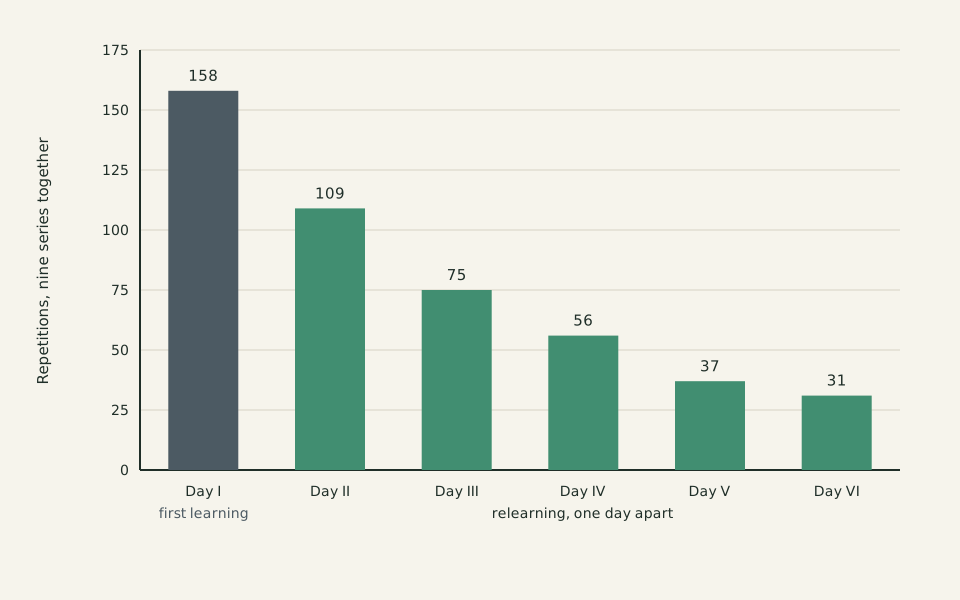
Diagram: Feedback & Forgetting, CC BY 4.0
Copy the credit line
"Relearning on six successive days" by Feedback & Forgetting, https://feedbackandforgetting.com/learning-memory/forgetting-curve/, licensed under CC BY 4.0, https://creativecommons.org/licenses/by/4.0/Data: Ebbinghaus, H. (1885). Über das Gedächtnis. Leipzig: Duncker & Humblot. Public domain (author d. 1909), ch. 8
Figure 6. Repetitions he needed to reach a first errorless recitation of nine 12-syllable series on six successive days, as means of seven tests; day I is the first learning.
He then compared schedules. About 38 repetitions per series, spread over three days, made later relearning as easy as 68 repetitions massed into the day before. He called the difference “large enough to be significant” (p. 89), but noted that he had found it under narrow conditions.
Replication tag: [single study] Ebbinghaus's own comparison: one learner, 12-syllable series, relearning 24 hours later. No matched replication found (search of 2026-10-07). Based on full text. Checked 2026-11-06.
A 2006 meta-analysis led by Nicholas Cepeda gathered 839 assessments of distributed practice from 317 experiments in 184 articles on verbal recall. By the review's abstract, the gap between study sessions that gave the best retention grew as the retention interval grew. This site's spaced repetition review takes those spacing experiments one at a time.
[status not assigned] Spaced versus massed study in verbal recall tasks. Only the review's abstract was read, and it reports neither the size of the spacing effect nor a bias-corrected estimate. Checked 2026-11-06.
How long should you wait before a review?
How long to wait depends on how long you need to remember. In a 2008 study, more than 1,350 people were taught a set of facts, reviewed them after a gap of up to 3.5 months, and took a final test up to a year after that. The best gap grew as the test moved further away. As a share of the test delay, though, it shrank: about 20–40% for a test a week away, and 5–10% for a test a year away.
Replication tag: [single study] People taught a set of facts, one review, final test up to a year later. No independent replication found (search of 2026-11-06). Based on the abstract. Checked 2026-11-06.
This site calls the pattern in these results the forgetting dividend (defined on the spaced repetition page). In the 2008 study, lengthening the gap before the review at first raised final test scores. The term names an observation and claims no mechanism; it does not mean you should wait until you have nearly forgotten. Think of the gap like rest between sets: it helps, but in the 2008 data, gaps past the best one slowly lowered final scores.
For your next study session, plan one relearning pass after a gap instead of repeating the material straight away. If the test is about a week after that pass, the 2008 data point to a gap of about 1.4 to 2.8 days between first study and the pass. Expect blanks when you start; in Ebbinghaus's records, relearning a day later still took only about two-thirds of the original time.
Data: Ebbinghaus 1885 and the 2015 replication
| Delay | Ebbinghaus savings, % (quoted) | Ebbinghaus relearning time, % of first learning (quoted) | Ebbinghaus formula, % (recomputed) | Dros savings, % (quoted) | Dros savings from repetitions, % (recomputed) | Mack savings, % (as reported) | Seitz savings, % (as reported) |
|---|---|---|---|---|---|---|---|
| About 20 min | 58.2 | 41.8 | 57.0 | 47.2 | 47.2 | 54.4 | 44.2 |
| 1 hour | 44.2 | 55.8 | 46.8 | 37.3 | 37.3 | 43.2 | 32.5 |
| About 9 hours | 35.8 | 64.2 | 34.5 | 27.6 | 27.6 | 28.5 | 27.0 |
| 1 day | 33.7 | 66.3 | 30.4 | 31.7 | 31.7 | 31.6 | 27.0 |
| 2 days | 27.8 | 72.2 | 28.1 | 23.0 | 23.0 | 36.5 | 28.6 |
| 6 days | 25.4 | 74.6 | 24.9 | 16.8 | 16.8 | 30.9 | 20.5 |
| 31 days | 21.1 | 78.9 | 21.2 | 4.1 | 4.1 | 25.8 | 20.1 |
Download the data (CSV, forgetting-curve-ebbinghaus-1885-vs-2015.csv) · Where each value comes from (JSON) Data: Ebbinghaus, H. (1885). Über das Gedächtnis. Leipzig: Duncker & Humblot. Public domain (author d. 1909); Murre, J. M. J., & Dros, J. (2015). Replication and analysis of Ebbinghaus' forgetting curve. PLOS ONE 10(7): e0120644, doi:10.1371/journal.pone.0120644, CC BY 4.0 (https://creativecommons.org/licenses/by/4.0/); University of Waterloo Counselling Services, “Curve of Forgetting”, archived copy of 2017-03-29 (quoted figures only)
How the table was built. Ebbinghaus's values come from his results table (1885, p. 103; 1913 translation, p. 76), and the formula column recomputes his equation with his own constants. Dros's values are Table 3 of Murre & Dros (2015), printed there as proportions; recomputing them from the repetition counts in their Table 1 matches all seven to three decimals. The Mack and Seitz columns are the 1991 values as reported in Table 3 of the 2015 paper.
The paper's text calls Table 3 time-based, yet its Table 2 time averages give other values (42.1% at 20 minutes). Table 2 also prints the 6-day average as “0”; its own times give 18.4%.
Data: Ebbinghaus's relearning on six successive days, 1885
| Day | Repetitions, nine 12-syllable series together (quoted) |
|---|---|
| I (first learning) | 158 |
| II | 109 |
| III | 75 |
| IV | 56 |
| V | 37 |
| VI | 31 |
Download the data (CSV, forgetting-curve-relearning-1885-ch8.csv) · Where each value comes from (JSON) Data: Ebbinghaus, H. (1885). Über das Gedächtnis. Leipzig: Duncker & Humblot. Public domain (author d. 1909)
Retrieval check
Answer from memory first, then follow the link to the passage and check.
- What did each point on Ebbinghaus's curve measure, and what did it leave out? Back to the passage
- At which delay did the 2015 replication differ most from Ebbinghaus, and what did the authors suspect? Back to the passage
- In the 2008 spacing study, what happened to the best review gap, as a share of the test delay, as the test moved further away? Back to the passage · The full spacing evidence
Sources
- Ebbinghaus, H. (1885). Über das Gedächtnis: Untersuchungen zur experimentellen Psychologie. Leipzig: Duncker & Humblot. Chapter VII (results table, p. 103; formula, p. 105; calculated column, p. 106) and chapter VIII (pp. 112, 122). https://archive.org/details/b28111710
- Ebbinghaus, H. (1913). Memory: A Contribution to Experimental Psychology (H. A. Ruger & C. E. Bussenius, Trans.). New York: Teachers College, Columbia University. Original work published 1885. Quotations from pp. 76, 77, 79 and 89. https://archive.org/details/memorycontributi00ebbiuoft
- Murre, J. M. J., & Dros, J. (2015). Replication and analysis of Ebbinghaus' forgetting curve. PLOS ONE, 10(7), e0120644. doi:10.1371/journal.pone.0120644. Quotations from Results (“remarkable”: The forgetting curve; “much shallower”: Serial position effects), Discussion (“mixed”: The 24-hour point in Ebbinghaus' forgetting curve) and Concluding Remark (“remains to be established”). https://doi.org/10.1371/journal.pone.0120644
- Heller, O., Mack, W., & Seitz, J. (1991). Replikation der Ebbinghaus'schen Vergessenskurve mit der Ersparnismethode: “Das Behalten und Vergessen als Funktion der Zeit”. Zeitschrift für Psychologie, 199, 3–18. As reported by Murre & Dros (2015). https://doi.org/10.1371/journal.pone.0120644
- Jenkins, J. G., & Dallenbach, K. M. (1924). Obliviscence during sleep and waking. American Journal of Psychology, 35, 605–612. As reported by Murre & Dros (2015). https://doi.org/10.1371/journal.pone.0120644
- Murre, J. M. J., & Dros, J. OSF project “Ebbinghaus (1880) Replication.” https://osf.io/6kfrp/
- Cepeda, N. J., Pashler, H., Vul, E., Wixted, J. T., & Rohrer, D. (2006). Distributed practice in verbal recall tasks: A review and quantitative synthesis. Psychological Bulletin, 132(3), 354–380. doi:10.1037/0033-2909.132.3.354 https://doi.org/10.1037/0033-2909.132.3.354
- Cepeda, N. J., Vul, E., Rohrer, D., Wixted, J. T., & Pashler, H. (2008). Spacing effects in learning: A temporal ridgeline of optimal retention. Psychological Science, 19(11), 1095–1102. doi:10.1111/j.1467-9280.2008.02209.x https://doi.org/10.1111/j.1467-9280.2008.02209.x
- University of Waterloo Counselling Services. “Curve of Forgetting.” Archived copy of 2017-03-29. https://web.archive.org/web/20170329184930/https://uwaterloo.ca/counselling-services/curve-forgetting
- Crossref. Work records and update searches (corrections, retractions, expressions of concern) for doi:10.1371/journal.pone.0120644, doi:10.1037/0033-2909.132.3.354 and doi:10.1111/j.1467-9280.2008.02209.x. https://api.crossref.org/works/10.1371/journal.pone.0120644
Cite this page
Feedback & Forgetting. (2026-11-06). Forgetting Curve: It Measured Relearning, Not Recall. https://feedbackandforgetting.com/learning-memory/forgetting-curve/ (accessed [date you read it])
No DOI is assigned to this page; cite the address above with the date you read it.
Related reading
-

Learning & Memory
Spaced Repetition: Should Review Gaps Grow? Studies Disagree
Picture credit
Illustration: Feedback & Forgetting. Generated schematic illustration — not a photograph or historical record. © Feedback & Forgetting, all rights reserved.
-
Learning & Memory
Active Recall: Quizzing Beat Rereading Later in a 2006 Study
Picture credit
"Mental Arithmetic. In Public School of S. A. Rachinsky" by Nikolay Bogdanov-Belsky — https://commons.wikimedia.org/wiki/File:Bogdanov-Belsky_Ustny_Schet_(Tretyakov).jpg — Public domain (PD-Art; painter d. 1945 (EU: from 2016; US: published before 1931, per the Commons file page)); modifications: cropped
-
Learning & Memory
Do Learning Styles Work? A 2008 Review Found Few Fair Tests
Picture credit
Illustration: Feedback & Forgetting. Generated schematic illustration — not a photograph or historical record. © Feedback & Forgetting, all rights reserved.