Does Brainstorming Work? In a Review, Groups Had Fewer Ideas
Myth review Feedback & Forgetting Published
Short answer. For sheer number of ideas, group brainstorming came out behind, according to a 2018 review this page read in full and the abstracts it could read. By the review's account, groups that talked face to face produced fewer ideas than the same number of people who worked alone and pooled their lists. Paul Paulus and colleagues base that on a 1987 paper and a 1991 meta-analysis, both titled for a “productivity loss in brainstorming groups” and read here only as citations. The verdict covers idea counts in short lab sessions, not idea quality or the other goals of a team meeting.
In one sentence: For sheer number of ideas, a 2018 review of lab studies reports that talking brainstorming groups fall behind the same number of people working alone.
Myth checked: A group brainstorming out loud comes up with more ideas than the same number of people working alone. [status not assigned] Talking groups vs. the same number of people working alone; idea counts in short lab sessions. Based on a 2018 review's full text and the abstracts this page could read; the experiments and meta-analysis the review cites were read as citations only. Checked 2026-11-06.
Outline5 sections
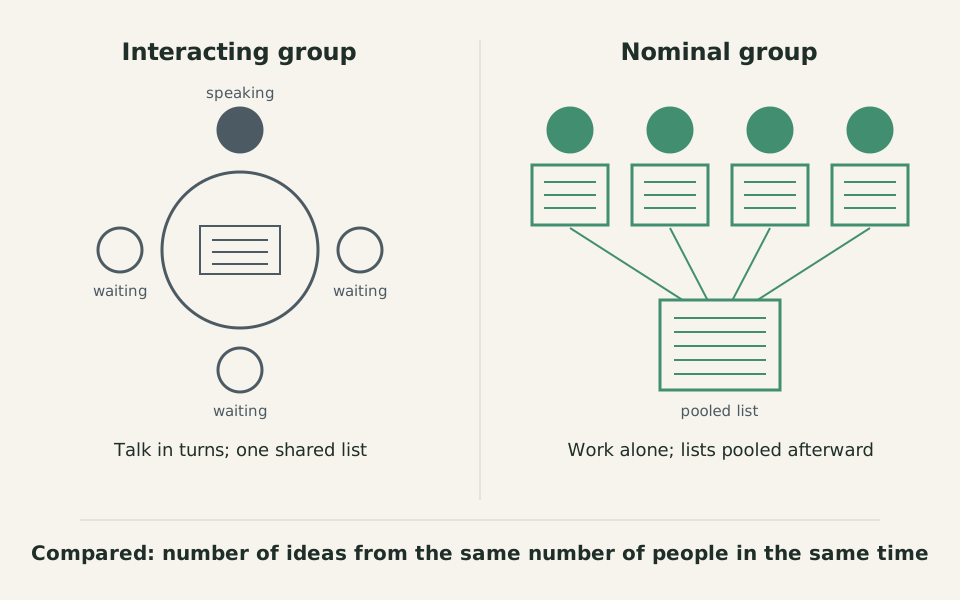
Diagram: Feedback & Forgetting, CC BY 4.0
Copy the credit line
"Interacting group vs. nominal group" by Feedback & Forgetting, https://feedbackandforgetting.com/creative-minds/brainstorming/, licensed under CC BY 4.0, https://creativecommons.org/licenses/by/4.0/The comparison behind the phrase productivity loss: a group that talks, and a nominal group of the same size whose members work alone and whose lists are combined afterward. Four people per group follows the example in the 2018 review; the drawing is not the design of any one study.
You and three coworkers get twenty minutes and a whiteboard to list every idea you can for a new product. Down the hall, four other people get the same task and time, but each works alone at a desk. Their lists are combined at the end. The question is which side should end up with the longer list.
Group brainstorming was promoted on the bet that the room wins. This page checks what lab studies found when they set up that comparison. It also checks how much of that evidence it could actually read.
Replication scorecard
| Claim | Popular source (read as) | Tested by (read as) | Summarized by (read as) | Status |
|---|---|---|---|---|
| A group brainstorming out loud comes up with more ideas than the same number of people working alone | Alex Osborn's 1953 book Applied Imagination, which popularized group brainstorming (citation only) | Diehl & Stroebe 1987; Mullen, Johnson & Salas 1991, a meta-analysis (citation only) | Paulus, Baruah & Kenworthy 2018 review (full text) | [status not assigned] Talking groups vs. nominal groups of the same size, idea counts in short lab sessions. The review reports fewer ideas in talking groups; the 1991 abstract of Gallupe, Bastianutti & Cooper (abstract only) found no difference in its own design; checked 2026-11-06 |
| Brainstorming rules, such as aiming for quantity and holding back criticism, help a group produce ideas | Osborn's rules, which most formal sessions use according to Paulus, Baruah & Kenworthy 2018 (full text) | Paulus, Kohn & Arditti 2011, as cited in that review (citation only) | Paulus, Baruah & Kenworthy 2018 review (full text) | [status not assigned] The review reports some evidence for the rules, strongest for aiming at quantity before quality; the studies behind it were not read; checked 2026-11-06 |
The promise

Illustration: Feedback & Forgetting. Generated schematic illustration — not a photograph or historical record. © Feedback & Forgetting, all rights reserved.
Two ways to set up the same idea session: one table for a group that talks, or separate desks for people who work alone and pool their lists later. A scene illustration; it does not show which setup produces more.
Alex Osborn's 1953 book Applied Imagination popularized group brainstorming. This page could not read the book, so it does not quote it. A 2018 review by Paul Paulus, Jonali Baruah and Jared Kenworthy describes the procedure he popularized. A group aims for as many ideas as possible in a short time, without worrying about quality.
The same review lists the rules most formal sessions follow: go for quantity, say whatever comes to mind, criticize nothing, and build on each other's ideas. It reports that talking in a group is the most common way to brainstorm, and that people tend to enjoy it and see it as effective. A 2026 paper in PLOS ONE by Theresa Wöllner, Tim Schweisfurth and Alexander Brem calls it one of the most widely adopted ways that organizations try to spark creativity.
The 2018 review reports some evidence for the rules themselves, the best of it for aiming at quantity first. It cites a 2011 paper by Paul Paulus, Nicholas Kohn and Lauren Arditti, “Effects of Quantity and Quality Instructions on Brainstorming.” This page read that paper only as a citation.
The question asked in 1958
Five years after Osborn's book, Donald Taylor, Paul Berry and Clifford Block published a paper in Administrative Science Quarterly. Its title asks: “Does Group Participation When Using Brainstorming Facilitate or Inhibit Creative Thinking?” Only its bibliographic record could be read here. The title shows the question was being asked within five years of the book. It does not give the answer, the design or the numbers, so none appear here.
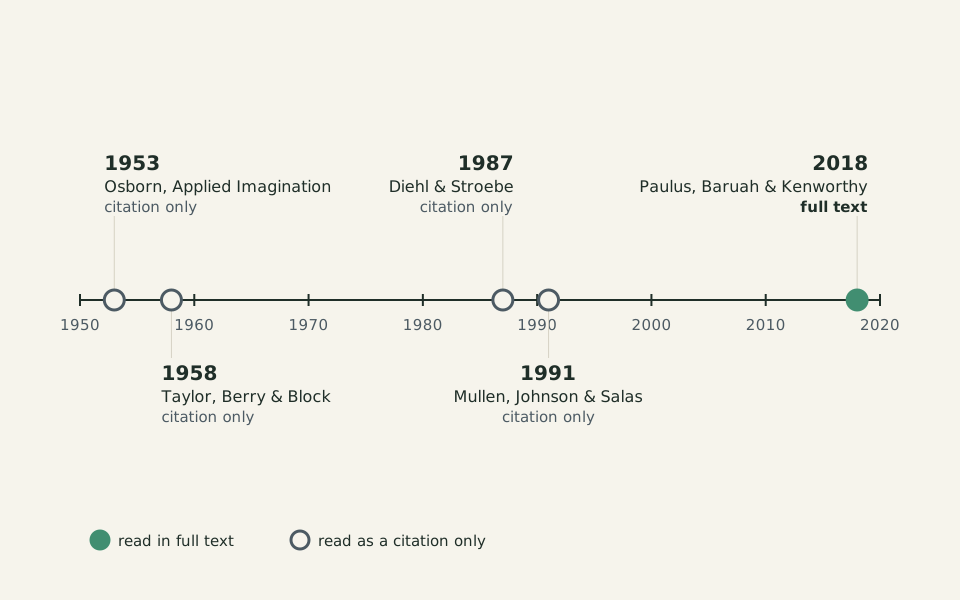
Diagram: Feedback & Forgetting, CC BY 4.0
Copy the credit line
"Brainstorming research milestones by read level" by Feedback & Forgetting, https://feedbackandforgetting.com/creative-minds/brainstorming/, licensed under CC BY 4.0, https://creativecommons.org/licenses/by/4.0/Five milestones in the brainstorming research this page draws on. Hollow markers are sources read only as citations; the filled marker is the one read in full. Positions follow the publication year.
The comparison those later papers made has a name. In the 2018 review, a nominal group is the same number of people brainstorming alone, with their ideas counted together. It is a lab comparison, not a meeting format.
The nominal group technique is something else, despite the similar name. By the abstract of a 2024 review by Seung Ho Lee and colleagues, it is a consensus method for pooling expert opinion. It runs in four stages: idea generation, round-robin sharing, clarification and voting.
Productivity loss, named twice
In 1987, Michael Diehl and Wolfgang Stroebe published “Productivity loss in brainstorming groups: Toward the solution of a riddle.” In 1991, Brian Mullen, Craig Johnson and Eduardo Salas published “Productivity Loss in Brainstorming Groups: A Meta-Analytic Integration.” A meta-analysis pools the results of many earlier studies. Both papers were read here as citations only, so the page gives none of their numbers or methods.
The titles still say something. Each names a productivity loss in brainstorming groups, and the 1987 title treats it as a riddle that needs solving. For the content, this page relies on summaries it could read.
By the 2018 review's account, groups of four that share ideas by talking tend to generate “only about half as many ideas” as the same number of people brainstorming alone (section “The Use of Different Modalities,” first paragraph). The review cites the 1987 and 1991 papers for that, and this page could not check the figure against them. A 1991 study by R. B. Gallupe, L. M. Bastianutti and W. H. Cooper starts its abstract from the same point. In earlier work, it says, groups that brainstormed together reliably came up with fewer ideas than an equal number of people working alone.
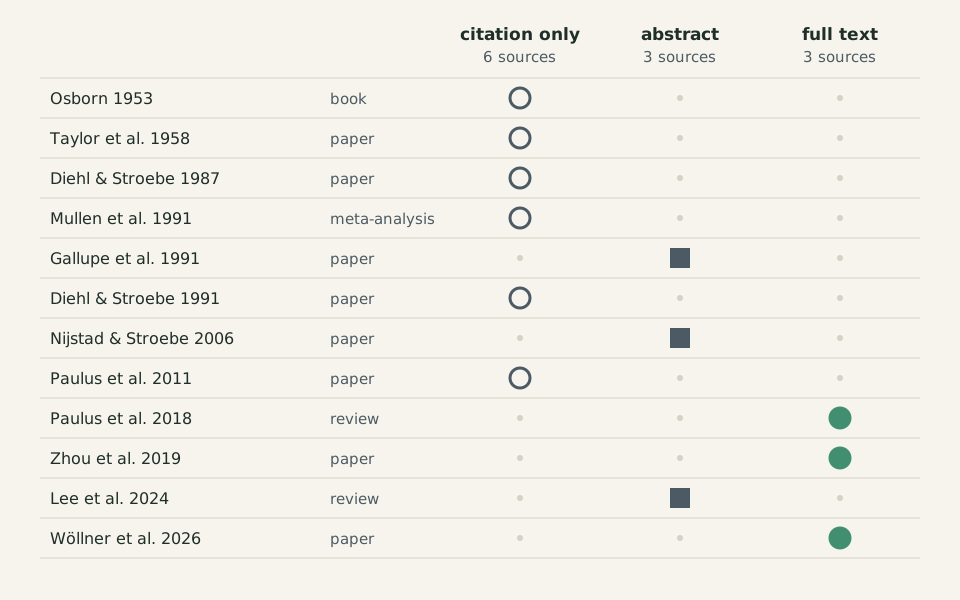
Diagram: Feedback & Forgetting, CC BY 4.0
Copy the credit line
"How much of each source was read" by Feedback & Forgetting, https://feedbackandforgetting.com/creative-minds/brainstorming/, licensed under CC BY 4.0, https://creativecommons.org/licenses/by/4.0/How much of each source this page could read, from Osborn's 1953 book to a 2026 paper. The same ledger is printed as a table, with a CSV file, in the Data section below.
That 1991 abstract also reports a twist. The study crossed electronic brainstorming, then a new technique, with the ordinary kind, and nominal groups with interacting ones. Electronic groups produced more ideas, but nominal and interacting groups did not differ, and interacting groups felt better about the process. The abstract gives no separate result for the groups that met face to face without computers.
[status not assigned] Electronic and nonelectronic, nominal and interacting groups in one 1991 study. The abstract gives no group size, sample or numbers. Based on the abstract. Checked 2026-11-06.
Why groups might fall behind
The abstract of the 1991 study names three suspected causes: social loafing, evaluation apprehension and production blocking. The 2018 review and the 2019 paper described below explain them. Production blocking means that in a talking group only one person can speak at a time, so others wait and may lose their ideas. Evaluation apprehension is the fear of being judged, and social loafing is putting in less effort when your part is hard to see.
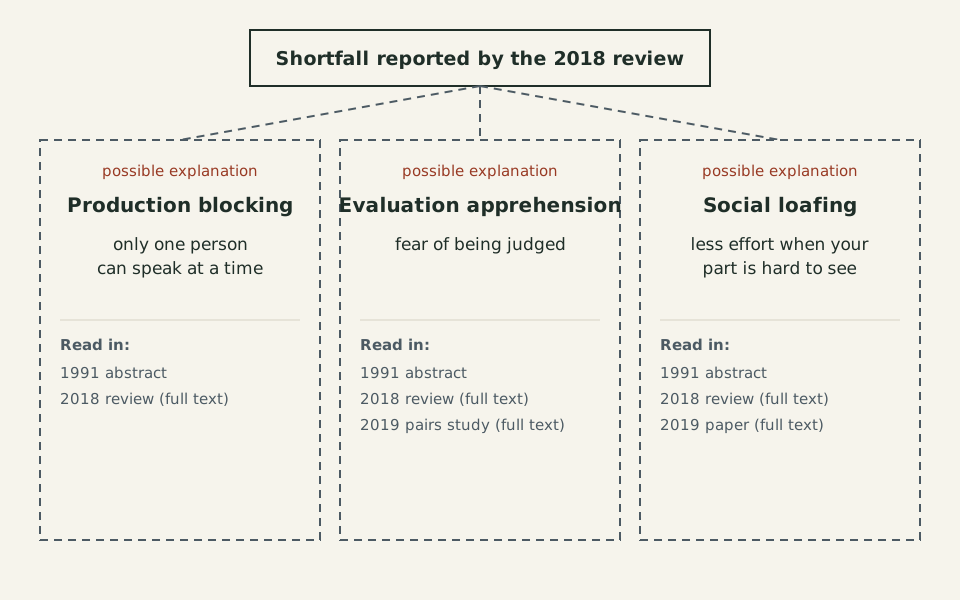
Diagram: Feedback & Forgetting, CC BY 4.0
Copy the credit line
"Possible explanations for the group shortfall" by Feedback & Forgetting, https://feedbackandforgetting.com/creative-minds/brainstorming/, licensed under CC BY 4.0, https://creativecommons.org/licenses/by/4.0/Three candidate explanations and where this page read them. None was tested in a talking group in the sources read for this page; each is labeled a possible explanation.
These are candidates, not settled causes, at the level this page could read them. Diehl and Stroebe's 1991 follow-up is titled “Productivity loss in idea-generating groups: Tracking down the blocking effect.” Bernard Nijstad and Wolfgang Stroebe proposed a model of idea generation in 2006. By its abstract, turn-taking gets in the way, while ideas from others help bring useful knowledge to mind.
One readable experiment tested two of these factors, though not in a talking group. In a 2019 study by Xiang Zhou and colleagues, 80 pairs of college students listed ways to improve their university. For 20 minutes they sent ideas to the experimenters by chat, without talking to each other. Pairs told that their ideas would be judged afterward produced 21.03 ideas on average, vs 32.95 for pairs told they would not be judged.
Replication tag: [single study] Pairs of college students, 19 to 23 years old, sending ideas by chat for 20 minutes; number of ideas. No matched replication found (search of 2026-11-06). Based on full text. Checked 2026-11-06.
Seeing a partner's ideas narrowed the range: pairs who could see each other's ideas covered 12.58 categories of ideas, vs 14.13 for pairs whose members worked separately and had their lists combined. Neither factor made a statistically significant difference to the novelty score the authors computed, though they note the scoring rule may not have been suitable. They suggest, as a possible explanation, that seeing a partner's ideas fixed attention on a few categories. A different kind of fixation, on an object's usual use, is the subject of this site's study file on functional fixedness.
Replication tag: [single study] Same pairs and task; number of idea categories. No matched replication found (search of 2026-11-06). Based on full text. Checked 2026-11-06.
Two follow-up experiments in the same paper added a 5-minute break halfway through. People who saw a partner's ideas, or in the third experiment sample ideas presented as a partner's, produced more ideas in the last 10 minutes when they took the break than when they worked straight through. Not every type of break passed the authors' stricter statistical test. Whether time away from a problem helps is a separate question, taken up in this site's review of the incubation effect.
Replication tag: [single study] College students sending ideas by chat, 10 minutes before and 10 minutes after a 5-minute break; number of ideas in the last 10 minutes. No matched replication found (search of 2026-11-06). Based on full text. Checked 2026-11-06.
Verdict: idea counts, not idea quality
On the narrow question the lab studies asked, the evidence this page could read points one way. A review read in full reports that talking groups produce fewer ideas than nominal groups of the same size, and one 1991 abstract opens with the same summary of earlier work. No tag is assigned, for two reasons. The experiments and the meta-analysis behind that summary were read only as citations, and the 1991 abstract found no difference between nominal and interacting groups in its own design.
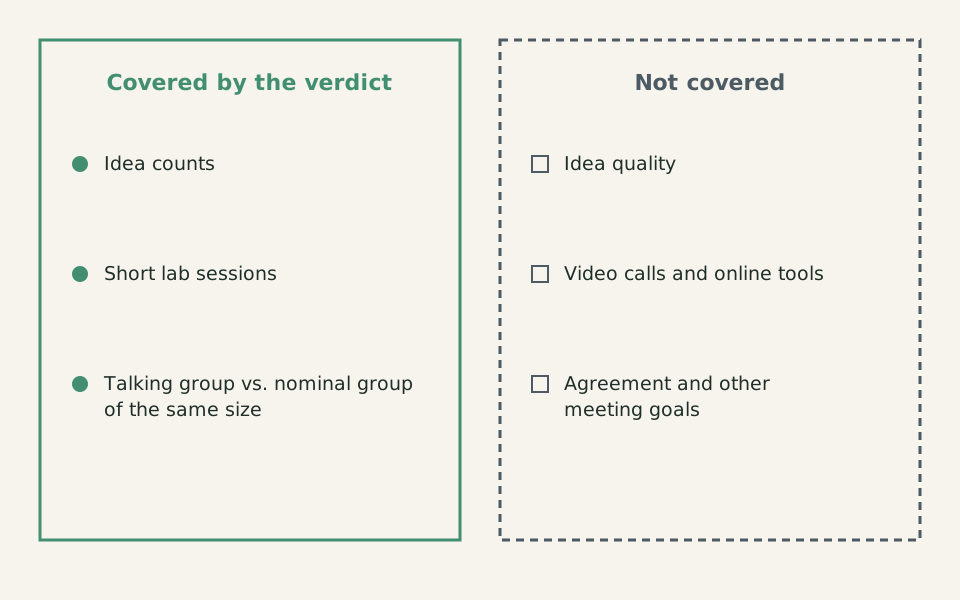
Diagram: Feedback & Forgetting, CC BY 4.0
Copy the credit line
"What the verdict covers" by Feedback & Forgetting, https://feedbackandforgetting.com/creative-minds/brainstorming/, licensed under CC BY 4.0, https://creativecommons.org/licenses/by/4.0/What this page's verdict covers and what it leaves out. Each item is described in the text below the figure.
The verdict leaves three things out:
- Idea quality. In the 2019 pairs study, novelty scores did not differ significantly between conditions, and the sources read here do not settle whether groups end up with better ideas.
- Video calls and online whiteboards. No source read here tested them. The 1991 study, read as an abstract, is the only one here that compared electronic with ordinary brainstorming. The 2019 pairs study had every group send ideas by chat, so it has no talking comparison. The 2018 review adds that sharing ideas electronically tends to produce more ideas than talking.
- Other goals of a meeting, such as agreement or a shared sense of ownership. Interacting groups in the 1991 study felt better about the process, which is a separate outcome from idea counts.
Before your next brainstorming meeting, give everyone a few quiet minutes to write ideas alone. Then pool and discuss them. The 2018 review suggests writing first and reports that studies by its first author found groups sharing ideas on paper slips can beat nominal groups. This page did not read those studies, so treat writing first as a promising setup, not a tested rule.
Data: What each source could support
| Source | Year (quoted) | Read as | What this page takes from it |
|---|---|---|---|
| Osborn, Applied Imagination | 1953 | citation only | The book exists; the 2018 review credits Osborn with popularizing brainstorming |
| Taylor, Berry & Block | 1958 | citation only | The paper exists; its title asks whether group participation helps or hinders creative thinking |
| Diehl & Stroebe | 1987 | citation only | Its title names a productivity loss in brainstorming groups |
| Mullen, Johnson & Salas | 1991 | citation only | Its title names a productivity loss in brainstorming groups and a meta-analytic integration |
| Gallupe, Bastianutti & Cooper | 1991 | abstract | Background: groups had produced fewer ideas; own result: no nominal vs interacting difference, electronic groups more productive |
| Diehl & Stroebe | 1991 | citation only | Its title names a blocking effect in idea-generating groups |
| Nijstad & Stroebe | 2006 | abstract | A model in which turn-taking interferes with idea generation and others' ideas aid recall of relevant knowledge |
| Paulus, Kohn & Arditti | 2011 | citation only | The paper exists; the 2018 review cites it for the quantity rule |
| Paulus, Baruah & Kenworthy | 2018 | full text | Talking groups produce fewer ideas than nominal groups; writing ideas down first may help |
| Zhou et al. | 2019 | full text | Pairs told they would be judged produced fewer ideas; seeing a partner's ideas narrowed the categories |
| Lee et al. | 2024 | abstract | The nominal group technique is a four-stage consensus method |
| Wöllner, Schweisfurth & Brem | 2026 | full text | Brainstorming is one of the most widely adopted techniques in organizations |
Download the data (CSV, brainstorming-source-ledger.csv) · Where each value comes from (JSON) Data: Paulus, P. B., Baruah, J., & Kenworthy, J. B. (2018). Enhancing collaborative ideation in organizations. Frontiers in Psychology 9: 2024, doi:10.3389/fpsyg.2018.02024, CC BY 4.0 (https://creativecommons.org/licenses/by/4.0/); Zhou, X., et al. (2019). Exposure to ideas, evaluation apprehension, and incubation intervals in collaborative idea generation. Frontiers in Psychology 10: 1459, doi:10.3389/fpsyg.2019.01459, CC BY 4.0 (https://creativecommons.org/licenses/by/4.0/)
The replication scorecard at the top of this page, as a CSV file · Where each value comes from (JSON) Data: Paulus, P. B., Baruah, J., & Kenworthy, J. B. (2018). Enhancing collaborative ideation in organizations. Frontiers in Psychology 9: 2024, doi:10.3389/fpsyg.2018.02024, CC BY 4.0 (https://creativecommons.org/licenses/by/4.0/)
Retrieval check
Answer from memory first, then follow the link to the passage and check.
- What phrase do the titles of the 1987 paper and the 1991 meta-analysis share? Back to the passage
- What three things does this page's verdict on brainstorming leave out? Back to the passage
- In the 2019 pairs study, what happened to idea counts when people were told their ideas would be judged? Back to the passage · When a break helps: the incubation effect
Sources
- Osborn, A. F. (1953). Applied Imagination: Principles and Procedures of Creative Thinking. New York: Scribner. https://archive.org/details/appliedimaginati00osborich
- Paulus, P. B., Baruah, J., & Kenworthy, J. B. (2018). Enhancing collaborative ideation in organizations. Frontiers in Psychology, 9, 2024. doi:10.3389/fpsyg.2018.02024 https://doi.org/10.3389/fpsyg.2018.02024
- Wöllner, T., Schweisfurth, T. G., & Brem, A. (2026). The impact of mixed-anonymity on brainstorming performance: Evidence from field experiments. PLOS ONE, 21, e0354236. doi:10.1371/journal.pone.0354236 https://doi.org/10.1371/journal.pone.0354236
- Paulus, P. B., Kohn, N. W., & Arditti, L. E. (2011). Effects of quantity and quality instructions on brainstorming. The Journal of Creative Behavior, 45(1), 38–46. doi:10.1002/j.2162-6057.2011.tb01083.x https://doi.org/10.1002/j.2162-6057.2011.tb01083.x
- Taylor, D. W., Berry, P. C., & Block, C. H. (1958). Does group participation when using brainstorming facilitate or inhibit creative thinking? Administrative Science Quarterly, 3(1), 23–47. doi:10.2307/2390603 https://doi.org/10.2307/2390603
- Lee, S. H., ten Cate, O., Gottlieb, M., Horsley, T., Shea, B., Fournier, K., Tran, C., Chan, T., Wood, T. J., & Humphrey-Murto, S. (2024). The use of virtual nominal groups in healthcare research: An extended scoping review. PLOS ONE, 19(6), e0302437. doi:10.1371/journal.pone.0302437 https://doi.org/10.1371/journal.pone.0302437
- Diehl, M., & Stroebe, W. (1987). Productivity loss in brainstorming groups: Toward the solution of a riddle. Journal of Personality and Social Psychology, 53(3), 497–509. doi:10.1037/0022-3514.53.3.497 https://doi.org/10.1037/0022-3514.53.3.497
- Mullen, B., Johnson, C., & Salas, E. (1991). Productivity loss in brainstorming groups: A meta-analytic integration. Basic and Applied Social Psychology, 12(1), 3–23. doi:10.1207/s15324834basp1201_1 https://doi.org/10.1207/s15324834basp1201_1
- Gallupe, R. B., Bastianutti, L. M., & Cooper, W. H. (1991). Unblocking brainstorms. Journal of Applied Psychology, 76(1), 137–142. doi:10.1037/0021-9010.76.1.137 https://doi.org/10.1037/0021-9010.76.1.137
- Diehl, M., & Stroebe, W. (1991). Productivity loss in idea-generating groups: Tracking down the blocking effect. Journal of Personality and Social Psychology, 61(3), 392–403. doi:10.1037/0022-3514.61.3.392 https://doi.org/10.1037/0022-3514.61.3.392
- Nijstad, B. A., & Stroebe, W. (2006). How the group affects the mind: A cognitive model of idea generation in groups. Personality and Social Psychology Review, 10(3), 186–213. doi:10.1207/s15327957pspr1003_1 https://doi.org/10.1207/s15327957pspr1003_1
- Zhou, X., Zhai, H.-K., Delidabieke, B., Zeng, H., Cui, Y.-X., & Cao, X. (2019). Exposure to ideas, evaluation apprehension, and incubation intervals in collaborative idea generation. Frontiers in Psychology, 10, 1459. doi:10.3389/fpsyg.2019.01459 https://doi.org/10.3389/fpsyg.2019.01459
- Crossref. Update searches (corrections, retractions, expressions of concern) for doi:10.2307/2390603, doi:10.1037/0022-3514.53.3.497, doi:10.1037/0022-3514.61.3.392, doi:10.1207/s15324834basp1201_1, doi:10.1037/0021-9010.76.1.137, doi:10.1207/s15327957pspr1003_1, doi:10.1002/j.2162-6057.2011.tb01083.x, doi:10.3389/fpsyg.2018.02024, doi:10.3389/fpsyg.2019.01459, doi:10.1371/journal.pone.0302437 and doi:10.1371/journal.pone.0354236. https://api.crossref.org/works?filter=updates:10.1037/0022-3514.53.3.497
Cite this page
Feedback & Forgetting. (2026-11-06). Does Brainstorming Work? In a Review, Groups Had Fewer Ideas. https://feedbackandforgetting.com/creative-minds/brainstorming/ (accessed [date you read it])
No DOI is assigned to this page; cite the address above with the date you read it.
Related reading
-
Creative Minds
Incubation Effect: The Classic Stages Came From Self-Reports
Picture credit
"Henri Poincaré" by Manuel (photograph); Ch. Wittmann (printer) — https://commons.wikimedia.org/wiki/File:Henri_Poincar%C3%A9,_PA03199.jpg — Public domain (Print inscribed “Cliché Manuel” (photograph) and “Imp. Ch. Wittmann” (printer); KU Leuven catalogue dates the printer as active 1891–1907, so the print was published by 1907. US: published before 1931, public domain. EU: photographer counted as Henri Manuel, head of the Manuel studio, d. 1947, so public domain since 2018 (70 years). Not verified: the studio was run by Henri Manuel with his brother Gaston, and the individual photographer is not named; no sign that the Mort pour la France extension applies (Henri Manuel died in 1947, after the war), not checked case by case. Year 1907 is the latest possible date, not a known date. Scan: KU Leuven Libraries print collection, PA03199, uploaded to Commons); modifications: cropped, resized
-

Creative Minds
Functional Fixedness: The Candle Problem Turns on the Box
Picture credit
Illustration: Feedback & Forgetting. Generated schematic illustration — not a photograph or historical record. © Feedback & Forgetting, all rights reserved.