Feynman Technique: Its Parts Were Studied Under Other Names
Method deep read Feedback & Forgetting Published
Short answer. The Feynman technique asks you to explain a topic in plain words, as if to someone new to it, then go back to the material wherever your explanation breaks down. Research has studied its parts under other names: self-explanation, learning by teaching, and the illusion of explanatory depth. The best-supported part in the sources read here is the last: in two later studies read in full, adults rated their understanding lower after writing out how a device works or why an event happened. The abstract of the one study read here that tested the technique by name mentions no comparison group.
In one sentence: In the records searched here, studies using the Feynman technique’s name are few and recent, but its core moves have been studied since 1989 as self-explanation, learning by teaching and the illusion of explanatory depth.
Outline6 sections
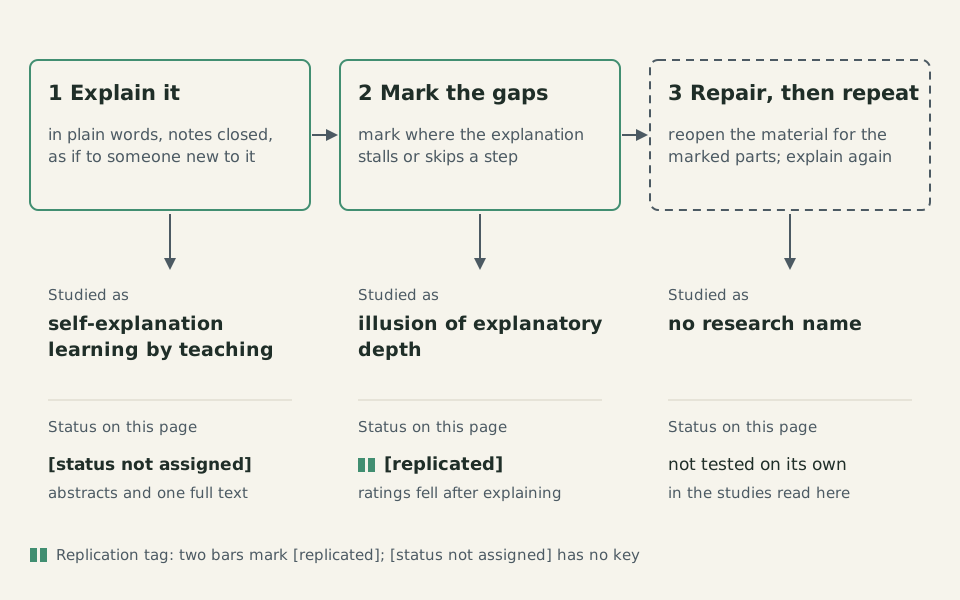
Diagram: Feedback & Forgetting, CC BY 4.0
Copy the credit line
"The Feynman technique in three steps, with the research names for each" by Feedback & Forgetting, https://feedbackandforgetting.com/learning-memory/feynman-technique/, licensed under CC BY 4.0, https://creativecommons.org/licenses/by/4.0/The technique in three steps, in this page’s wording, with the research name for each and the status each claim has here. The same rows are in the table under Data below.
Rate how well you understand a zipper from 1 to 7, then explain in writing how it works. In a study published in 2024, 202 adults did this for a zipper and a toilet flush, then rated themselves again. Their average rating fell from 3.38 to 3.13 once they had tried to put the mechanism into words. The question here is whether that drop is the point of the Feynman technique, and whether anyone has tested the rest of it.
This page takes each move of the technique to the research that tested something like it. Every source is read at the level it could be reached: full text, abstract, or citation only.
The technique as usually described
“Blackboard”, Winslow Homer, public domain
Full credit
"Blackboard" by Winslow Homer — https://commons.wikimedia.org/wiki/File:Winslow_Homer_-_Blackboard_(1877).jpg — Public domain (painter Winslow Homer d. 1910 (Prouts Neck, Maine); watercolor on wove paper, 1877, signed and dated Homer '77; National Gallery of Art, Washington, 1990.60.1; public domain in the EU (70 years after the author's death, from 1981) and in the US (published or registered before 1 January 1931 according to the Commons file page licensing template, and in any case author dead more than 70 years for an unpublished work); faithful photographic reproduction of a two-dimensional work (PD-Art); photograph source National Gallery of Art online collection (file page source field). First publication of the watercolor not checked); modifications: cropped, resizedWinslow Homer, Blackboard, 1877, watercolor (National Gallery of Art, Washington).
The name refers to Richard Feynman, but none of the sources read for this page shows him describing the method, and none of his own books could be read. A 2020 literature review by Adhina Rizkillah Harahap, read here through its abstract, describes the technique as students teaching a topic to friends or to themselves until they understand it.
This page uses three steps, in its own wording: explain the topic in plain words with your notes closed, mark where the explanation stalls, then reopen the material for those parts and explain again. No original statement of the steps could be read, so treat them as a summary, not a quotation.
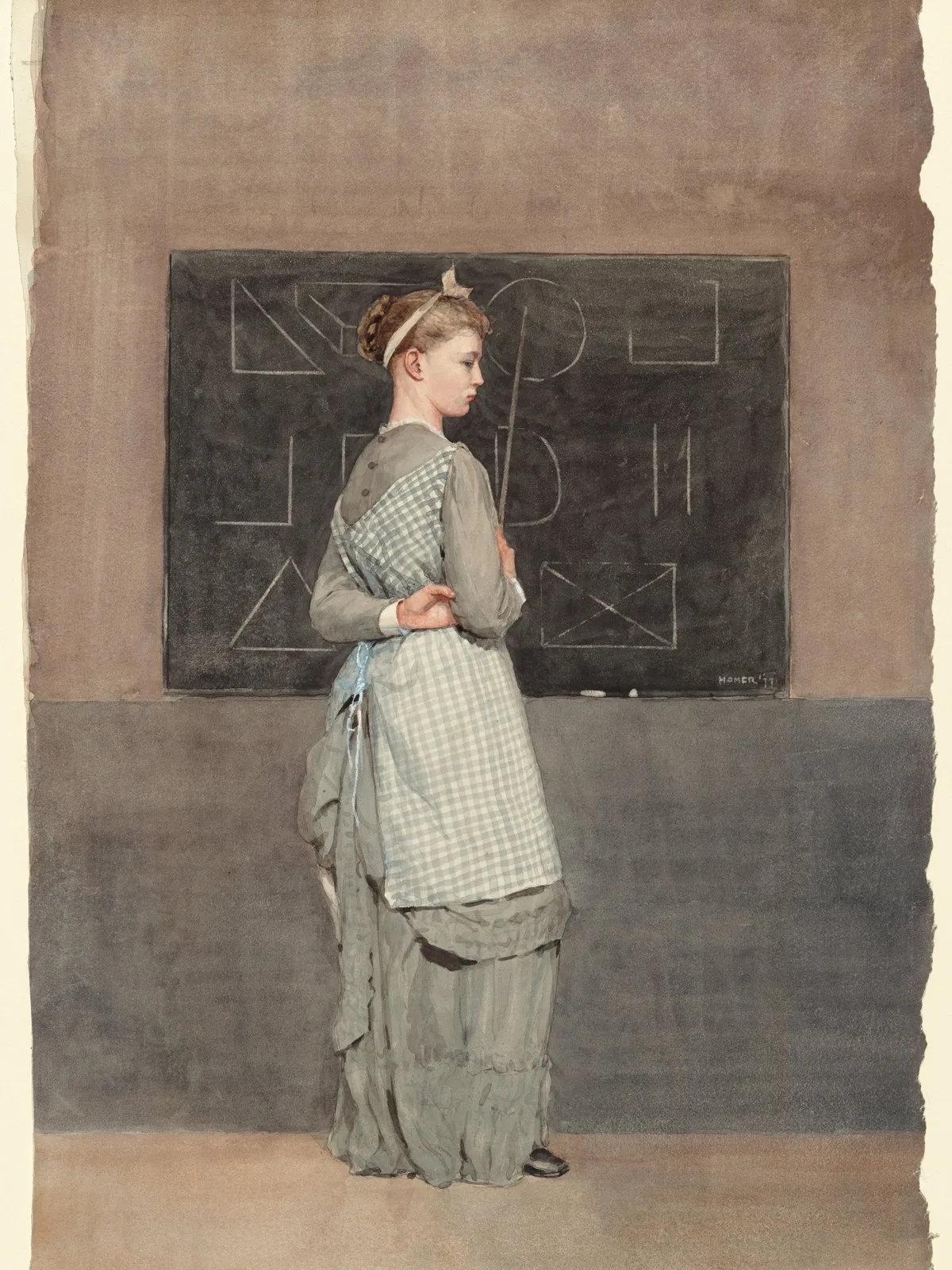
Homer’s watercolor shows a classroom scene from 1877, not the technique itself. The technique puts you in both roles at once: the one explaining and the one who notices what is missing.
Unlike rereading, the routine has you produce an explanation instead of taking one in. That puts it close to two lines of research on explaining, and to a third on how well people judge what they understand.
Where the name came from
On 6 November 2026 this page searched two scholarly indexes for the phrase “Feynman technique.” A Crossref search returned 100 records ranked by relevance. The earliest of them to use the phrase for a way of studying dates from October 2020.
That record is a book chapter by Sairindhree Sen. Only its title, “Self-Teaching Based on Feynman Technique: A Potential Meta-Cognitive Tool for Teacher Capacity-Building,” could be read. Harahap’s review followed in December 2020.
Europe PMC, which searches the full text of open-access papers, listed eight records containing the phrase. The earliest of them is from December 2022. Three of the openly licensed papers on that list, on medical training and language learning, were opened for this page; each mentions the technique in passing and none says where the name came from.
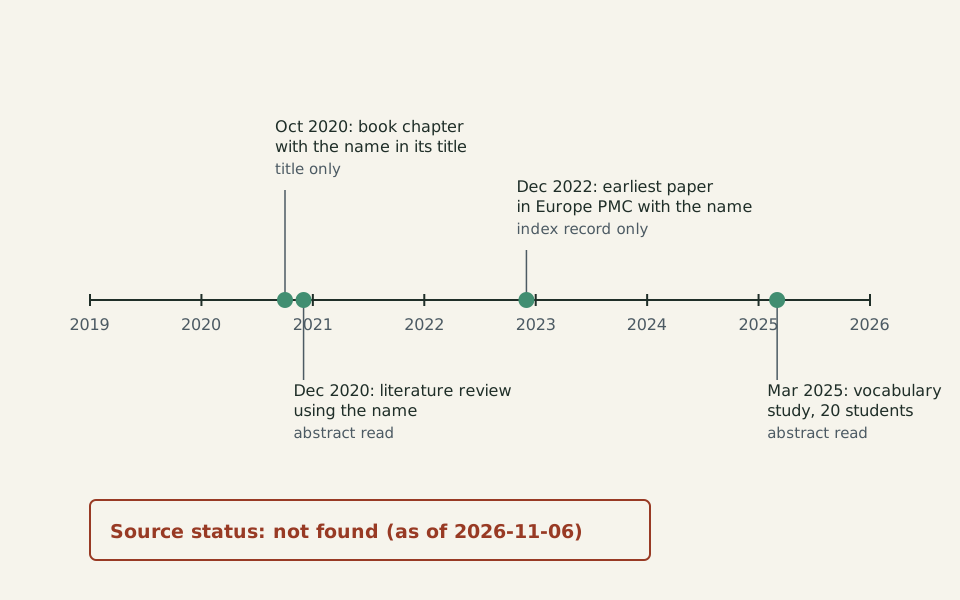
Diagram: Feedback & Forgetting, CC BY 4.0
Copy the credit line
"Dated records of the name Feynman technique, found on 2026-11-06" by Feedback & Forgetting, https://feedbackandforgetting.com/learning-memory/feynman-technique/, licensed under CC BY 4.0, https://creativecommons.org/licenses/by/4.0/Dated records of the phrase found in two scholarly indexes on 6 November 2026. The same records are listed in the table below.
| Date | Record | Read as |
|---|---|---|
| Oct 2020 | Book chapter with the name in its title (Sen) | citation only |
| Dec 2020 | Literature review using the name (Harahap) | abstract |
| Dec 2022 | Earliest paper in Europe PMC containing the name | index record only |
| Mar 2025 | Vocabulary study of 20 Grade 10 students | abstract |
These indexes cover scholarly papers, not the books, blogs and videos where study advice also travels, so the name may be older than 2020. None of the sources read shows Richard Feynman himself using the phrase or setting out the steps.
Source status: not found Where the name first appeared. Earliest readable uses: a 2020 title and a 2020 abstract, read as citation and abstract only. Searched Crossref and Europe PMC; not found as of this date, which does not mean no earlier record exists. Checked 2026-11-06.
A study that used the name
One of the records tested the technique by name. In a 2025 paper by Le Khanh Linh and Pham Thi Kieu Oanh, 20 Grade 10 students used it for seven weeks to learn English vocabulary, and their retention was better afterwards than before, according to the abstract. The abstract mentions no comparison group, so it cannot show that the technique, rather than seven more weeks of lessons, made the difference.
[status not assigned] Grade 10 students, 20 in all, English vocabulary, a seven-week program with tests before and after; no comparison group in the abstract. Based on the abstract. Checked 2026-11-06.
Self-explanation
Self-explanation means explaining material to yourself while you study it, and it is the research name closest to the first step. In 1989, Michelene Chi and four colleagues recorded students thinking aloud as they studied worked examples of mechanics problems. According to the abstract, the students the authors call “Good” produced many explanations that tied each step of a solution to principles in the text, guided by accurate checks on what they did and did not understand.
The “Poor” students explained little, misjudged their own understanding, and leaned on the examples when they solved problems later. That study compared students; it did not assign anyone to explain. A 1994 study by Chi and three colleagues did.
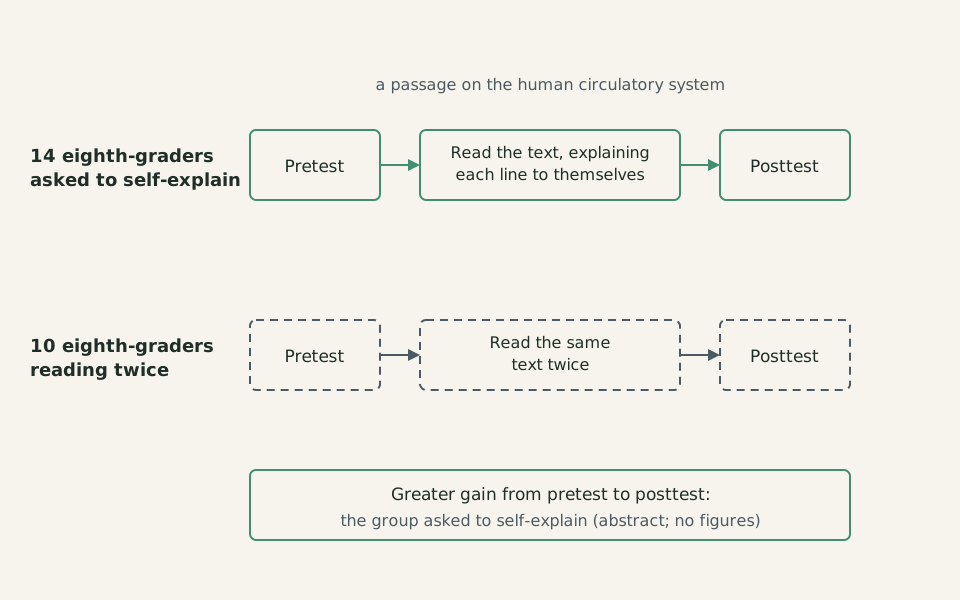
Diagram: Feedback & Forgetting, CC BY 4.0
Copy the credit line
"Design of the 1994 self-explanation study" by Feedback & Forgetting, https://feedbackandforgetting.com/learning-memory/feynman-technique/, licensed under CC BY 4.0, https://creativecommons.org/licenses/by/4.0/The 1994 design and result as the abstract describes them; the abstract gives no scores.
Fourteen eighth-graders were asked to explain to themselves after reading each line of a text on the human circulatory system. Ten others read the same text twice without that instruction. Everyone was tested before and after reading, and the group asked to explain gained more, according to the abstract. It adds that students who produced many explanations understood the material better than those who produced few.
According to the same abstract, every student who explained a lot ended up with a correct mental model of the circulatory system, while many of the students who were not asked to explain, and many who explained little, did not. That is a comparison inside a small sample, and it does not show that the instruction alone made the difference.
[status not assigned] Eighth-graders, 24 in all, an expository text on the circulatory system, tests before and after reading. Based on the abstract; the 2018 meta-analysis of such instructions was read only as a citation. Checked 2026-11-06.
Later work pooled studies that asked learners to explain. A 2018 meta-analysis led by Kiran Bisra is titled “Inducing Self-Explanation: a Meta-Analysis.” Only its citation could be read, so its pooled result is not reported here, and the 1994 result cannot be judged against it.
Learning by teaching
Learning by teaching is the research name for studying material in order to explain it to someone else. In a 2014 paper, John Nestojko and three colleagues told some participants they would be tested on a passage and others that they would teach it to another student. No one taught; everyone was tested.
According to the abstract, those expecting to teach recalled the passage more completely and in better order. They also answered more questions about it correctly, particularly questions on main points.
[status not assigned] Participants studying text passages, tests after study; two experiments in one paper. Based on the abstract; two studies of learning by teaching from 2013 and 2014 were read only as citations. Checked 2026-11-06.
Logan Fiorella and Richard Mayer wrote those two studies, titled “The relative benefits of learning by teaching and teaching expectancy” (2013) and “Role of expectations and explanations in learning by teaching” (2014). Only their citations could be read.
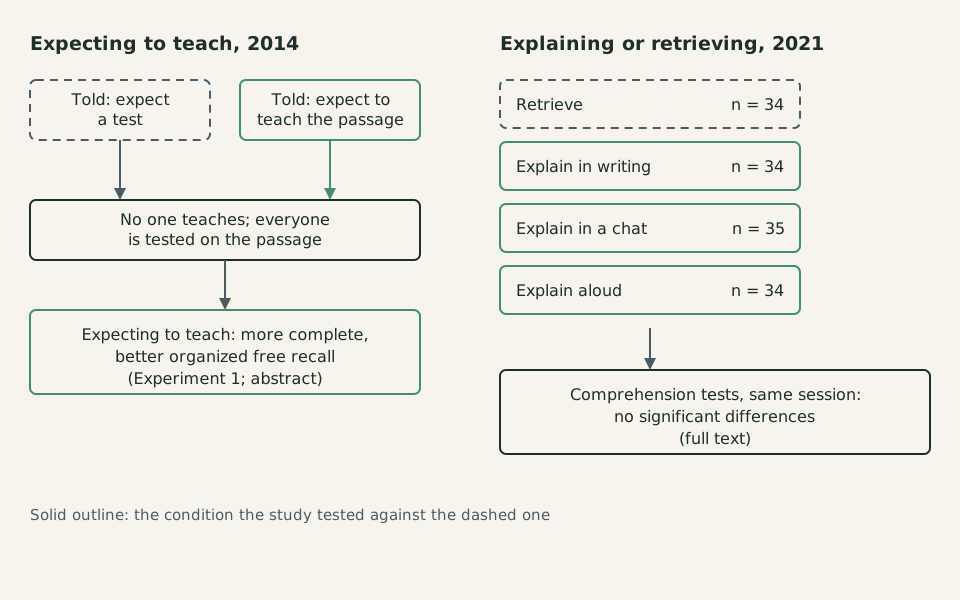
Diagram: Feedback & Forgetting, CC BY 4.0
Copy the credit line
"Two studies of learning by teaching, 2014 and 2021" by Feedback & Forgetting, https://feedbackandforgetting.com/learning-memory/feynman-technique/, licensed under CC BY 4.0, https://creativecommons.org/licenses/by/4.0/Two designs: the 2014 abstract’s comparison, and the four conditions of the 2021 experiment read in full.
Explaining versus retrieving
A 2021 experiment by Leonie Jacob, Andreas Lachner and Katharina Scheiter, read in full, set explaining against retrieval practice. After reading an immunology text, 137 university students either explained it to a fictitious peer (aloud, in a text editor or in a chat window) or retrieved what they had read. On comprehension tests in the same session, the differences between the four conditions were not significant.
The experiment was built around a narrower idea. According to the paper, an earlier study had found that explaining aloud to a fictitious peer beat restudying while writing the explanation did not, perhaps because writing feels less like talking to someone. The chat window was meant to restore that sense of a listener, but it gave no significant advantage here.
Explaining took more effort, and students rated it more enjoyable and interesting than retrieving. The authors suggest that the low quality of many explanations may account for the null result, and they note that earlier studies, not read here, had found benefits of explaining.
[status not assigned] Explaining versus retrieving: 137 university students, an immunology text, tests in the same session. One study found no significant difference; the earlier studies it cites with a benefit were not read. Based on full text. Checked 2026-11-06.
That comparison marks the line between this technique and active recall. Active recall asks you to bring material back from memory and check it. The 2021 paper describes explaining as a generative activity: you select the important ideas and connect them for a listener. This site’s review of active recall covers the evidence for retrieving; in the one study read here that set the two side by side, explaining did not come out ahead.
The illusion of explanatory depth
In 2002, Leonid Rozenblit and Frank Keil named the gap the second step relies on. Their abstract says people believe they understand how complex things work in far more detail and depth than they do, and calls this an illusion of explanatory depth. It reports the illusion in six studies and says it is much stronger for explanations than for facts, procedures or stories.
Only that abstract could be read. As described by Robert Körner, Astrid Schütz and Lars-Eric Petersen in 2024, and by Christian Gaviria and Javier Corredor in 2025, the original procedure had people rate their understanding on a 7-point scale, write step-by-step explanations of a few items, and rate those items again. Both later papers say the ratings were lower after explaining.
Both later papers also ran the procedure themselves, and both were read in full. In the 2024 paper’s second study, 202 adults rated how a zipper works and how a toilet flushes, explained both, and rated again: the mean fell from 3.38 to 3.13. In its third study, with 242 adults aged 18 to 78, it fell from 4.22 to 3.82.
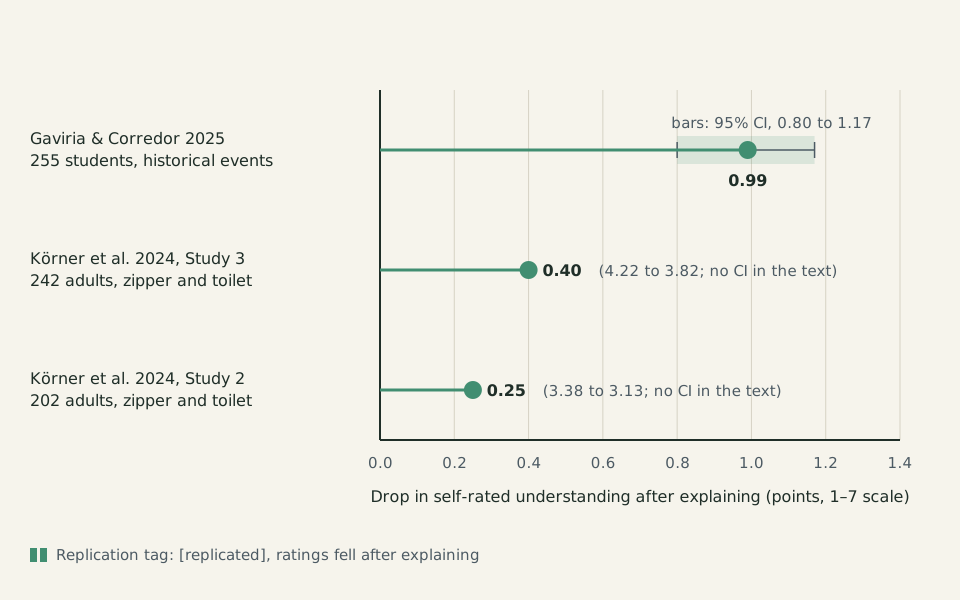
Diagram: Feedback & Forgetting, CC BY 4.0
Copy the credit line
"Drop in self-rated understanding after writing an explanation" by Feedback & Forgetting, https://feedbackandforgetting.com/learning-memory/feynman-technique/, licensed under CC BY 4.0, https://creativecommons.org/licenses/by/4.0/Data: Körner, R., Schütz, A., & Petersen, L.-E. (2024). PLOS ONE 19(4): e0297850, doi:10.1371/journal.pone.0297850, Studies 2 and 3, Results; CC BY 4.0 (https://creativecommons.org/licenses/by/4.0/); drops computed by Feedback & Forgetting; Gaviria, C., & Corredor, J. (2025). Memory & Cognition 53(3): 881–895, doi:10.3758/s13421-024-01616-6, Results; CC BY 4.0 (https://creativecommons.org/licenses/by/4.0/)
How far self-rated understanding fell after writing an explanation, on a 1 to 7 scale, in two papers read in full. The drops for the 2024 studies are this site’s subtraction of the reported means.
In the 2025 study, 255 college students explained the causes of one Colombian historical event. Their ratings fell by 0.99 points on average, with a 95% confidence interval of 0.80 to 1.17. In the first study of the 2024 paper, with 163 participants, ratings fell for devices but showed no significant change for procedures such as cooking pasta, in line with the 2002 abstract.
The size of the drop varied between people. In the 2025 study, students who scored higher on the Cognitive Reflection Test, three arithmetic questions in which the first answer that comes to mind is wrong, judged their understanding more accurately. So did students who had taken university courses on Colombian history.
Replication tag: [replicated] Self-rated understanding fell after writing an explanation: adults (college students in one study, mostly university students in two more, adults aged 18 to 78 in another), everyday devices and causes of historical events, ratings on a 7-point scale in the same session. Based on full text of two later studies by independent teams and the abstract of the 2002 paper. Checked 2026-11-06.
What the drop does not show
The drop is a change in how people judge their own understanding, measured within one session. None of these studies tested whether explaining made people learn more or remember longer. For the technique, that makes the second step the best-supported one: in these studies, writing an explanation reliably lowered people’s ratings of their own understanding.
If your own confidence drops after you try to explain a topic, that is the result these studies would lead you to expect, not a sign that the technique is failing you.
How to try it
The steps below are this page’s version, built from the studies above. They have not been tested as a package, and they do not promise a score.
- Explain it, notes closed. Say or write how the topic works, step by step, in plain words, as if to someone new to it. Writing leaves a record of where you stalled, and in the 2021 study, written and spoken explanations did not differ significantly.
- Mark the gaps. Note each place where you stop, skip a step, or lean on a term you cannot unpack. In the explanatory-depth studies, ratings fell after people wrote the explanation, so the gaps are what the exercise is for.
- Repair, then repeat. Reopen the material for the marked parts only, then explain the whole topic again. This step is this page’s addition; no study read here tested it on its own.
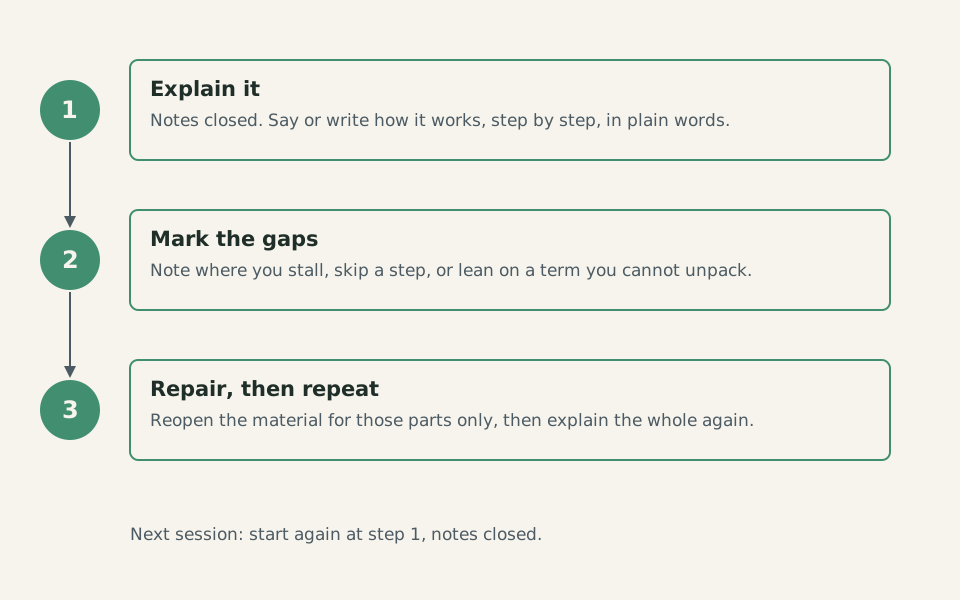
Diagram: Feedback & Forgetting, CC BY 4.0
Copy the credit line
"One session of the Feynman technique in three steps" by Feedback & Forgetting, https://feedbackandforgetting.com/learning-memory/feynman-technique/, licensed under CC BY 4.0, https://creativecommons.org/licenses/by/4.0/One session of the technique as this page describes it. The numbered list above is the text version.
Choose questions of how or why something works. The 2002 abstract reports a much weaker illusion for facts, procedures and stories, and the first 2024 study found no significant drop for procedures, so for a list of dates or the steps of a recipe the technique has less to show you, and a quiz on the material may serve you as well.
If you need the material in a week or a month, come back to step 1 on a later day instead of repeating it the same evening. This site’s spaced repetition review explains why the best gap depends on how far away your test is.
A study routine can spread widely before anyone tests it as a whole. This site’s review of learning styles looks at another popular idea about studying and at which studies ran the right test.
The next time you finish a chapter, close it and write a half-page explanation of its main idea for someone who has not read it. Circle the places where you got stuck, and reread only those parts before you explain it again.
Data: The steps and the studies behind them
| Step | Claim | Study | Value (quoted) | Value (recomputed) | Read as | Status |
|---|---|---|---|---|---|---|
| The name | Chapter titled “Self-Teaching Based on Feynman Technique…” | Sen 2020 | citation only | no tag: citation only | ||
| The name | Review describes students teaching a topic until they understand it | Harahap 2020 | abstract | no tag: a description | ||
| The name | Vocabulary retention better after the program than before | Le Khanh Linh & Pham Thi Kieu Oanh 2025 | 20 students | abstract | [status not assigned] | |
| 1 Explain | “Good” students generated many self-explanations while studying examples | Chi et al. 1989 | abstract | no tag: a comparison of students | ||
| 1 Explain | Self-explanation on instruction gave a greater pretest-to-posttest gain than reading twice | Chi et al. 1994 | 14 vs 10 students | 24 students | abstract | [status not assigned] |
| 1 Explain | Meta-analysis titled “Inducing Self-Explanation” | Bisra et al. 2018 | citation only | no tag: citation only | ||
| 1 Explain | Expecting to teach gave fuller, better organized free recall | Nestojko et al. 2014 | abstract | [status not assigned] | ||
| 1 Explain | Study titled “The relative benefits of learning by teaching and teaching expectancy” | Fiorella & Mayer 2013 | citation only | no tag: citation only | ||
| 1 Explain | Study titled “Role of expectations and explanations in learning by teaching” | Fiorella & Mayer 2014 | citation only | no tag: citation only | ||
| 1 Explain | Explaining did not give significantly better comprehension than retrieving | Jacob, Lachner & Scheiter 2021 | 137 students | full text | [status not assigned] | |
| 2 Mark the gaps | People feel they understand how things work in more depth than they do | Rozenblit & Keil 2002 | abstract | no tag: the tag is on the rating drop below | ||
| 2 Mark the gaps | Self-rated understanding fell after explaining, Study 2 | Körner, Schütz & Petersen 2024 | 3.38 to 3.13 | 0.25 | full text | Replication tag: [replicated] |
| 2 Mark the gaps | Self-rated understanding fell after explaining, Study 3 | Körner, Schütz & Petersen 2024 | 4.22 to 3.82 | 0.40 | full text | Replication tag: [replicated] |
| 2 Mark the gaps | Self-rated understanding fell after explaining | Gaviria & Corredor 2025 | 0.99 (95% CI 0.80 to 1.17) | full text | Replication tag: [replicated] |
Download the data (CSV, feynman-technique-steps.csv) · Where each value comes from (JSON) Data: Körner, R., Schütz, A., & Petersen, L.-E. (2024). PLOS ONE 19(4): e0297850, doi:10.1371/journal.pone.0297850, CC BY 4.0 (https://creativecommons.org/licenses/by/4.0/); Gaviria, C., & Corredor, J. (2025). Memory & Cognition 53(3): 881–895, doi:10.3758/s13421-024-01616-6, CC BY 4.0 (https://creativecommons.org/licenses/by/4.0/); Jacob, L., Lachner, A., & Scheiter, K. (2021). PLOS ONE 16(4): e0250406, doi:10.1371/journal.pone.0250406, CC BY 4.0 (https://creativecommons.org/licenses/by/4.0/); Chi, M. T. H., de Leeuw, N., Chiu, M.-H., & LaVancher, C. (1994). Cognitive Science 18(3): 439–477, doi:10.1207/s15516709cog1803_3, abstract (group sizes quoted); Le Khanh Linh & Pham Thi Kieu Oanh (2025). International Journal of Social Science and Human Research 8(3), doi:10.47191/ijsshr/v8-i3-40, abstract (sample size quoted)
Retrieval check
Answer from memory first, then follow the link to the passage and check.
- Which part of the Feynman technique does research call self-explanation, and what did the 1994 study ask students to do? Back to the passage
- In the explanatory-depth studies, what did people rate, and when did they rate it? Back to the passage
- In the one study read here that compared them, did explaining beat retrieving? Back to the passage · How active recall differs
Sources
- Harahap, A. R. (2020). An Alternative Method Of Online Learning Using The Feynman Technique. Khazanah: Jurnal Mahasiswa, 12(2). doi:10.20885/khazanah.vol12.iss2.art50 https://doi.org/10.20885/khazanah.vol12.iss2.art50
- Sen, S. (2020). Self-Teaching Based on Feynman Technique: A Potential Meta-Cognitive Tool for Teacher Capacity-Building. In Beyond the Blackboard: Emerging Issues in 21st Century Education. Redshine Publication. doi:10.25215/1300103310.01 https://doi.org/10.25215/1300103310.01
- Crossref. Bibliographic search for “Feynman technique”, first 100 records by relevance, 6 November 2026. https://api.crossref.org/works?query.bibliographic=%22Feynman+technique%22&rows=100
- Europe PMC. Search for the phrase “Feynman technique” across titles, abstracts and open-access full texts, 6 November 2026. https://www.ebi.ac.uk/europepmc/webservices/rest/search?query=%22Feynman%20technique%22&format=json
- Le Khanh Linh & Pham Thi Kieu Oanh (2025). Enhancing Grade 10 Students’ Vocabulary Retention Using the Feynman Technique. International Journal of Social Science and Human Research, 8(3). doi:10.47191/ijsshr/v8-i3-40 https://doi.org/10.47191/ijsshr/v8-i3-40
- Chi, M. T. H., Bassok, M., Lewis, M. W., Reimann, P., & Glaser, R. (1989). Self-Explanations: How Students Study and Use Examples in Learning to Solve Problems. Cognitive Science, 13(2), 145–182. doi:10.1207/s15516709cog1302_1 https://doi.org/10.1207/s15516709cog1302_1
- Chi, M. T. H., de Leeuw, N., Chiu, M.-H., & LaVancher, C. (1994). Eliciting Self-Explanations Improves Understanding. Cognitive Science, 18(3), 439–477. doi:10.1207/s15516709cog1803_3 https://doi.org/10.1207/s15516709cog1803_3
- Bisra, K., Liu, Q., Nesbit, J. C., Salimi, F., & Winne, P. H. (2018). Inducing Self-Explanation: a Meta-Analysis. Educational Psychology Review, 30(3), 703–725. doi:10.1007/s10648-018-9434-x https://doi.org/10.1007/s10648-018-9434-x
- Nestojko, J. F., Bui, D. C., Kornell, N., & Bjork, E. L. (2014). Expecting to teach enhances learning and organization of knowledge in free recall of text passages. Memory & Cognition, 42(7), 1038–1048. doi:10.3758/s13421-014-0416-z https://doi.org/10.3758/s13421-014-0416-z
- Fiorella, L., & Mayer, R. E. (2013). The relative benefits of learning by teaching and teaching expectancy. Contemporary Educational Psychology, 38(4), 281–288. doi:10.1016/j.cedpsych.2013.06.001 https://doi.org/10.1016/j.cedpsych.2013.06.001
- Fiorella, L., & Mayer, R. E. (2014). Role of expectations and explanations in learning by teaching. Contemporary Educational Psychology, 39(2), 75–85. doi:10.1016/j.cedpsych.2014.01.001 https://doi.org/10.1016/j.cedpsych.2014.01.001
- Jacob, L., Lachner, A., & Scheiter, K. (2021). Does increasing social presence enhance the effectiveness of writing explanations? PLOS ONE, 16(4), e0250406. doi:10.1371/journal.pone.0250406 https://doi.org/10.1371/journal.pone.0250406
- Rozenblit, L., & Keil, F. (2002). The misunderstood limits of folk science: an illusion of explanatory depth. Cognitive Science, 26(5), 521–562. doi:10.1207/s15516709cog2605_1 https://doi.org/10.1207/s15516709cog2605_1
- Körner, R., Schütz, A., & Petersen, L.-E. (2024). “It doesn’t matter if you are in charge of the trees, you always miss the trees for the forest”: Power and the illusion of explanatory depth. PLOS ONE, 19(4), e0297850. doi:10.1371/journal.pone.0297850 https://doi.org/10.1371/journal.pone.0297850
- Gaviria, C., & Corredor, J. (2025). Understanding, fast and shallow: Individual differences in memory performance associated with cognitive load predict the illusion of explanatory depth. Memory & Cognition, 53(3), 881–895. doi:10.3758/s13421-024-01616-6 https://doi.org/10.3758/s13421-024-01616-6
- Crossref. Work records and update searches (corrections, retractions, expressions of concern) for doi:10.20885/khazanah.vol12.iss2.art50, doi:10.25215/1300103310.01, doi:10.47191/ijsshr/v8-i3-40, doi:10.1207/s15516709cog1302_1, doi:10.1207/s15516709cog1803_3, doi:10.1007/s10648-018-9434-x, doi:10.3758/s13421-014-0416-z, doi:10.1016/j.cedpsych.2013.06.001, doi:10.1016/j.cedpsych.2014.01.001, doi:10.1371/journal.pone.0250406, doi:10.1207/s15516709cog2605_1, doi:10.1371/journal.pone.0297850 and doi:10.3758/s13421-024-01616-6. https://api.crossref.org/works?filter=updates:10.1207/s15516709cog2605_1
Cite this page
Feedback & Forgetting. (2026-11-06). Feynman Technique: Its Parts Were Studied Under Other Names. https://feedbackandforgetting.com/learning-memory/feynman-technique/ (accessed [date you read it])
No DOI is assigned to this page; cite the address above with the date you read it.
Related reading
-
Learning & Memory
Forgetting Curve: It Measured Relearning, Not Recall
Picture credit
"Zeitschrift fur Psychologie, 1909: Herman Ebbinghaus" by Wellcome Collection — https://commons.wikimedia.org/wiki/File:Zeitschrift_fur_Psychologie,_1909;_Herman_Ebbinghaus._Wellcome_L0003734.jpg — CC BY 4.0 (https://creativecommons.org/licenses/by/4.0/); modifications: cropped mount, padded
-

Learning & Memory
Spaced Repetition: Should Review Gaps Grow? Studies Disagree
Picture credit
Illustration: Feedback & Forgetting. Generated schematic illustration — not a photograph or historical record. © Feedback & Forgetting, all rights reserved.
-

Learning & Memory
Active Recall: Quizzing Beat Rereading Later in a 2006 Study
Picture credit
"Mental Arithmetic. In Public School of S. A. Rachinsky" by Nikolay Bogdanov-Belsky — https://commons.wikimedia.org/wiki/File:Bogdanov-Belsky_Ustny_Schet_(Tretyakov).jpg — Public domain (PD-Art; painter d. 1945 (EU: from 2016; US: published before 1931, per the Commons file page)); modifications: cropped