Door-in-the-Face and 5 Other Classic Studies: Which Held Up?
Comparison index Feedback & Forgetting Published
Short answer. The door-in-the-face technique opens with a large request that is likely to be refused, then retreats to a smaller one, the request that was wanted all along. In a 2021 direct replication of a 1975 study, people who had turned down an extreme request agreed to a smaller target request more often than people asked only the target request, according to the replication's abstract, which gives no rates. The table below sets door-in-the-face beside five other classic compliance and conformity studies and the later tests that could be read for this page; two of the six rows could be given a replication tag.
In one sentence: Six classic compliance and conformity studies, each set beside the later tests that could be read: the reruns did not all come out the same way.
Outline4 sections
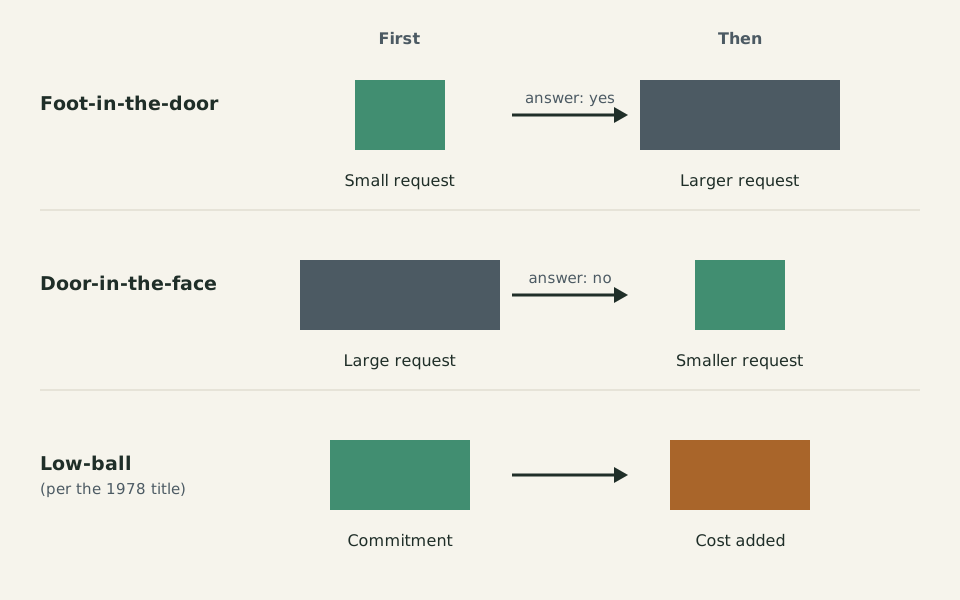
Diagram: Feedback & Forgetting, CC BY 4.0
Copy the credit line
"Three sequential request techniques" by Feedback & Forgetting, https://feedbackandforgetting.com/influence-persuasion/persuasion-classics/, licensed under CC BY 4.0, https://creativecommons.org/licenses/by/4.0/Figure 1. Three sequential request techniques from the table below. Door-in-the-face and foot-in-the-door run in opposite directions; the low-ball order follows the title of the 1978 paper, whose abstract could not be read.
A team led by Oliver Genschow reran a 1975 door-in-the-face study on another continent and published it in 2021. By their abstract, compliance came out about as high as it had in the 1975 study. That is one classic and one rerun. The rest of this page sets the other famous compliance and conformity studies beside the later tests that could be read, and asks how each looks.
Door-in-the-face technique: the 1975 study and the 2021 rerun
The technique has two steps. First comes a request so large that it is likely to be refused. Then the asker retreats to a smaller one, the target request. A 1975 paper by Robert Cialdini and five colleagues named the procedure in its title: “Reciprocal concessions procedure for inducing compliance: The door-in-the-face technique.” Only the citation record of that paper could be read here, so its requests and its numbers are not described on this page.
The 2021 replication by Genschow and six colleagues fills part of that gap. By its abstract, the team compared three groups: people who turned down an extreme request before hearing the target request, people who heard only the target request, and people who got a similarly small request first. Those who had refused the extreme request were the likeliest to agree. The abstract gives no rates, group sizes or intervals.
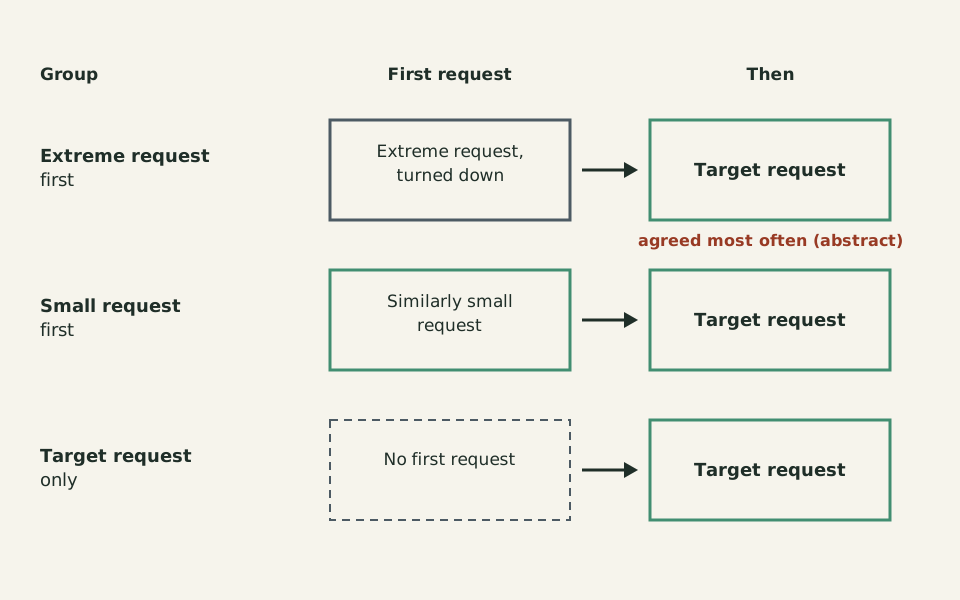
Diagram: Feedback & Forgetting, CC BY 4.0
Copy the credit line
"Design of the 2021 door-in-the-face replication" by Feedback & Forgetting, https://feedbackandforgetting.com/influence-persuasion/persuasion-classics/, licensed under CC BY 4.0, https://creativecommons.org/licenses/by/4.0/Figure 2. The three groups of the 2021 direct replication, as its abstract describes them. The abstract reports which group agreed most often but gives no rates, so no bars are drawn.
The 1975 title names the proposed explanation: a concession by the asker is met by a concession in return. The 2021 team set out to test that idea, and their abstract reads the results as support for the role of reciprocity norms. That reading is the authors' own. Reciprocity has a longer research line, including a 1971 paper by Dennis Regan titled “Effects of a favor and liking on compliance,” read here only as a citation.
[status not assigned] Turning down an extreme request first raised agreement with a smaller target request: one direct replication (2021) of a 1975 study, delay not stated. The abstract reports no rates, sample sizes or intervals, so its precision cannot be judged, and the 1975 paper was read as a citation only. Based on the abstract. Checked 2026-11-06.
Timing may matter. In a 1975 field experiment by Arnie Cann, Steven Sherman and Roy Elkes, refusing a large request was followed by more agreement when the smaller request came right away; when it came 7 to 10 days later, the refusal carried over instead, by their abstract.
[status not assigned] A refused large request followed at once by a smaller one raised agreement in one 2 x 2 field experiment. Abstract-level evidence only. Checked 2026-11-06.
A 2012 meta-analysis by Thomas Hugh Feeley, Ashley Anker and Ariel Aloe is titled “The Door-in-the-Face Persuasive Message Strategy: A Meta-Analysis of the First 35 Years.” Its abstract could not be read, so this page takes no result from it.
The table
Each row is one classic. The status column gives this site's replication tag where the evidence read allows one, and the reason where it does not.
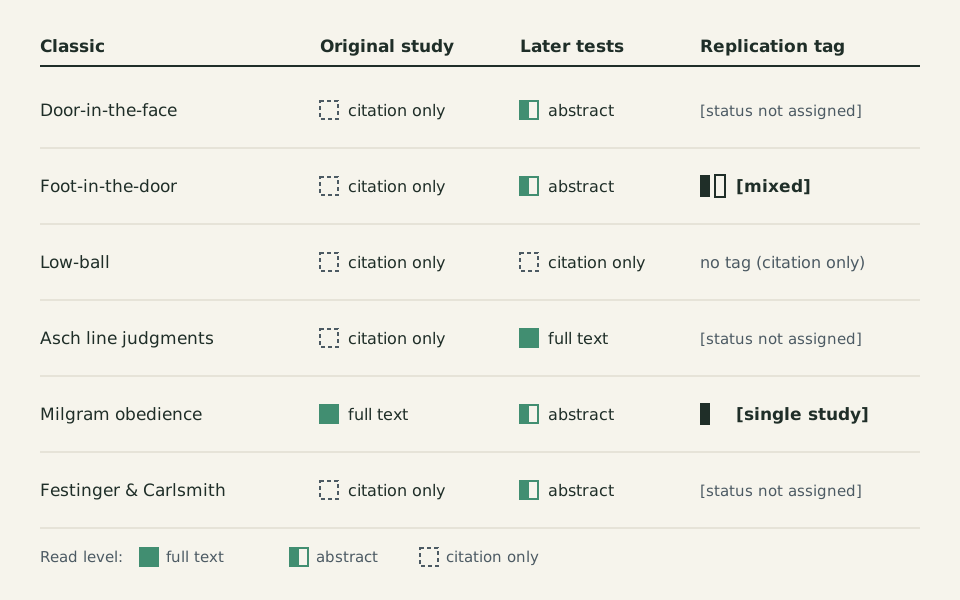
Diagram: Feedback & Forgetting, CC BY 4.0
Copy the credit line
"Six persuasion classics by read level and replication tag" by Feedback & Forgetting, https://feedbackandforgetting.com/influence-persuasion/persuasion-classics/, licensed under CC BY 4.0, https://creativecommons.org/licenses/by/4.0/Figure 3. The six classics on this page, with how much of the original study and of the later tests could be read. The table below holds the same information as text.
| Classic | Original study, as read | Later tests read here | Status, checked 2026-11-06 |
|---|---|---|---|
| Door-in-the-face | Cialdini et al. 1975: citation only | Genschow et al. 2021 direct replication: compliance about as high as in 1975, no rates given (abstract) | [status not assigned] one rerun, abstract-level evidence |
| Foot-in-the-door | Freedman & Fraser 1966: citation only | 1975 telephone study, 51.9% vs 33.3% agreed; not shown for giving blood (1979); not significant in a 2013 direct replication (abstracts) | Replication tag: [mixed] some field studies, not others; based on abstracts |
| Low-ball | Cialdini et al. 1978: citation only | Burger & Caputo 2015 meta-analysis: citation only | No tag: citation only |
| Asch line judgments | Asch 1956: citation only | Franzen & Mader 2023, 99 students in Bern without payment for accuracy: wrong answers on 33% of critical trials (full text) | [status not assigned] original known only as described by the 2023 authors |
| Milgram obedience | Milgram's program as tabulated by Haslam et al. 2014: 2.5% to 92.5% went on to 450 volts across 21 versions (full text) | Burger 2009 stopped at 150 volts; Doliński et al. 2017 used Burger's procedure; neither abstract gives rates | Replication tag: [single study] no full rerun to 450 volts read; based on full text and abstracts |
| Festinger & Carlsmith | Festinger & Carlsmith 1959: citation only | Vaidis et al. 2024 multilab replication of the induced-compliance paradigm, based on a 1983 study: high vs low choice not significant (abstract) | [status not assigned] abstract-level evidence; the rerun followed a 1983 study, not the 1959 one |
The foot-in-the-door row follows this site's foot-in-the-door review, where the 1966 paper could be read only as a citation and the later tests split by setting.
The low-ball row has titles and nothing more. The 1978 paper by Cialdini and three colleagues and a 2015 meta-analysis by Jerry Burger and Deanna Caputo were read only as citations, so that row carries no result.
For the Asch row, Axel Franzen and Sebastian Mader describe the original work: citing a 1955 report by Solomon Asch, they give wrong answers on 36.8% of critical trials among 123 participants. In their own group that was not paid per correct answer, people gave wrong answers on 33% of critical trials, so most answers in that group stayed correct. The tag is left open because the original could be checked only through their description.
A 1996 meta-analysis by Rod Bond and Peter Smith of studies using Asch's line task was read only as a citation, so no result is taken from it.
The Milgram row's counts come from the 21 versions compared by Nick Haslam, Steve Loughnan and Gina Perry: 1 of 40 to 37 of 40 went on to 450 volts in what were presented as shocks, 323 of 740 overall. This site's Milgram study file lists every version.
In the last row, the 1959 paper by Leon Festinger and James Carlsmith, “Cognitive consequences of forced compliance,” was read only as a citation. A 2024 multilab replication led by David Vaidis was based on a 1983 study by Croyle and Cooper rather than on the 1959 one; by its abstract, attitudes after writing an essay against one's own view did not differ significantly between high choice and low choice.
How to read a replication tag
A tag goes on a specific claim, with its scope and the date it was checked, never on the bare name of an effect. The tags are tried in a fixed order, and the first one that fits is used.
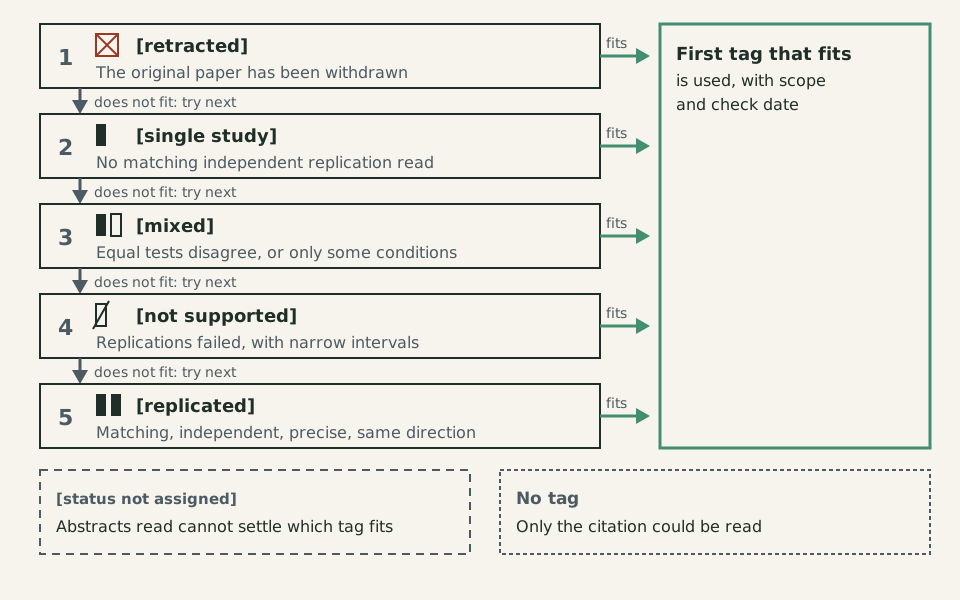
Diagram: Feedback & Forgetting, CC BY 4.0
Copy the credit line
"Order in which replication tags are tried" by Feedback & Forgetting, https://feedbackandforgetting.com/influence-persuasion/persuasion-classics/, licensed under CC BY 4.0, https://creativecommons.org/licenses/by/4.0/Figure 4. The order in which this site tries its five replication tags, with the two outcomes that give no tag. The list below holds the same steps as text.
- Retracted: the original paper has been withdrawn.
- Single study: no matching independent replication has been read.
- Mixed: equally good tests disagree, or the effect appears only under some conditions.
- Not supported: suitable replications failed, with intervals narrow enough to rule out an effect that matters.
- Replicated: a matching, independent, peer-reviewed replication with enough precision found the same direction.
- Status not assigned: the abstracts read cannot settle which of these fits. Claims read only as citations get no tag at all.
That order explains the table. The Milgram row stops at single study because no rerun that went to 450 volts was read. Foot-in-the-door is mixed: the effect showed up in some settings and not others. Door-in-the-face does not reach replicated, because an abstract with no rates cannot show the precision step 5 asks for. This site's learning myths scorecard applies the same tags to study-habit claims.
Requests in sequence
Three of the six classics are sequences of requests. Foot-in-the-door asks small, then larger; door-in-the-face asks large, then smaller, so the two run in opposite directions. Low-ball, going by the 1978 title, gets a commitment first and brings in the cost after.

Illustration: Feedback & Forgetting. Generated schematic illustration — not a photograph or historical record. © Feedback & Forgetting, all rights reserved.
Three doors in a row, for requests made in sequence: foot-in-the-door asks small, then larger, and door-in-the-face asks large, then smaller. A scene illustration; how far each door is open stands for order, not for any rate.
Which order works better is not settled by what could be read here. A 2005 meta-analysis by Alexandre Pascual and Nicolas Guéguen pooled 22 foot-in-the-door and 22 door-in-the-face studies that compared the two with a similar target request. Its abstract reports no significant difference, which is not the same as a tie.
[status not assigned] Foot-in-the-door and door-in-the-face, compared head to head with similar target requests. Abstract-level evidence only; no effect sizes or confidence intervals in the abstract. Checked 2026-11-06.
Spotting the pattern does not mean calling it a trick; an honest request can also be scaled down after a no. Noticing it matters because the smaller request deserves its own decision.
The next time a large request you turn down is followed at once by a smaller one, notice the retreat, and weigh the smaller request as if it were the first thing you had been asked.
Data: Values quoted in the persuasion classics table
| Study | What the number is | Value (quoted) | Share, % (recomputed) | Read as |
|---|---|---|---|---|
| Snyder & Cunningham 1975 | Agreed after a small first request | 0.519 | 51.9 | abstract |
| Snyder & Cunningham 1975 | Agreed with no first request | 0.333 | 33.3 | abstract |
| Cann, Sherman & Elkes 1975 | Delay before the later request, days | 7 to 10 | abstract | |
| Pascual & Guéguen 2005 | Studies pooled, each technique | 22 | abstract | |
| Asch 1955, as reported by Franzen & Mader 2023 | Wrong answers on critical trials (as reported) | 36.8% (123 participants) | full text | |
| Franzen & Mader 2023 | Wrong answers on critical trials, group not paid per correct answer | 33% (99 participants) | full text | |
| Haslam, Loughnan & Perry 2014 | Went on to 450 volts, lowest version | 1 of 40 | 2.5 | full text |
| Haslam, Loughnan & Perry 2014 | Went on to 450 volts, highest version | 37 of 40 | 92.5 | full text |
| Haslam, Loughnan & Perry 2014 | Went on to 450 volts, all 21 versions | 323 of 740 | 43.6 | full text |
| Burger 2009 | Highest level reached, volts | 150 | abstract |
Download the data (CSV, persuasion-classics.csv) · Where each value comes from (JSON) Data: Franzen, A., & Mader, S. (2023). The power of social influence: A replication and extension of the Asch experiment. PLOS ONE 18(11): e0294325, doi:10.1371/journal.pone.0294325, CC BY 4.0 (https://creativecommons.org/licenses/by/4.0/); Haslam, N., Loughnan, S., & Perry, G. (2014). Meta-Milgram: An empirical synthesis of the obedience experiments. PLOS ONE 9(4): e93927, doi:10.1371/journal.pone.0093927, CC BY 4.0 (https://creativecommons.org/licenses/by/4.0/); Genschow et al. (2021), doi:10.1037/pspa0000261; Snyder & Cunningham (1975), doi:10.1037/h0076245; Cann, Sherman & Elkes (1975), doi:10.1037/0022-3514.32.5.774; Foss & Dempsey (1979), doi:10.1037/0022-3514.37.4.580; Burger (1999), doi:10.1207/s15327957pspr0304_2; Arnold & Kaiser (2018), doi:10.1002/ijop.12289 (abstracts; quoted values, publishers' terms apply); Gamian-Wilk & Dolinski (2020), doi:10.1177/0033294119872208; Pascual & Guéguen (2005), doi:10.2466/pr0.96.1.122-128; Burger (2009), doi:10.1037/a0010932; Doliński et al. (2017), doi:10.1177/1948550617693060 (abstracts; quoted values, publishers' terms apply)
Retrieval check
Answer from memory first, then follow the link to the passage and check.
- Which two techniques in the table run their requests in opposite orders? Back to the passage · The small-first order, followed through its later tests
- In the 2023 rerun of Asch's line task, did most answers in the group not paid per correct answer go with the wrong majority or stay correct? Back to the passage
- Which row's multilab rerun used a different version of the procedure from the original, and what did its abstract report? Back to the passage
Sources
- Genschow, O., Westfal, M., Crusius, J., Bartosch, L., Feikes, K. I., Pallasch, N., & Wozniak, M. (2021). Does social psychology persist over half a century? A direct replication of Cialdini et al.’s (1975) classic door-in-the-face technique. Journal of Personality and Social Psychology, 120(2), e1–e7. doi:10.1037/pspa0000261 https://doi.org/10.1037/pspa0000261
- Cialdini, R. B., Vincent, J. E., Lewis, S. K., Catalan, J., Wheeler, D., & Darby, B. L. (1975). Reciprocal concessions procedure for inducing compliance: The door-in-the-face technique. Journal of Personality and Social Psychology, 31(2), 206–215. doi:10.1037/h0076284 https://doi.org/10.1037/h0076284
- Regan, D. T. (1971). Effects of a favor and liking on compliance. Journal of Experimental Social Psychology, 7(6), 627–639. doi:10.1016/0022-1031(71)90025-4 https://doi.org/10.1016/0022-1031(71)90025-4
- Cann, A., Sherman, S. J., & Elkes, R. (1975). Effects of initial request size and timing of a second request on compliance: The foot in the door and the door in the face. Journal of Personality and Social Psychology, 32(5), 774–782. doi:10.1037/0022-3514.32.5.774 https://doi.org/10.1037/0022-3514.32.5.774
- Feeley, T. H., Anker, A. E., & Aloe, A. M. (2012). The door-in-the-face persuasive message strategy: A meta-analysis of the first 35 years. Communication Monographs, 79(3), 316–343. doi:10.1080/03637751.2012.697631 https://doi.org/10.1080/03637751.2012.697631
- Freedman, J. L., & Fraser, S. C. (1966). Compliance without pressure: The foot-in-the-door technique. Journal of Personality and Social Psychology, 4(2), 195–202. doi:10.1037/h0023552 https://doi.org/10.1037/h0023552
- Snyder, M., & Cunningham, M. R. (1975). To comply or not comply: Testing the self-perception explanation of the "foot-in-the-door" phenomenon. Journal of Personality and Social Psychology, 31(1), 64–67. doi:10.1037/h0076245 https://doi.org/10.1037/h0076245
- Foss, R. D., & Dempsey, C. B. (1979). Blood donation and the foot-in-the-door technique: A limiting case. Journal of Personality and Social Psychology, 37(4), 580–590. doi:10.1037/0022-3514.37.4.580 https://doi.org/10.1037/0022-3514.37.4.580
- Gamian-Wilk, M., & Dolinski, D. (2020). The foot-in-the-door phenomenon 40 and 50 years later: A direct replication of the original Freedman and Fraser study in Poland and in Ukraine. Psychological Reports, 123(6), 2582–2596. doi:10.1177/0033294119872208 https://doi.org/10.1177/0033294119872208
- Burger, J. M. (1999). The foot-in-the-door compliance procedure: A multiple-process analysis and review. Personality and Social Psychology Review, 3(4), 303–325. doi:10.1207/s15327957pspr0304_2 https://doi.org/10.1207/s15327957pspr0304_2
- Arnold, O., & Kaiser, F. G. (2018). Understanding the foot-in-the-door effect as a pseudo-effect from the perspective of the Campbell paradigm. International Journal of Psychology, 53(2), 157–165. doi:10.1002/ijop.12289 https://doi.org/10.1002/ijop.12289
- Cialdini, R. B., Cacioppo, J. T., Bassett, R., & Miller, J. A. (1978). Low-ball procedure for producing compliance: Commitment then cost. Journal of Personality and Social Psychology, 36(5), 463–476. doi:10.1037/0022-3514.36.5.463 https://doi.org/10.1037/0022-3514.36.5.463
- Burger, J. M., & Caputo, D. (2015). The low-ball compliance procedure: A meta-analysis. Social Influence, 10(4), 214–220. doi:10.1080/15534510.2015.1049203 https://doi.org/10.1080/15534510.2015.1049203
- Asch, S. E. (1956). Studies of independence and conformity: I. A minority of one against a unanimous majority. Psychological Monographs: General and Applied, 70(9), 1–70. doi:10.1037/h0093718 https://doi.org/10.1037/h0093718
- Franzen, A., & Mader, S. (2023). The power of social influence: A replication and extension of the Asch experiment. PLOS ONE, 18(11), e0294325. doi:10.1371/journal.pone.0294325 https://doi.org/10.1371/journal.pone.0294325
- Bond, R., & Smith, P. B. (1996). Culture and conformity: A meta-analysis of studies using Asch's (1952b, 1956) line judgment task. Psychological Bulletin, 119(1), 111–137. doi:10.1037/0033-2909.119.1.111 https://doi.org/10.1037/0033-2909.119.1.111
- Haslam, N., Loughnan, S., & Perry, G. (2014). Meta-Milgram: An empirical synthesis of the obedience experiments. PLOS ONE, 9(4), e93927. doi:10.1371/journal.pone.0093927 https://doi.org/10.1371/journal.pone.0093927
- Milgram, S. (1963). Behavioral study of obedience. The Journal of Abnormal and Social Psychology, 67(4), 371–378. doi:10.1037/h0040525 https://doi.org/10.1037/h0040525
- Burger, J. M. (2009). Replicating Milgram: Would people still obey today? American Psychologist, 64(1), 1–11. doi:10.1037/a0010932 https://doi.org/10.1037/a0010932
- Doliński, D., Grzyb, T., Folwarczny, M., Grzybała, P., Krzyszycha, K., Martynowska, K., & Trojanowski, J. (2017). Would you deliver an electric shock in 2015? Obedience in the experimental paradigm developed by Stanley Milgram in the 50 years following the original studies. Social Psychological and Personality Science, 8(8), 927–933. doi:10.1177/1948550617693060 https://doi.org/10.1177/1948550617693060
- Festinger, L., & Carlsmith, J. M. (1959). Cognitive consequences of forced compliance. The Journal of Abnormal and Social Psychology, 58(2), 203–210. doi:10.1037/h0041593 https://doi.org/10.1037/h0041593
- Vaidis, D. C., Sleegers, W. W. A., van Leeuwen, F., DeMarree, K. G., Sætrevik, B., Ross, R. M., Schmidt, K., Protzko, J., Morvinski, C., et al. (2024). A multilab replication of the induced-compliance paradigm of cognitive dissonance. Advances in Methods and Practices in Psychological Science, 7(1), 25152459231213375. doi:10.1177/25152459231213375 https://doi.org/10.1177/25152459231213375
- Pascual, A., & Guéguen, N. (2005). Foot-in-the-door and door-in-the-face: A comparative meta-analytic study. Psychological Reports, 96(1), 122–128. doi:10.2466/pr0.96.1.122-128 https://doi.org/10.2466/pr0.96.1.122-128
- Crossref. Work records and update searches (corrections, retractions, expressions of concern) for the 23 DOIs cited on this page and in its data file. https://api.crossref.org/works?filter=updates:10.1037/pspa0000261
Cite this page
Feedback & Forgetting. (2026-11-06). Door-in-the-Face and 5 Other Classic Studies: Which Held Up?. https://feedbackandforgetting.com/influence-persuasion/persuasion-classics/ (accessed [date you read it])
No DOI is assigned to this page; cite the address above with the date you read it.
Related reading
-
Influence & Persuasion
Foot-in-the-Door Technique: Later Tests Gave Mixed Results
Picture credit
Illustration: Feedback & Forgetting. Generated schematic illustration — not a photograph or historical record. © Feedback & Forgetting, all rights reserved.
-

Influence & Persuasion
Milgram Experiment: Obedience Ranged Widely Across Versions
Picture credit
Illustration: Feedback & Forgetting. Generated schematic illustration — not a photograph or historical record. © Feedback & Forgetting, all rights reserved.