Foot-in-the-Door Technique: Later Tests Gave Mixed Results
Method deep read Feedback & Forgetting Published
Short answer. The foot-in-the-door technique is a two-step request: first a small favor, then a larger one. In a 1975 telephone study by Mark Snyder and Michael Cunningham, 51.9% of people first asked to answer 8 survey questions later agreed to answer 30 for a different organization, against 33.3% of people with no first request, according to the paper's abstract. Later tests were mixed: by their abstract, three experiments on giving blood did not show an effect, and a 2013 direct replication in Poland and Ukraine found no significant one.
In one sentence: Saying yes to a small request made people likelier to say yes to a bigger one in some studies; this page shows which later tests repeated it and which did not.
Outline5 sections
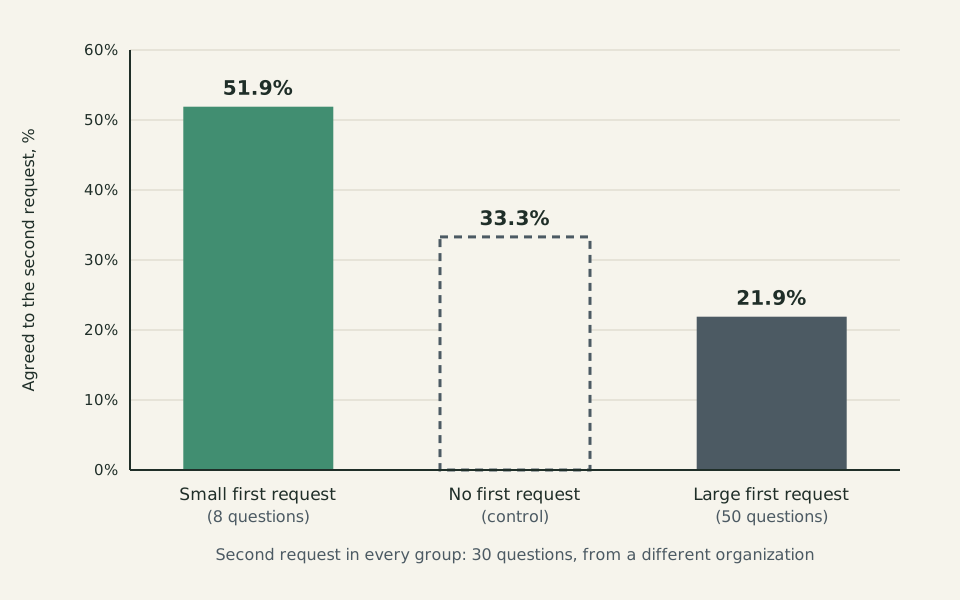
Diagram: Feedback & Forgetting, CC BY 4.0
Copy the credit line
"Agreement with a 30-question request after a small, a large or no first request" by Feedback & Forgetting, https://feedbackandforgetting.com/influence-persuasion/foot-in-the-door/, licensed under CC BY 4.0, https://creativecommons.org/licenses/by/4.0/Data: Snyder, M., & Cunningham, M. R. (1975). To comply or not comply: Testing the self-perception explanation of the "foot-in-the-door" phenomenon. Journal of Personality and Social Psychology 31(1), 64–67, doi:10.1037/h0076245, abstract (quoted proportions; publisher's terms apply)
Figure 1. Share of people who agreed to answer 30 questions for a public service organization, by what they had been asked first. The values are the proportions printed in the abstract of Snyder and Cunningham (1975); the abstract gives no group sizes, so no error bars are drawn.
Picture yourself in a 1975 field experiment: a caller asks you to answer eight questions for a telephone survey. The researchers sized that request so a yes is all but certain. Later, someone from a different public service organization asks you to answer 30 questions. The question for this page is whether that first small yes makes you likelier to agree to the bigger request, and how well the answer has held up.
The technique already had a name by then. A 1966 paper by Jonathan Freedman and Scott Fraser in the Journal of Personality and Social Psychology is titled “Compliance without pressure: The foot-in-the-door technique.” This page could read only that paper's citation record, not its abstract or its text, so its experiments and its numbers are not described here. The studies below are the ones whose abstracts could be read.
What did the 1975 telephone study ask?
Mark Snyder and Michael Cunningham set out to test one explanation of the foot-in-the-door effect: self-perception. They split people into three groups. One group was first asked to answer 8 questions in a telephone survey, a request sized so that agreement was all but certain. A second group was first asked to answer 50 questions, sized the other way, so that refusal was all but certain.
A third group, the control, got no first request at all. Then all three groups were asked to answer 30 questions, and this time the request came from a different public service organization. The people asking the second time were not the ones who had just been helped.
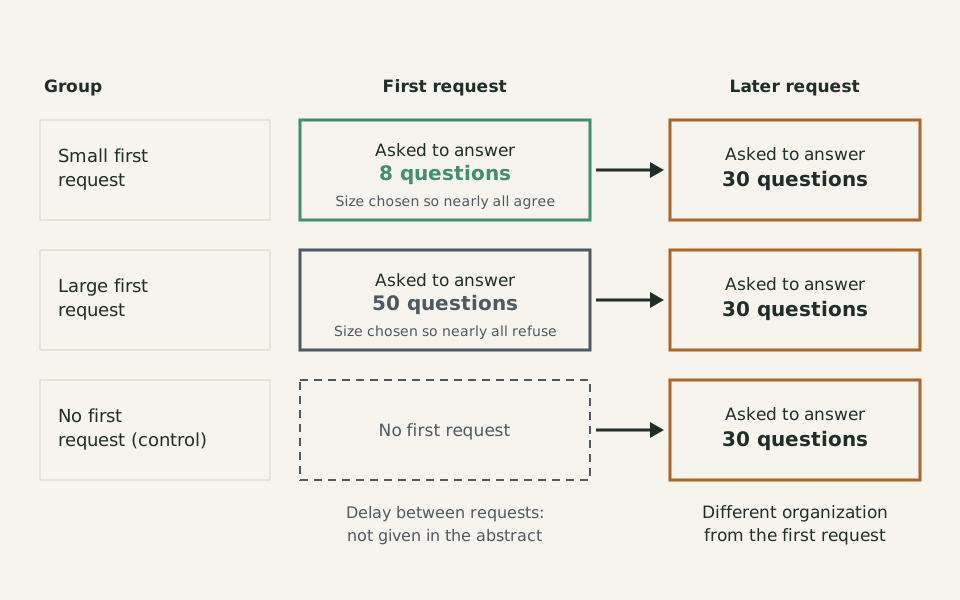
Diagram: Feedback & Forgetting, CC BY 4.0
Copy the credit line
"Design of the 1975 telephone study" by Feedback & Forgetting, https://feedbackandforgetting.com/influence-persuasion/foot-in-the-door/, licensed under CC BY 4.0, https://creativecommons.org/licenses/by/4.0/Figure 2. The three groups in the 1975 telephone study, drawn from the paper's abstract. The later request came from a different public service organization than the first. The abstract does not say how long the gap between the two requests was.
The abstract leaves out several things you would want to know: the number of people in each group, who they were, and how many days passed between the two requests. Nor does it report a test of statistical significance. Those details sit in the full paper, which this page could not read.
How big was the difference?
In the small-first-request group, 51.9% agreed to the 30-question request. The control group came in at 33.3%, a gap of 18.6 percentage points. Among people given the large first request, only 21.9% agreed, 11.4 points below the control.
Replication tag: [single study] A small first request raised agreement with a larger request from a different organization: people reached by telephone, 8 then 30 survey questions, delay not stated. No matched replication with a different requester was found among the abstracts read. Based on the abstract. Checked 2026-11-06.
The large-request result points the other way. A big first request, sized to be refused, was followed by less agreement later, not more. Keep that in mind for the section on door-in-the-face, where a refused request is supposed to help.
What can three percentages tell you?
Put as a ratio, 51.9% is about 1.56 times 33.3%. In percentage points the gap is 18.6. Both numbers describe the same two groups, and neither tells you how sure to be about the gap. A ratio can make a gap sound bigger when the starting share is low, while points keep the starting share in view.
To judge that, you need the number of people in each group. How far chance alone could move a gap of this size depends on those group sizes. The abstract does not give them, so Figure 1 has no error bars and this page reports no confidence interval.
There is a second limit. One telephone study shows what happened with one kind of request, asked by one set of researchers at one time. The later studies on this page try to answer whether the same pattern holds for other requests and other places.
Why might a small yes matter?
Snyder and Cunningham framed their study around self-perception theory. On this account, when you agree to a small request you start to see yourself as someone who helps with such things, and that self-image carries over. Their abstract says the results came out as that theory predicted.
The design made the test sharper, because the theory predicts movement in both directions: agreeing should push later agreement up, and refusing should push it down. By the abstract, both happened. A result that fits a prediction is still not proof that the predicted process caused it.
The same year, Arnie Cann, Steven Sherman and Roy Elkes ran a field experiment that crossed two factors. People either agreed to a small first request or refused a large one, and the moderate second request came either at once or 7 to 10 days later. By their abstract, three of the four groups fit a self-perception account, with the first response carrying over to the second. The odd one out, a large request followed at once by a smaller one, fit a bargaining account instead.
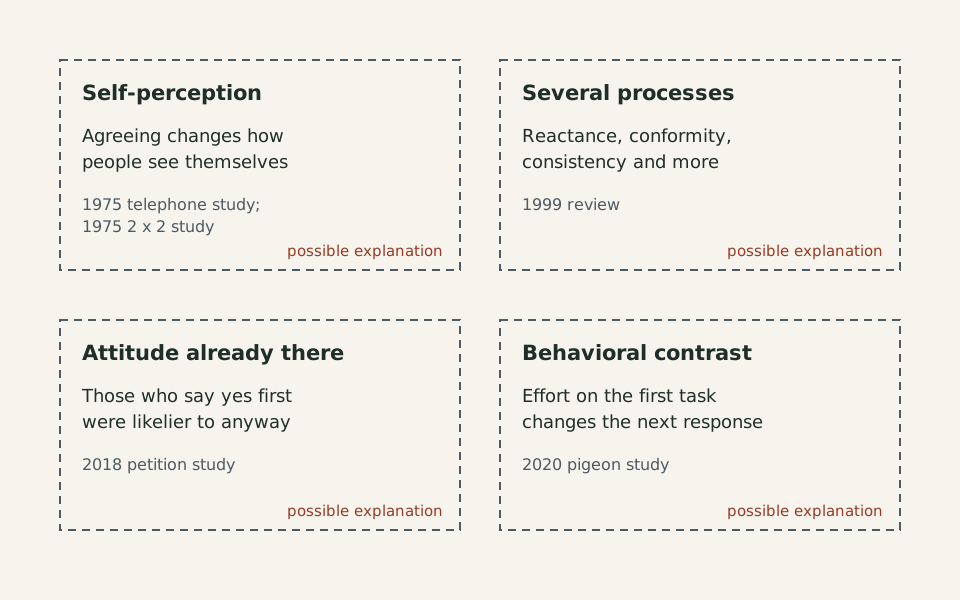
Diagram: Feedback & Forgetting, CC BY 4.0
Copy the credit line
"Four proposed explanations for the foot-in-the-door effect" by Feedback & Forgetting, https://feedbackandforgetting.com/influence-persuasion/foot-in-the-door/, licensed under CC BY 4.0, https://creativecommons.org/licenses/by/4.0/Figure 3. Four explanations proposed in the studies read for this page, each marked as a possible explanation. The studies read here do not settle which one, if any, is the cause.
A 1999 review by Jerry Burger did not pick a single winner. Its abstract names six processes that can shape compliance after a first request: self-perception, psychological reactance, conformity, consistency, attributions and commitment. Burger argued that these processes, acting together, can account both for studies where the technique worked and for studies where it failed or even lowered compliance.
Two later studies offer different readings again. Oliver Arnold and Florian Kaiser randomly assigned 229 people either to be asked to sign a pro-environmental petition or to a control group. Those who complied with the petition were likelier to agree to a bigger request, but the authors found no drop in the request's cost and no rise in attitude. They suggest the people who signed already held stronger attitudes, which would make some reported foot-in-the-door effects pseudo-effects rather than effects of the first request.
In a 2020 study with pigeons, Bartonicek and Colombo reported in their abstract that the birds' delay before responding to an effortful second task scaled with the effort the first task had taken. The authors proposed behavioral contrast, not self-image, as the explanation.
The four ideas point to different checks. Self-perception expects the first answer, yes or no, to carry over, and the 1975 telephone results in both directions fit that. The 2018 account points instead to who says yes in the first place; behavioral contrast was proposed from pigeon data and, among the studies read here, was not tested in people. Treat all four as possible explanations; the studies read here do not settle which one, if any, drives the effect in people.
Has the foot-in-the-door effect been replicated?
Two early papers are titled as meta-analyses. One, led by Arthur Beaman in 1983, is titled “Fifteen years of foot-in-the-door research: A meta-analysis.” The other, by James Dillard, John Hunter and Michael Burgoon in 1984, is titled “Sequential-request persuasive strategies: Meta-analysis of foot-in-the-door and door-in-the-face.” Neither abstract could be read, so this page takes no results from them.
Burger's 1999 review is the overview whose abstract could be read. It says relevant investigations and several meta-analyses support the processes it lists, and that the technique was ineffective in some studies and lowered compliance in others. The abstract also says the review identifies the conditions under which the effect is likeliest, without listing them.
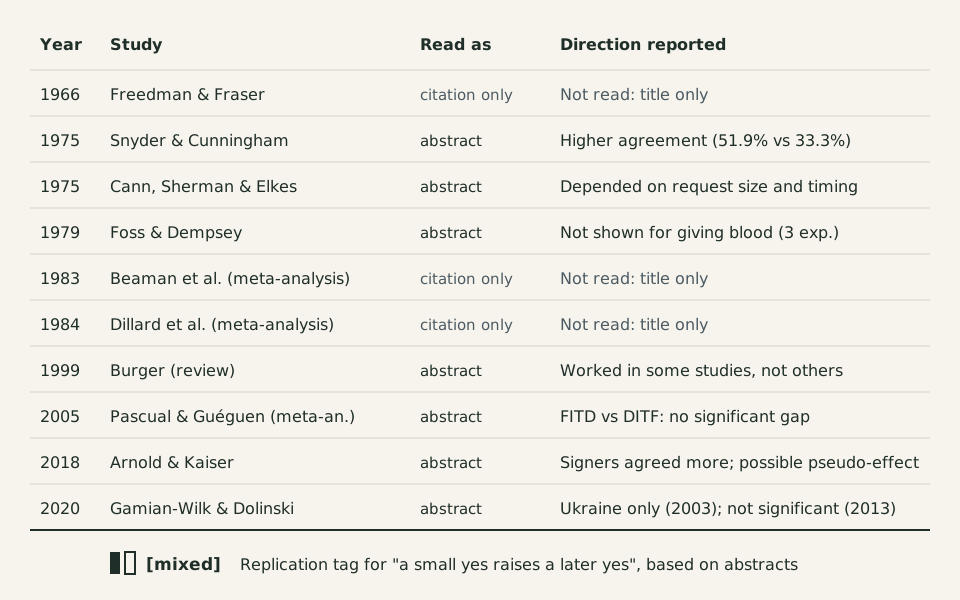
Diagram: Feedback & Forgetting, CC BY 4.0
Copy the credit line
"Foot-in-the-door evidence ledger, 1966 to 2020" by Feedback & Forgetting, https://feedbackandforgetting.com/influence-persuasion/foot-in-the-door/, licensed under CC BY 4.0, https://creativecommons.org/licenses/by/4.0/Figure 4. The foot-in-the-door evidence read for this page, by year, with how much of each source could be read and the direction its abstract reports. The table under Data at the end of the page holds the same information as text.
Some tests did not show the effect. In 1979, Robert Foss and Carolyn Dempsey ran three experiments on recruiting blood donors, and according to their abstract none showed that the technique raised actual donating. They concluded that it may sway what people say they will do for small kinds of help, but probably not costly acts.
Among the studies read here, the closest test of the original procedure was a direct replication. Malgorzata Gamian-Wilk and Dariusz Dolinski repeated the Freedman and Fraser experiment in Poland and Ukraine in 2003 and again in 2013. In 2003 the technique worked in Ukraine but not in Poland; in 2013 the effect was not significant in either country. Their abstract also notes that the effect sizes reported in meta-analyses tend to be small.
Why does a direct replication carry weight?
A meta-analysis pools many studies that differ in their requests, people and settings. A direct replication repeats one procedure as closely as it can, so a failure is harder to blame on a change of method. Running it twice, ten years apart, also let the same team see whether the result moved over time; their abstract reports a drop in compliance. The 2020 authors explain their results by what they call the high ecological validity of the procedure; the abstract does not spell out what that means in practice.
A procedure that worked in one country and year but not in others is the kind of split this site's mixed tag is for. The tag does not call the effect false. It records an effect that showed up under some conditions and not others. The scope line below writes those conditions out.
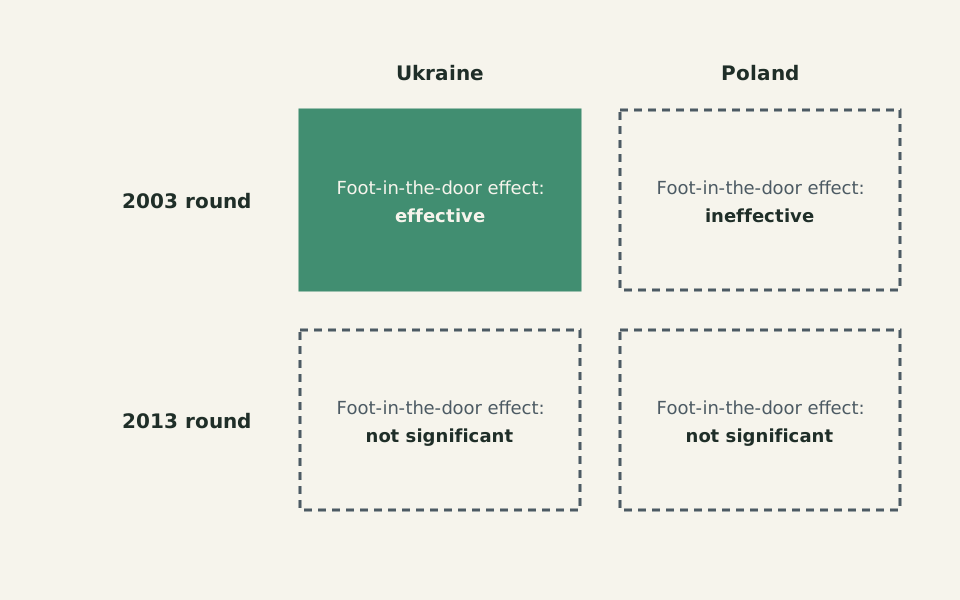
Diagram: Feedback & Forgetting, CC BY 4.0
Copy the credit line
"Direct replication in Poland and Ukraine, 2003 and 2013" by Feedback & Forgetting, https://feedbackandforgetting.com/influence-persuasion/foot-in-the-door/, licensed under CC BY 4.0, https://creativecommons.org/licenses/by/4.0/Figure 5. The four country-and-year results of the 2020 direct replication of the original foot-in-the-door procedure, as its abstract reports them. The filled box marks the one result reported as effective; dashed boxes mark results reported as ineffective or not significant. The abstract gives no rates or group sizes.
Replication tag: [mixed] Agreeing to a small first request went with more agreement to a larger later request in a 1975 field study and a 2018 experiment (read by its authors as a possible pseudo-effect), but was not shown for giving blood (1979) and not significantly in a 2013 direct replication in Poland and Ukraine. People approached in field studies and one experiment; delay stated only for one 1975 2 x 2 study (none or 7–10 days). Based on abstracts. Checked 2026-11-06.
Its mirror image: door-in-the-face
Door-in-the-face runs the order backwards. It opens with a large request that you are likely to refuse, then retreats to a smaller one. Foot-in-the-door wants your first answer to be yes; door-in-the-face expects it to be no.
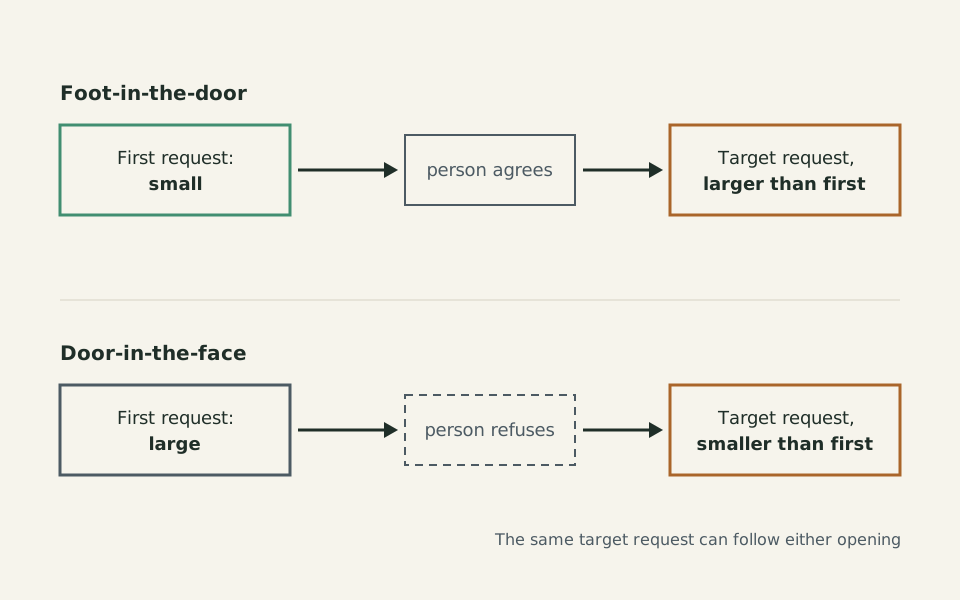
Diagram: Feedback & Forgetting, CC BY 4.0
Copy the credit line
"Two orders of requests" by Feedback & Forgetting, https://feedbackandforgetting.com/influence-persuasion/foot-in-the-door/, licensed under CC BY 4.0, https://creativecommons.org/licenses/by/4.0/Figure 6. The two orders of requests. In both, the request that matters is the last one; what differs is the first request and the answer it is meant to draw.
Timing seems to matter for the backwards order. In the Cann, Sherman and Elkes study, refusing a large request was followed by more agreement when the smaller request came right away. When it came 7 to 10 days later, the refusal carried over instead. The authors read the immediate pattern as bargaining; that is their explanation, not a separately tested one.
The 1975 telephone study had a different organization make the second request. There, people first asked for 50 questions, a request built to be refused, agreed less often (21.9% vs 33.3%). Read side by side, the two abstracts agree on one thing: refusing a large request went with less agreement later, except in the one Cann condition where the smaller request came right away. That is a pattern across two studies, not a tested rule.
[status not assigned] A refused large request followed at once by a smaller one raised agreement in one 2 x 2 field experiment. Abstract-level evidence only; the replication record for door-in-the-face is kept on this site's classics page. Checked 2026-11-06.
The two orders have also been compared head to head. A 2005 meta-analysis by Alexandre Pascual and Nicolas Guéguen pooled studies that compared the two directly with a similar target request: 22 foot-in-the-door studies with 1,581 participants and 22 door-in-the-face studies with 1,611. Its abstract reports no significant difference in how often people agreed. A result that is not significant is not the same as a tie, and the abstract gives no effect sizes or intervals.
[status not assigned] Foot-in-the-door and door-in-the-face, compared head to head with similar target requests. Abstract-level evidence only; no effect sizes or confidence intervals in the abstract. Checked 2026-11-06.
For door-in-the-face on its own terms, see this site's door-in-the-face page, which sets six classic compliance studies beside their replications.
How to spot a foot-in-the-door request
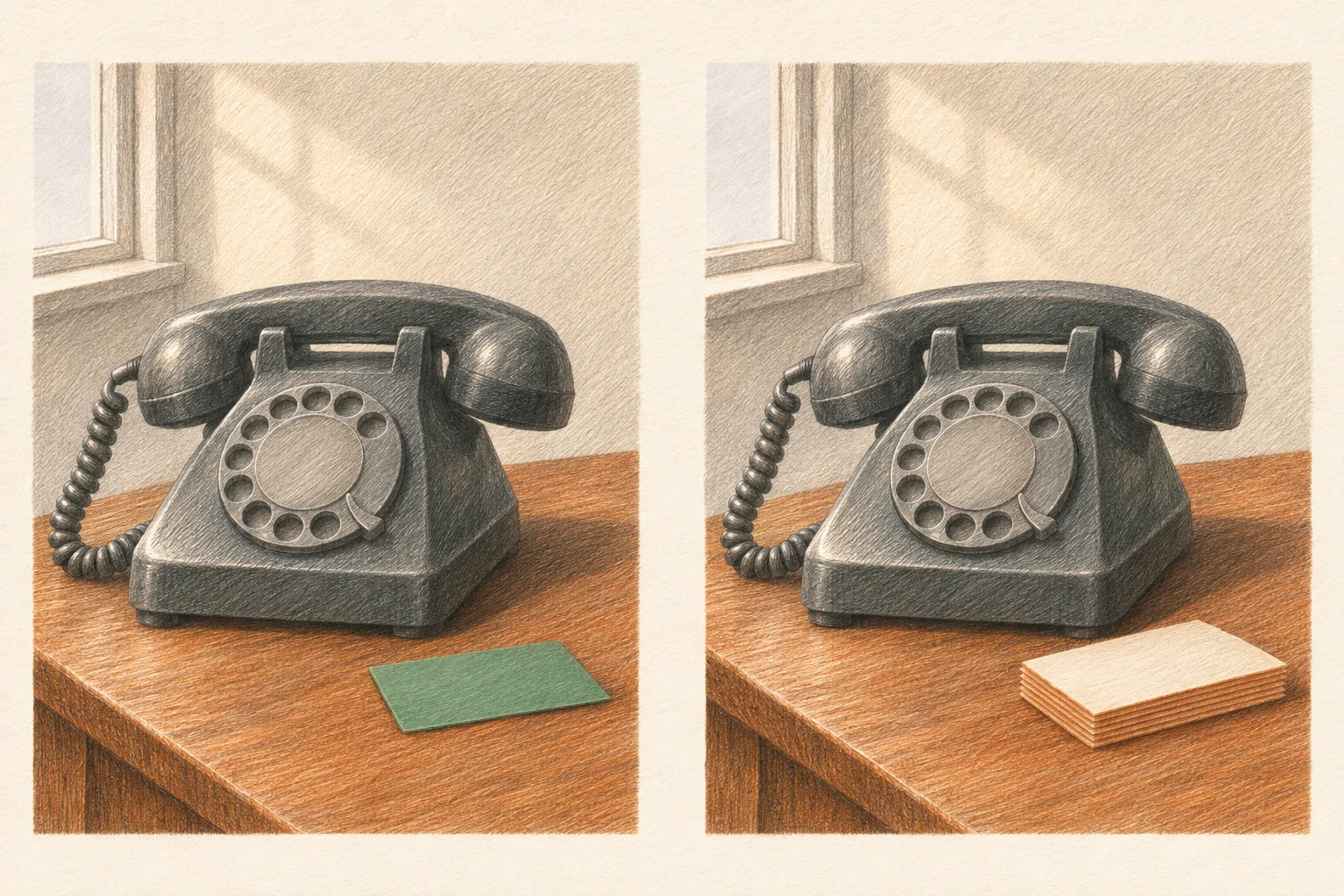
Illustration: Feedback & Forgetting. Generated schematic illustration — not a photograph or historical record. © Feedback & Forgetting, all rights reserved.
A small request, then a larger one. In the 1975 telephone study described above, people were first asked to answer a few survey questions and later asked to answer more. A scene illustration; the height of the stack stands for no number.
What gives the pattern away is the sequence. A small, easy request comes first, sized so that saying yes costs little. A larger request comes later; in the studies above it asked for more of the same kind of help, such as more survey questions in 1975 or a bigger environmental request in 2018. In the 1975 telephone study the second asker was a different organization, so the two requests need not come from the same person.
Noticing the pairing is not the same as calling it a trick. Plenty of ordinary requests grow in steps. The studies above found the pattern raising agreement in some settings and not in others. The reason to notice it is simpler: the second request deserves its own decision.
This site's study file on the Milgram experiment covers another classic study of obedience from the same decade.
The next time someone asks you for a small favor and follows with a bigger one, notice the pairing and weigh the second request as if it had come to you first, on its own merits.
Data: Foot-in-the-door evidence read for this page
| Study | What was tested | Result reported in the abstract (values quoted) | Read as |
|---|---|---|---|
| Freedman & Fraser 1966 | Paper titled “Compliance without pressure: The foot-in-the-door technique” | Not read | citation only |
| Snyder & Cunningham 1975 | 8 or 50 questions first, or none; then 30 questions for a different organization | 0.519 vs 0.333 (control) vs 0.219 agreed | abstract |
| Cann, Sherman & Elkes 1975 | Small or large first request; second request at once or 7 to 10 days later | Small request carried over; refusal carried over after a delay; refusal raised agreement at once | abstract |
| Foss & Dempsey 1979 | Recruiting blood donors | Did not show an effect on agreeing or donating in 3 experiments | abstract |
| Beaman et al. 1983 | Meta-analysis titled “Fifteen years of foot-in-the-door research” | Not read | citation only |
| Dillard, Hunter & Burgoon 1984 | Meta-analysis of foot-in-the-door and door-in-the-face | Not read | citation only |
| Burger 1999 | Review of processes and meta-analyses | 6 processes; worked in some studies, failed or lowered compliance in others | abstract |
| Pascual & Guéguen 2005 | Meta-analysis: 22 vs 22 studies (1,581 and 1,611 participants) | No significant difference between the two techniques | abstract |
| Arnold & Kaiser 2018 | Petition first, then a bigger request; 229 participants | Those who signed agreed more often than controls; read by the authors as a possible pseudo-effect | abstract |
| Gamian-Wilk & Dolinski 2020 | Direct replication in Poland and Ukraine, 2003 and 2013 | Ukraine yes, Poland no (2003); not significant in either (2013) | abstract |
Download the data (CSV, foot-in-the-door-evidence.csv) · Where each value comes from (JSON) Data: Snyder & Cunningham (1975), doi:10.1037/h0076245; Cann, Sherman & Elkes (1975), doi:10.1037/0022-3514.32.5.774; Foss & Dempsey (1979), doi:10.1037/0022-3514.37.4.580 (abstracts; quoted values, publisher's terms apply); Burger (1999), doi:10.1207/s15327957pspr0304_2; Pascual & Guéguen (2005), doi:10.2466/pr0.96.1.122-128; Arnold & Kaiser (2018), doi:10.1002/ijop.12289; Gamian-Wilk & Dolinski (2020), doi:10.1177/0033294119872208; Bartonicek & Colombo (2020), doi:10.1007/s10071-020-01395-y (abstracts; quoted values, publishers' terms apply); Freedman & Fraser (1966), doi:10.1037/h0023552; Beaman et al. (1983), doi:10.1177/0146167283092002; Dillard, Hunter & Burgoon (1984), doi:10.1111/j.1468-2958.1984.tb00028.x (citation records only; no values)
Retrieval check
Answer from memory first, then follow the link to the passage and check.
- In the 1975 telephone study, what were the first and second requests, and who made the second one? Back to the passage
- Which later tests did not show a foot-in-the-door effect, and how much of each could this page read? Back to the passage
- How does door-in-the-face reverse the order of requests, and why might timing matter? Back to the passage · Door-in-the-Face and 5 Other Classic Studies: Which Held Up?
Sources
- Freedman, J. L., & Fraser, S. C. (1966). Compliance without pressure: The foot-in-the-door technique. Journal of Personality and Social Psychology, 4(2), 195–202. doi:10.1037/h0023552 https://doi.org/10.1037/h0023552
- Snyder, M., & Cunningham, M. R. (1975). To comply or not comply: Testing the self-perception explanation of the "foot-in-the-door" phenomenon. Journal of Personality and Social Psychology, 31(1), 64–67. doi:10.1037/h0076245 https://doi.org/10.1037/h0076245
- Cann, A., Sherman, S. J., & Elkes, R. (1975). Effects of initial request size and timing of a second request on compliance: The foot in the door and the door in the face. Journal of Personality and Social Psychology, 32(5), 774–782. doi:10.1037/0022-3514.32.5.774 https://doi.org/10.1037/0022-3514.32.5.774
- Foss, R. D., & Dempsey, C. B. (1979). Blood donation and the foot-in-the-door technique: A limiting case. Journal of Personality and Social Psychology, 37(4), 580–590. doi:10.1037/0022-3514.37.4.580 https://doi.org/10.1037/0022-3514.37.4.580
- Beaman, A. L., Cole, C. M., Preston, M., Klentz, B., & Steblay, N. M. (1983). Fifteen years of foot-in-the-door research: A meta-analysis. Personality and Social Psychology Bulletin, 9(2), 181–196. doi:10.1177/0146167283092002 https://doi.org/10.1177/0146167283092002
- Dillard, J. P., Hunter, J. E., & Burgoon, M. (1984). Sequential-request persuasive strategies: Meta-analysis of foot-in-the-door and door-in-the-face. Human Communication Research, 10(4), 461–488. doi:10.1111/j.1468-2958.1984.tb00028.x https://doi.org/10.1111/j.1468-2958.1984.tb00028.x
- Burger, J. M. (1999). The foot-in-the-door compliance procedure: A multiple-process analysis and review. Personality and Social Psychology Review, 3(4), 303–325. doi:10.1207/s15327957pspr0304_2 https://doi.org/10.1207/s15327957pspr0304_2
- Pascual, A., & Guéguen, N. (2005). Foot-in-the-door and door-in-the-face: A comparative meta-analytic study. Psychological Reports, 96(1), 122–128. doi:10.2466/pr0.96.1.122-128 https://doi.org/10.2466/pr0.96.1.122-128
- Arnold, O., & Kaiser, F. G. (2018). Understanding the foot-in-the-door effect as a pseudo-effect from the perspective of the Campbell paradigm. International Journal of Psychology, 53(2), 157–165. doi:10.1002/ijop.12289 https://doi.org/10.1002/ijop.12289
- Gamian-Wilk, M., & Dolinski, D. (2020). The foot-in-the-door phenomenon 40 and 50 years later: A direct replication of the original Freedman and Fraser study in Poland and in Ukraine. Psychological Reports, 123(6), 2582–2596. doi:10.1177/0033294119872208 https://doi.org/10.1177/0033294119872208
- Bartonicek, A., & Colombo, M. (2020). Claw-in-the-door: Pigeons, like humans, display the foot-in-the-door effect. Animal Cognition, 23(5), 893–900. doi:10.1007/s10071-020-01395-y https://doi.org/10.1007/s10071-020-01395-y
- Crossref. Work records and update searches (corrections, retractions, expressions of concern) for the eleven DOIs cited on this page. https://api.crossref.org/works/10.1037/h0023552
Cite this page
Feedback & Forgetting. (2026-11-06). Foot-in-the-Door Technique: Later Tests Gave Mixed Results. https://feedbackandforgetting.com/influence-persuasion/foot-in-the-door/ (accessed [date you read it])
No DOI is assigned to this page; cite the address above with the date you read it.
Related reading
-

Influence & Persuasion
Milgram Experiment: Obedience Ranged Widely Across Versions
Picture credit
Illustration: Feedback & Forgetting. Generated schematic illustration — not a photograph or historical record. © Feedback & Forgetting, all rights reserved.
-

Influence & Persuasion
Door-in-the-Face and 5 Other Classic Studies: Which Held Up?
Picture credit
Illustration: Feedback & Forgetting. Generated schematic illustration — not a photograph or historical record. © Feedback & Forgetting, all rights reserved.