Goodhart’s Law: Cited to a 1975 Paper on Monetary Policy
Case breakdown Feedback & Forgetting Published
Short answer. Goodhart's law is named after the economist Charles Goodhart, and later papers trace it to his 1975 paper on British monetary management. As quoted in papers by Mireille Hildebrandt (2022) and by Léa Moncoucy and colleagues (2025), his line reads: “Any observed statistical regularity will tend to collapse once pressure is placed upon it for control purposes.” The shorter line given in six of the papers read here in full, “When a measure becomes a target, it ceases to be a good measure,” is a later rewording, which four readable papers credit to Marilyn Strathern (1997). Neither original could be read for this page.
In one sentence: Later papers trace Goodhart’s law to a 1975 point about British monetary policy; the famous line about targets is a later rewording, credited in readable papers to Marilyn Strathern in 1997.
Outline6 sections
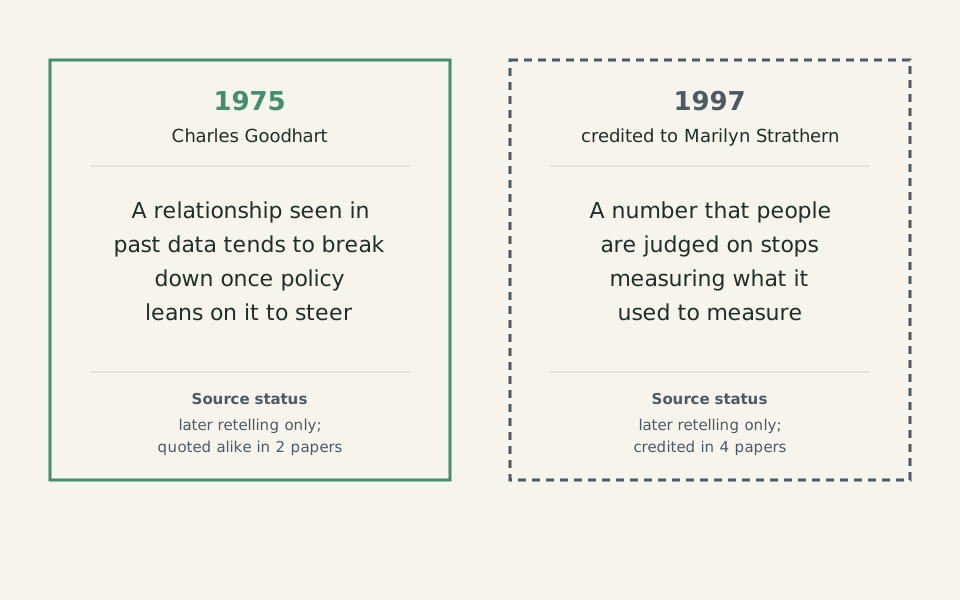
Diagram: Feedback & Forgetting, CC BY 4.0
Copy the credit line
"Two wordings of Goodhart's law" by Feedback & Forgetting, https://feedbackandforgetting.com/systems-loops/goodharts-law/, licensed under CC BY 4.0, https://creativecommons.org/licenses/by/4.0/Two wordings that travel under one name, both paraphrased. Neither original was read here: the left one is known from later quotations, and later papers name Strathern as the source of the right one.
In 1975, the economist Charles Goodhart published a paper on how Britain managed its money. Its title was “Problems of Monetary Management: The U.K. Experience.” Reference lists in later papers place it in Papers in Monetary Economics 1, from the Reserve Bank of Australia, and list the same title again in collections from 1981 and 1984. Nothing in the title mentions targets, scores or rankings. So how did a point from a paper on managing money in Britain become the line people quote about sales quotas, test scores and citation counts?
This page follows the law back through every source it could read and marks how much of each was read. It keeps two things apart: what Goodhart is quoted as saying, and the shorter line that carries his name. A file of every source and claim is at the end of the page.
The saying and the paper
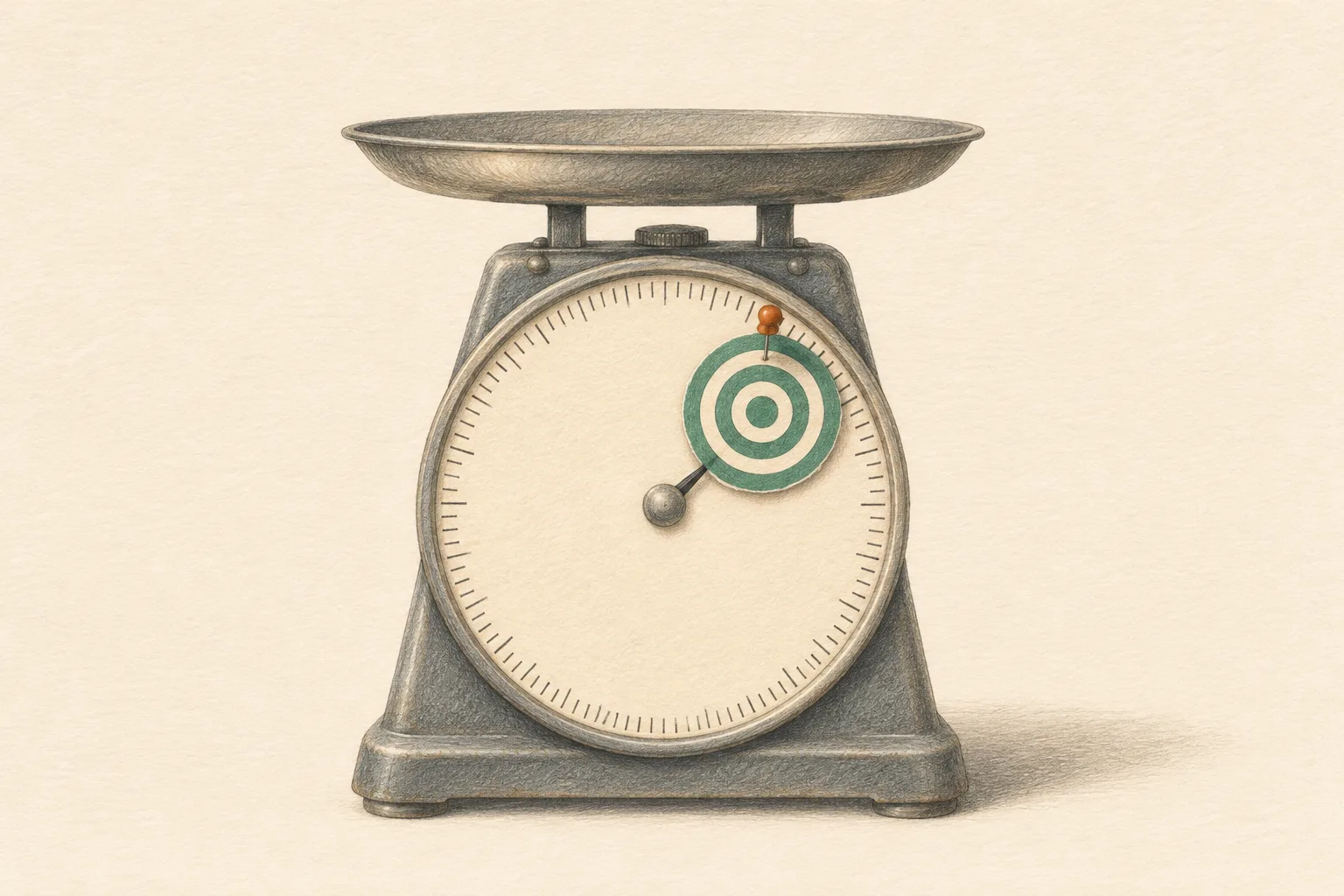
Illustration: Feedback & Forgetting. Generated schematic illustration — not a photograph or historical record. © Feedback & Forgetting, all rights reserved.
A measuring instrument with a target pinned to its face: the popular wording of Goodhart's law in one picture, not a record of any real case.
The two wordings make different claims. Goodhart's line, as quoted above, is about a statistical regularity: a relationship between numbers that held in past data. It says the relationship tends to break once someone leans on it “for control purposes,” which means once policy starts to steer by it.
The popular line is about a measure and a target. It says nothing about past data or about control, and it reads as a rule about people: once you are judged on a number, the number stops telling you what it used to. Both ideas turn up in the readable sources, but they are not the same sentence. Only one of them is tied to a paper from 1975.
That tie runs through later papers, not through the paper itself. Hildebrandt cites the 1984 printing and writes that Goodhart identified the point in 1975; Moncoucy and colleagues cite a 1975 paper in a volume edited by A. S. Courakis, at page 116. A 2018 preprint by David Manheim and Scott Garrabrant, posted on arXiv without peer review and revised in 2019, gives the same wording and cites the 1975 paper in the Reserve Bank of Australia series.
Source status: later retelling only Original not read; the wording is quoted alike in two later papers. Earliest readable source quoting it: Bevan and Hamblin 2009 (full text), with “on” where the later papers have “upon.” The 1975 paper and its 1981 and 1984 printings were read as citations only. Checked 2026-11-06.
Hildebrandt's explanation for why a number would stop working once it becomes a goal is that people respond to the use of a measure by changing what they do, and that change undoes what the measure was capturing, so the measure keeps lagging behind. Treem and coauthors, writing about workplace analytics, put it in terms of signals: a measure fails when it assumes that the signals feeding it are honest, reliable and fixed. Both are explanations the authors offer, not results of a test.
What the 1975 paper was about
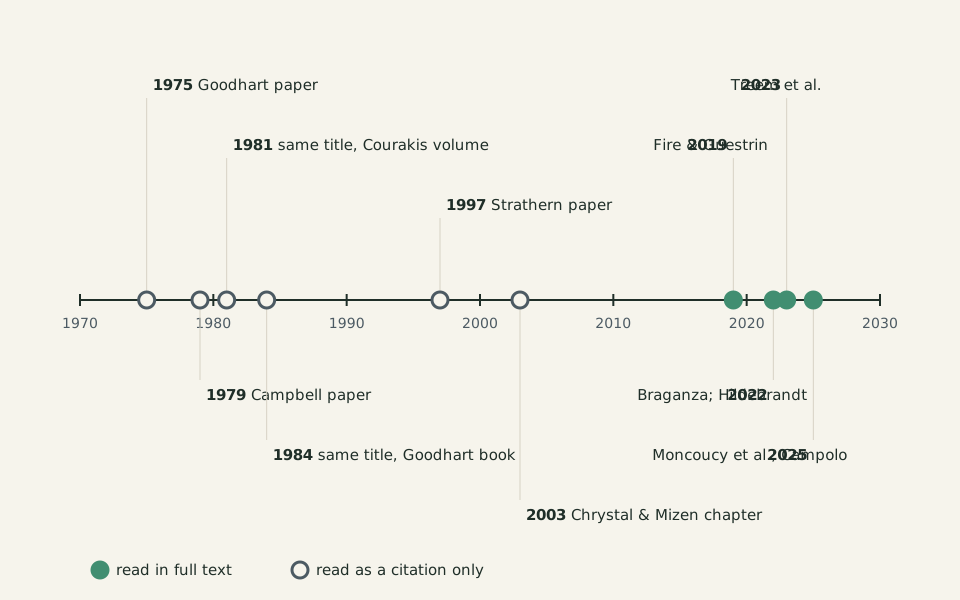
Diagram: Feedback & Forgetting, CC BY 4.0
Copy the credit line
"Goodhart's law: dates on record" by Feedback & Forgetting, https://feedbackandforgetting.com/systems-loops/goodharts-law/, licensed under CC BY 4.0, https://creativecommons.org/licenses/by/4.0/Dates from bibliographic records and reference lists. Filled markers are sources read in full; open markers were read only as citations.
This page could not read the 1975 paper or either later printing, so what it can say about the paper comes from its title and from how later papers describe it. The title names the subject: problems of monetary management in the United Kingdom. A 2003 chapter by K. Alec Chrystal and Paul Mizen, in a volume of essays in Goodhart's honor, is titled “Goodhart's Law: its origins, meaning and implications for monetary policy.” Only its citation was read.
Gwyn Bevan and Richard Hamblin, in a 2009 paper in the Journal of the Royal Statistical Society, give the subject in a little more detail. They describe the law as coming out of Goodhart's analysis of how the UK government relied on money supply targets to control inflation. They also place that failure in the 1980s and cite the 1984 printing, which does not fit a paper first printed in 1975. This page keeps the subject they describe and sets their dating aside.
The page numbers shift with each printing. Bevan and Hamblin give page 94 of the 1984 book, while Moncoucy and colleagues give page 116 and cite the volume edited by Courakis, which Campolo's reference list dates to 1981. The wording shifts by one word as well: Bevan and Hamblin print “placed on it” where the 2022 and 2025 papers print “placed upon it.” With the original unread, this page quotes the version that two independent papers agree on and notes the other.
Who wrote the popular wording
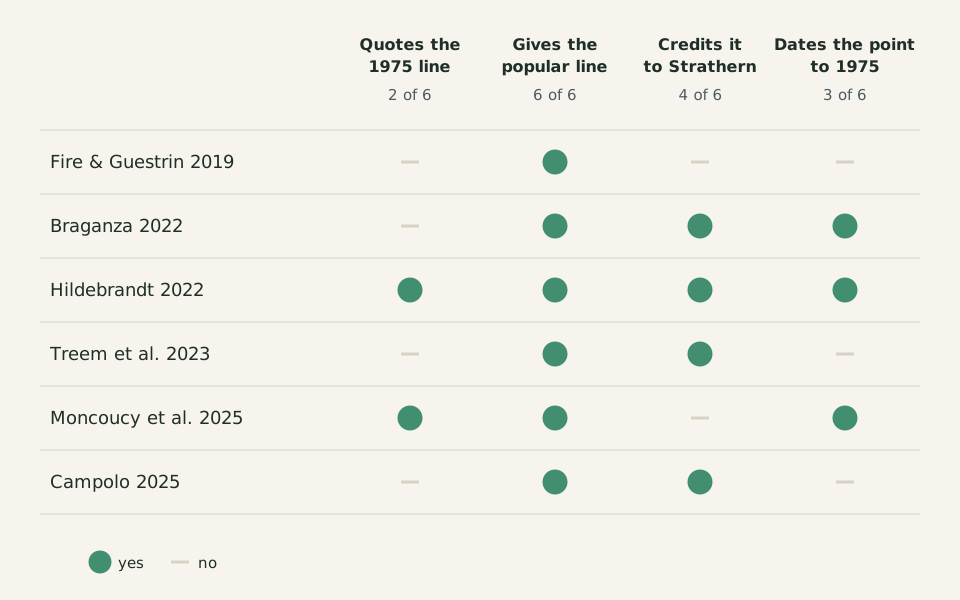
Diagram: Feedback & Forgetting, CC BY 4.0
Copy the credit line
"Who gives which wording" by Feedback & Forgetting, https://feedbackandforgetting.com/systems-loops/goodharts-law/, licensed under CC BY 4.0, https://creativecommons.org/licenses/by/4.0/How six papers read in full handle the two wordings. The full grid, with every row, is in the Data table below.
Four papers that could be read in full credit the popular line to Marilyn Strathern. Jeffrey Treem and three coauthors (2023) cite her 1997 paper for it, and Hildebrandt (2022) writes that later work by Strathern summed Goodhart's point up this way. Oliver Braganza (2022) says the best-known phrasing was coined by Strathern in the setting of university audits. Alexander Campolo (2025) calls it a version of the law popularized by her and cites page 308, though his note prints the year as 1977.
Strathern's 1997 paper is titled “‘Improving ratings’: audit in the British University system” and appeared in European Review. Only its citation was read, so this page cannot show the sentence in its setting or say whether she offered it as her own summary. Not every readable paper names her. Michael Fire and Carlos Guestrin (2019) give the line simply as Goodhart's law, and Moncoucy and colleagues give it as Goodhart's point “in simpler terms.”
Source status: later retelling only Original not read; credited to Strathern 1997 in four later papers. Earliest readable source giving the line: Fire and Guestrin 2019 (full text), with no name attached. Earliest readable sources crediting Strathern: Braganza 2022 and Hildebrandt 2022 (full text). The 1997 paper was read as a citation only. Checked 2026-11-06.
Credit for the idea itself is argued over. Braganza writes that Goodhart's precedence as the originator is disputed and points to a 2018 piece by Jeffery Rodamar titled “There ought to be a law! Campbell versus Goodhart.” Only its citation was read here.
Cousins: Campbell's law and the cobra story
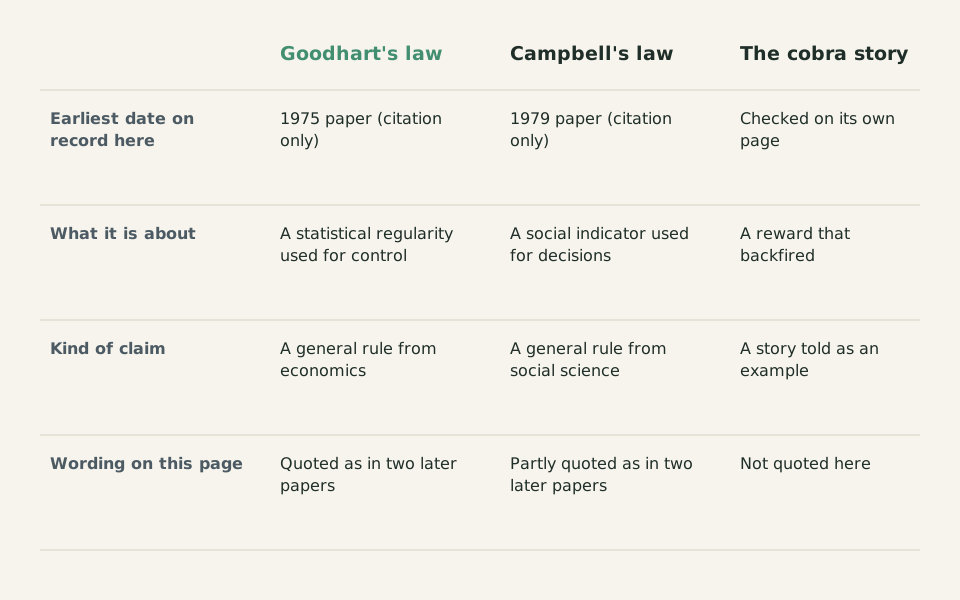
Diagram: Feedback & Forgetting, CC BY 4.0
Copy the credit line
"Goodhart's law and two cousins" by Feedback & Forgetting, https://feedbackandforgetting.com/systems-loops/goodharts-law/, licensed under CC BY 4.0, https://creativecommons.org/licenses/by/4.0/Three ideas compared side by side. The same comparison is in the table below.
The nearest relative is Campbell's law, named after the social scientist Donald T. Campbell. As quoted in Braganza (2022) and Hildebrandt (2022), his 1979 version says that the more a quantitative social indicator is used for social decision-making, “the more apt it will be to distort and corrupt the social processes it is intended to monitor.” His paper, titled “Assessing the impact of planned social change,” was read here only as a citation. The Manheim and Garrabrant preprint says Campbell's law arguably has scholarly precedence.
The two laws point at different things. Goodhart's line, as quoted, is about a statistical relationship that policy leans on, and Campbell's is about an indicator that corrupts the very process it was meant to watch. The measure-and-target line fits either one.
The cobra story is a different kind of claim. It is told as an example of a reward that backfired, a bounty on snakes that led people to breed them, rather than as a general rule. This site checks the cobra story against the records it could find on a page of its own.
| Compared | Goodhart's law | Campbell's law | The cobra story |
|---|---|---|---|
| Earliest date on record here | 1975 paper (citation only) | 1979 paper (citation only) | Checked on its own page |
| What it is about | A statistical regularity used for control | A social indicator used for decisions | A reward that backfired |
| Kind of claim | A general rule from economics | A general rule from social science | A story told as an example |
| Wording on this page | Quoted as in two later papers | Partly quoted as in two later papers | Not quoted here |
Cases on the record
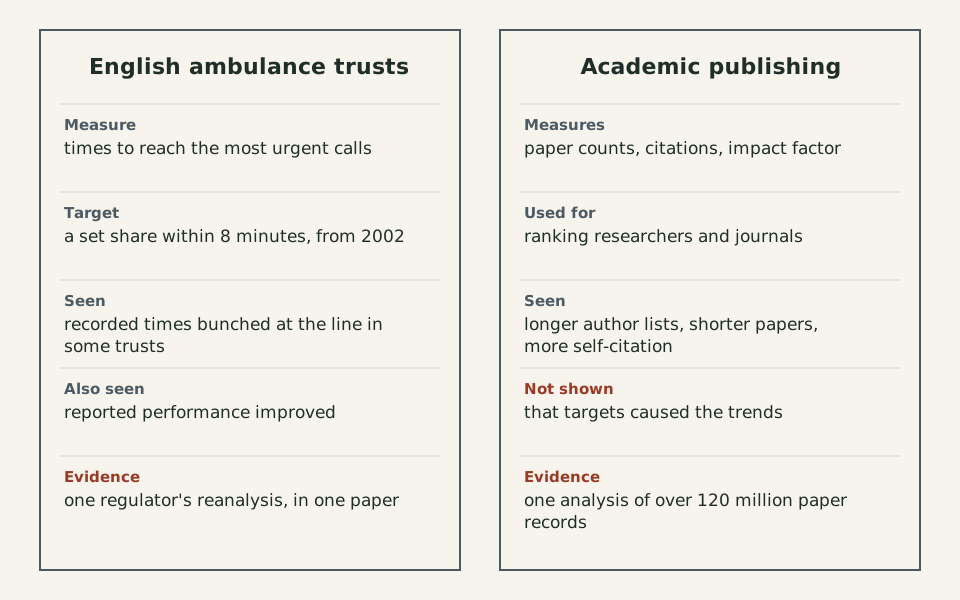
Diagram: Feedback & Forgetting, CC BY 4.0
Copy the credit line
"Two cases on the record" by Feedback & Forgetting, https://feedbackandforgetting.com/systems-loops/goodharts-law/, licensed under CC BY 4.0, https://creativecommons.org/licenses/by/4.0/Each case shows part of what the law predicts, not all of it. Both are described from papers read in full.
The first case comes from English ambulance services, as Bevan and Hamblin (2009) describe it. From 2002, England's star ratings judged ambulance trusts on whether they reached 75% of category A calls, the most urgent kind, within 8 minutes. The number of trusts meeting that target rose from 3 of 32 in 2000–2001 to 26 of 31 in 2004–2005. A matching 8-minute standard for less urgent calls, which carried no target, was met by 1 trust in every one of those years.
The recorded times also bent toward the line. According to the paper, a reanalysis of English ambulance data by the Commission for Health Improvement found manual “corrections” in around a third of trusts, with response times bunched at or just under 8 minutes. The commission estimated that the most dramatic corrections would have raised performance by at most 6%, and Bevan and Hamblin conclude that the star ratings still produced substantial improvements.
Replication tag: [single study] Recorded response times shifted to fall within the 8-minute target in around a third of English ambulance trusts: category A calls, in a reanalysis the paper cites to the regulator's 2003 reports; one paper reporting that reanalysis. Based on full text. Checked 2026-11-06.
The second case is academic publishing. Fire and Guestrin (2019) analyzed records of more than 120 million papers and read trends such as longer author lists, shorter papers and more self-citation as signs that publishing measures had become targets. In their discussion section they also write that “there may be other underlying factors that contributed to the observed results,” so their data show the trends, not that targets caused them.
Replication tag: [single study] Publishing measures such as paper counts and citations lost value as measures over time: large bibliographic datasets covering the last century; one observational analysis by its authors' reading. Based on full text. Checked 2026-11-06.
Drawing the loop
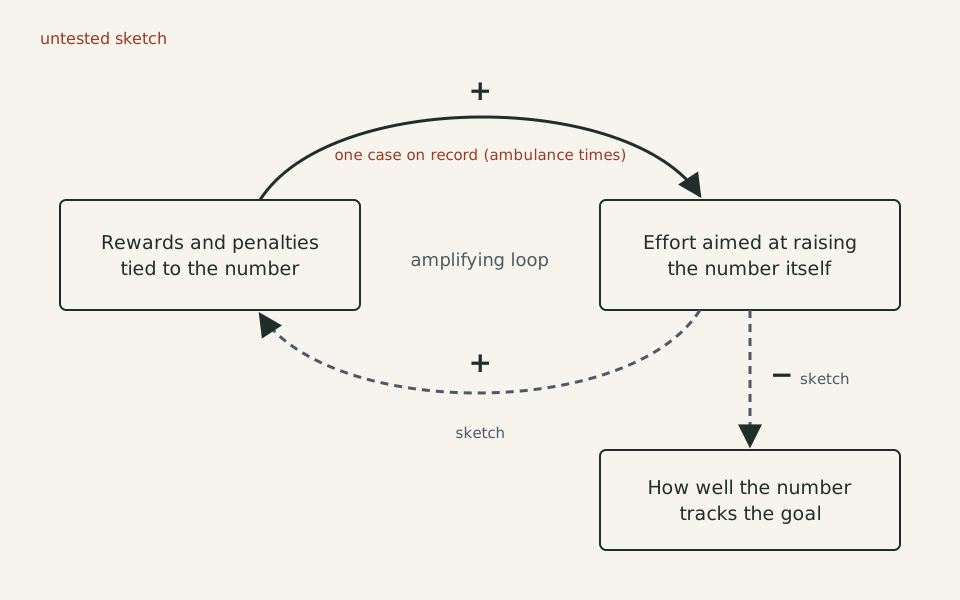
Diagram: Feedback & Forgetting, CC BY 4.0
Copy the credit line
"Goodhart's law drawn as a loop" by Feedback & Forgetting, https://feedbackandforgetting.com/systems-loops/goodharts-law/, licensed under CC BY 4.0, https://creativecommons.org/licenses/by/4.0/A sketch of Goodhart's law as a feedback loop. Every arrow is a guess unless a source measured it, and the ambulance case measured only one.
Goodhart's law can be drawn as a feedback loop, the way this site's page on everyday feedback loops draws thermostats and traffic. Rewards tied to a number pull effort toward whatever raises the number. People who raise it win more of the rewards, which pulls more effort the same way. Both arrows carry a plus sign, so on paper the loop amplifies, while a side arrow with a minus sign shows the number tracking the goal less well as that effort grows.
Run the loop literacy checks on it and the sketch comes up short. Each part can be named, and each arrow has a sign. A test on record exists for only one link: the ambulance data show recorded times shifting toward the 8-minute line once it was a target. Braganza's 2022 paper is titled as a theory and model of proxy-based competition, and this page does not treat a model as a test.
For your next practice, if you track your studying with a number such as cards reviewed or hours logged, write down next to it what the number is supposed to stand for. Once a week, check that thing directly, for instance by answering a few questions from memory on material you studied days earlier. If the number keeps climbing while those answers do not improve, the number has stopped telling you what you wanted to know.
Data: Who gave which wording, and how much was read
Each row is one claim about one source. Two papers read in full are described in the text above but left out of this file: Bevan and Hamblin (2009), whose license notice rules out commercial reuse, and the Manheim and Garrabrant preprint, which carries a non-commercial license. The charts carry no numbers from either paper's results, and the ambulance case appears in them only as a short description in words.
| Source | Year (as reported) | Claim | Read as |
|---|---|---|---|
| Goodhart 1975 | 1975 | A paper by Charles Goodhart titled Problems of Monetary Management: The U.K. Experience appeared in 1975 in Papers in Monetary Economics 1 | Citation only |
| Campbell 1979 | 1979 | Donald T. Campbell published a paper titled Assessing the impact of planned social change in 1979 | Citation only |
| Goodhart 1981 | 1981 | A paper by Goodhart titled Problems of Monetary Management: The U.K. Experience appears in a 1981 volume edited by A. S. Courakis, pages 111 to 144 | Citation only |
| Goodhart 1984 | 1984 | A chapter titled Problems of Monetary Management: The UK Experience appears in Goodhart's 1984 book Monetary Theory and Practice, pages 91 to 121 | Citation only |
| Strathern 1997 | 1997 | Marilyn Strathern published a paper titled Improving ratings: audit in the British University system in 1997 | Citation only |
| Chrystal & Mizen 2003 | 2003 | A 2003 chapter by K. Alec Chrystal and Paul Mizen is titled Goodhart's Law: its origins, meaning and implications for monetary policy | Citation only |
| Fire & Guestrin 2019 | 2019 | Gives the popular line as a statement of Goodhart's law and names no one else for it | Full text |
| Braganza 2022 | 2022 | Dates Goodhart's paper to 1975, in Papers in Monetary Economics 1, pages 1 to 20 | Full text |
| Braganza 2022 | 2022 | Says the best-known phrasing of the law was coined by Marilyn Strathern, in the context of university auditing | Full text |
| Hildebrandt 2022 | 2022 | Quotes Goodhart's line with the word upon, says Goodhart identified it in 1975, and cites the 1984 printing | Full text |
| Hildebrandt 2022 | 2022 | Credits the popular line to later work by Strathern, citing her 1997 paper | Full text |
| Treem et al. 2023 | 2023 | Gives the popular line as Goodhart's law and cites Strathern 1997 for it | Full text |
| Moncoucy et al. 2025 | 2025 | Quotes Goodhart's line with the word upon, at page 116, citing a 1975 paper in the volume edited by A. S. Courakis | Full text |
| Moncoucy et al. 2025 | 2025 | Gives the popular line as Goodhart's law in simpler terms and names no one for it | Full text |
| Campolo 2025 | 2025 | Calls the popular line a version of Goodhart's law popularized by Marilyn Strathern, citing page 308 of her paper | Full text |
Download the data (CSV, goodharts-law-sources.csv) · Where each value comes from (JSON) Data: Braganza, O. (2022). Proxyeconomics, a theory and model of proxy-based competition and cultural evolution. Royal Society Open Science 9(2): 211030, doi:10.1098/rsos.211030, CC BY 4.0 (https://creativecommons.org/licenses/by/4.0/); Hildebrandt, M. (2022). The issue of proxies and choice architectures. Frontiers in Artificial Intelligence 5: 789076, doi:10.3389/frai.2022.789076, CC BY 4.0 (https://creativecommons.org/licenses/by/4.0/); Treem, J. W., et al. (2023). Signaling and meaning in organizational analytics. Journal of Computer-Mediated Communication 28(4): zmad023, doi:10.1093/jcmc/zmad023, CC BY 4.0 (https://creativecommons.org/licenses/by/4.0/); Moncoucy, L., et al. (2025). The value of consciousness: experiences worth having. Philosophical Transactions of the Royal Society B 380: 20240303, doi:10.1098/rstb.2024.0303, CC BY 4.0 (https://creativecommons.org/licenses/by/4.0/); Campolo, A. (2025). State-of-the-art: The temporal order of benchmarking culture. Digital Society 4(2): 35, doi:10.1007/s44206-025-00190-x, CC BY 4.0 (https://creativecommons.org/licenses/by/4.0/); Fire, M., & Guestrin, C. (2019). Over-optimization of academic publishing metrics. GigaScience 8(6): giz053, doi:10.1093/gigascience/giz053, CC BY 4.0 (https://creativecommons.org/licenses/by/4.0/); Titles and bibliographic details only, from Crossref and the reference lists above: Goodhart 1975, 1981 and 1984; Campbell 1979; Strathern 1997; Chrystal & Mizen 2003
Retrieval check
Answer from memory first, then follow the link to the passage and check.
- What subject was Goodhart's 1975 paper about, going by its title? Back to the passage
- What is the source status of the line about a measure becoming a target, and whom do readable papers credit for it? Back to the passage
- How is the cobra story a different kind of claim from Goodhart's law? Back to the passage · The cobra story, checked against the record
Sources
- Goodhart, C. A. E. (1975). Problems of monetary management: The U.K. experience. Papers in Monetary Economics, 1. Reserve Bank of Australia. As listed by Braganza (2022, ref. 20) and Manheim & Garrabrant (2018, ref. 1). https://doi.org/10.1098/rsos.211030
- Hildebrandt, M. (2022). The issue of proxies and choice architectures. Why EU law matters for recommender systems. Frontiers in Artificial Intelligence, 5, 789076. doi:10.3389/frai.2022.789076 https://doi.org/10.3389/frai.2022.789076
- Moncoucy, L., Dołęga, K., Tallon-Baudry, C., & Cleeremans, A. (2025). The value of consciousness: experiences worth having. Philosophical Transactions of the Royal Society B: Biological Sciences, 380(1939), 20240303. doi:10.1098/rstb.2024.0303 https://doi.org/10.1098/rstb.2024.0303
- Strathern, M. (1997). ‘Improving ratings’: Audit in the British University system. European Review, 5(3), 305–321. doi:10.1002/(SICI)1234-981X(199707)5:3<305::AID-EURO184>3.0.CO;2-4 https://doi.org/10.1002/(SICI)1234-981X(199707)5:3<305::AID-EURO184>3.0.CO;2-4
- Goodhart, C. (1981). Problems of monetary management: The U.K. experience. In A. S. Courakis (Ed.), Inflation, depression, and economic policy in the West (pp. 111–144). Mansell. As listed by Campolo (2025). https://doi.org/10.1007/s44206-025-00190-x
- Goodhart, C. A. E. (1984). Problems of monetary management: The UK experience. In Monetary Theory and Practice (pp. 91–121). Macmillan Education UK. doi:10.1007/978-1-349-17295-5_4 https://doi.org/10.1007/978-1-349-17295-5_4
- Chrystal, K. A., & Mizen, P. D. (2003). Goodhart's Law: its origins, meaning and implications for monetary policy. In P. Mizen (Ed.), Central Banking, Monetary Theory and Practice: Essays in Honour of Charles Goodhart, vol. 1. Edward Elgar. doi:10.4337/9781781950777.00022 https://doi.org/10.4337/9781781950777.00022
- Bevan, G., & Hamblin, R. (2009). Hitting and missing targets by ambulance services for emergency calls: Effects of different systems of performance measurement within the UK. Journal of the Royal Statistical Society: Series A (Statistics in Society), 172(1), 161–190. doi:10.1111/j.1467-985X.2008.00557.x https://doi.org/10.1111/j.1467-985X.2008.00557.x
- Manheim, D., & Garrabrant, S. (2018). Categorizing variants of Goodhart's Law. arXiv:1803.04585, version 4 (2019). Preprint. https://arxiv.org/abs/1803.04585
- Treem, J. W., Barley, W. C., Weber, M. S., & Barbour, J. B. (2023). Signaling and meaning in organizational analytics: coping with Goodhart’s Law in an era of digitization and datafication. Journal of Computer-Mediated Communication, 28(4), zmad023. doi:10.1093/jcmc/zmad023 https://doi.org/10.1093/jcmc/zmad023
- Braganza, O. (2022). Proxyeconomics, a theory and model of proxy-based competition and cultural evolution. Royal Society Open Science, 9(2), 211030. doi:10.1098/rsos.211030 https://doi.org/10.1098/rsos.211030
- Campolo, A. (2025). State-of-the-art: The temporal order of benchmarking culture. Digital Society, 4(2), 35. doi:10.1007/s44206-025-00190-x https://doi.org/10.1007/s44206-025-00190-x
- Fire, M., & Guestrin, C. (2019). Over-optimization of academic publishing metrics: observing Goodhart’s Law in action. GigaScience, 8(6), giz053. doi:10.1093/gigascience/giz053 https://doi.org/10.1093/gigascience/giz053
- Rodamar, J. (2018). There ought to be a law! Campbell versus Goodhart. Significance, 15(6), 9. doi:10.1111/j.1740-9713.2018.01205.x https://doi.org/10.1111/j.1740-9713.2018.01205.x
- Campbell, D. T. (1979). Assessing the impact of planned social change. Evaluation and Program Planning, 2(1), 67–90. doi:10.1016/0149-7189(79)90048-X https://doi.org/10.1016/0149-7189(79)90048-X
- Crossref. Update searches (corrections, retractions, expressions of concern) for doi:10.1098/rsos.211030, doi:10.3389/frai.2022.789076, doi:10.1098/rstb.2024.0303, doi:10.1111/j.1467-985x.2008.00557.x, doi:10.1093/jcmc/zmad023, doi:10.1007/s44206-025-00190-x, doi:10.1093/gigascience/giz053, doi:10.1007/978-1-349-17295-5_4, doi:10.1002/(sici)1234-981x(199707)5:3<305::aid-euro184>3.0.co;2-4, doi:10.1016/0149-7189(79)90048-x, doi:10.4337/9781781950777.00022 and doi:10.1111/j.1740-9713.2018.01205.x. https://api.crossref.org/works?filter=updates:10.1098/rsos.211030
Cite this page
Feedback & Forgetting. (2026-11-06). Goodhart’s Law: Cited to a 1975 Paper on Monetary Policy. https://feedbackandforgetting.com/systems-loops/goodharts-law/ (accessed [date you read it])
No DOI is assigned to this page; cite the address above with the date you read it.
Related reading
-
Systems & Loops
Feedback Loop Examples: Which Ones Have a Test on Record
Picture credit
"Boulton and Watt centrifugal governor" by Andy Dingley — https://commons.wikimedia.org/wiki/File:Boulton_and_Watt_centrifugal_governor.jpg — CC BY 3.0 (https://creativecommons.org/licenses/by/3.0/); modifications: cropped
-
Systems & Loops
Cobra Effect: Did People Breed Cobras? No Record Found Yet
Picture credit
"Indian cobra, with 'spectacle' marking on hood. Watercolour" by Wellcome Collection — https://commons.wikimedia.org/wiki/File:Indian_cobra,_with_%27spectacle%27_marking_on_hood._Watercolour_Wellcome_L0019950.jpg — CC BY 4.0 (https://creativecommons.org/licenses/by/4.0/)