Cobra Effect: Did People Breed Cobras? No Record Found Yet
Myth review Feedback & Forgetting Published
Short answer. The cobra effect is named after a story in which a bounty on dead cobras in British-ruled India, often placed in Delhi, led people to breed cobras for the money. Snake bounties in India are on record: an 1874 book by Edward Nicholson reports rewards paid for killed snakes from 1869 to 1872 and describes no breeding. As of 2026-11-06, this page found no record from the period of the cobra-breeding story itself. The earliest telling it could read is a preprint by David Manheim and Scott Garrabrant, in a 2019 revision, which calls the situation “supposed.”
In one sentence: Snake bounties in British India are on record, but this page found no record from the time of anyone breeding cobras to collect one.
Myth checked: In colonial India, a bounty on dead cobras led people to breed cobras for the reward, and when the bounty ended they set the snakes loose, leaving more cobras than before. Source status: later retelling only Snake rewards from 1869 to 1872 are on record (see below), but no record from the period was found of a cobra bounty in Delhi, the breeding or the release. Earliest readable telling: Manheim and Garrabrant's preprint, 2019 revision (full text, not peer reviewed); the release step first appears in Chollete and Harrison 2021 (full text), as does the Delhi setting. Searched Europe PMC, PubMed Central full texts, Crossref and two scanned 19th-century books on the Internet Archive. Checked 2026-11-06.
Outline5 sections
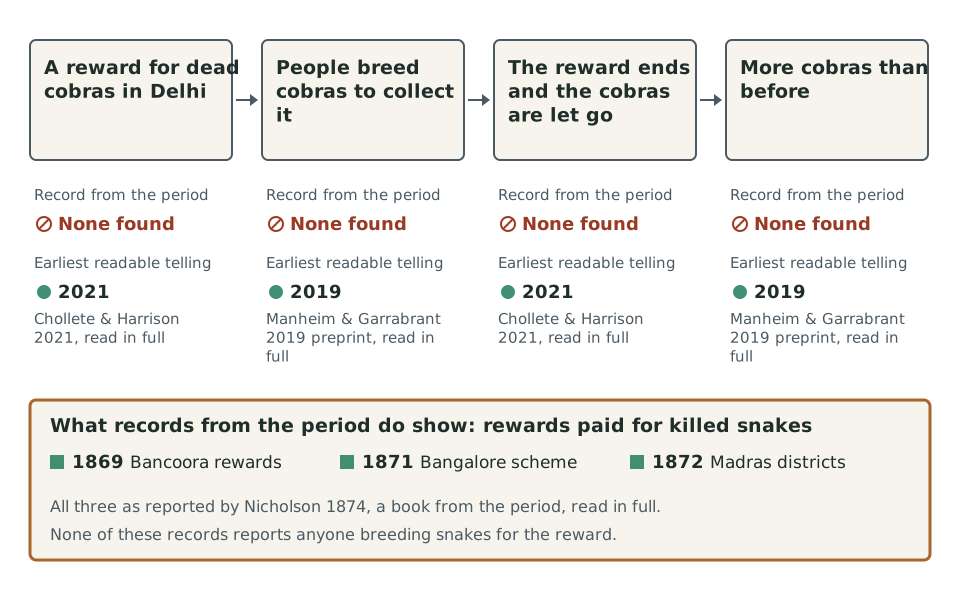
Diagram: Feedback & Forgetting, CC BY 4.0
Copy the credit line
"The cobra story, step by step, against the record" by Feedback & Forgetting, https://feedbackandforgetting.com/systems-loops/cobra-effect/, licensed under CC BY 4.0, https://creativecommons.org/licenses/by/4.0/The four steps of the story, each set against what this page found. The bottom panel lists snake rewards that are on record from the period.
A 2022 article by Sergio Della Sala sets the cobra story in New Delhi, with cash paid at city hall. People start breeding cobras for the money, the reward is stopped, the snakes are freed, and the streets end up with more cobras than before. In its section on the cobra effect, the same article calls it “a likely apocryphal anecdote.” The question here is which parts of the story rest on a record from the time, and which rest only on later retellings.
This page lists every version of the story it could read and marks how much of each it read. It then sets them beside what an 1874 book on Indian snakes reports about paying people for dead snakes. A file of the sources is at the end of the page.
Replication scorecard
| Claim | Retold in (read as) | Checked against (read as) | Status |
|---|---|---|---|
| A bounty on dead cobras was paid in Delhi under British rule | Chollete & Harrison 2021; Della Sala 2022; Kelleher et al. 2025; Olden et al. 2026 (full text) | A search for a record from the period in Europe PMC, PubMed Central, Crossref and the Internet Archive; none found for Delhi (snake rewards elsewhere: last row) | Source status: later retelling only Earliest readable telling with Delhi: Chollete & Harrison 2021 (full text); checked 2026-11-06 |
| People bred cobras to collect the bounty, then set them loose when it ended | Chollete & Harrison 2021; Rodriguez & Oppenheimer 2025 (full text) | The same search; none found | Source status: later retelling only Breeding first in the 2019 preprint revision among tellings read in full; release first in Chollete & Harrison 2021 (full text); checked 2026-11-06 |
| The name cobra effect comes from Horst Siebert's 2001 book Der Kobra-Effekt | Della Sala 2022; Korteling et al. 2023 (full text) | Siebert 2001 (citation only) | Source status: later retelling only Book not read; the name is credited to it in later papers; checked 2026-11-06 |
| Officials in British India paid rewards for killed snakes | Nicholson 1874 (full text) | Nicholson 1874, figures for Bancoora 1869, Bangalore 1871 and Madras 1872; Twain 1897 (full text) | Source status: contemporary record read A book from the period that reports reward counts and sums for 1869 to 1872; checked 2026-11-06 |
The story as told
"Indian cobra, with 'spectacle' marking on hood. Watercolour" by Wellcome Collection — https://commons.wikimedia.org/wiki/File:Indian_cobra,_with_%27spectacle%27_marking_on_hood._Watercolour_Wellcome_L0019950.jpg — CC BY 4.0 (https://creativecommons.org/licenses/by/4.0/)
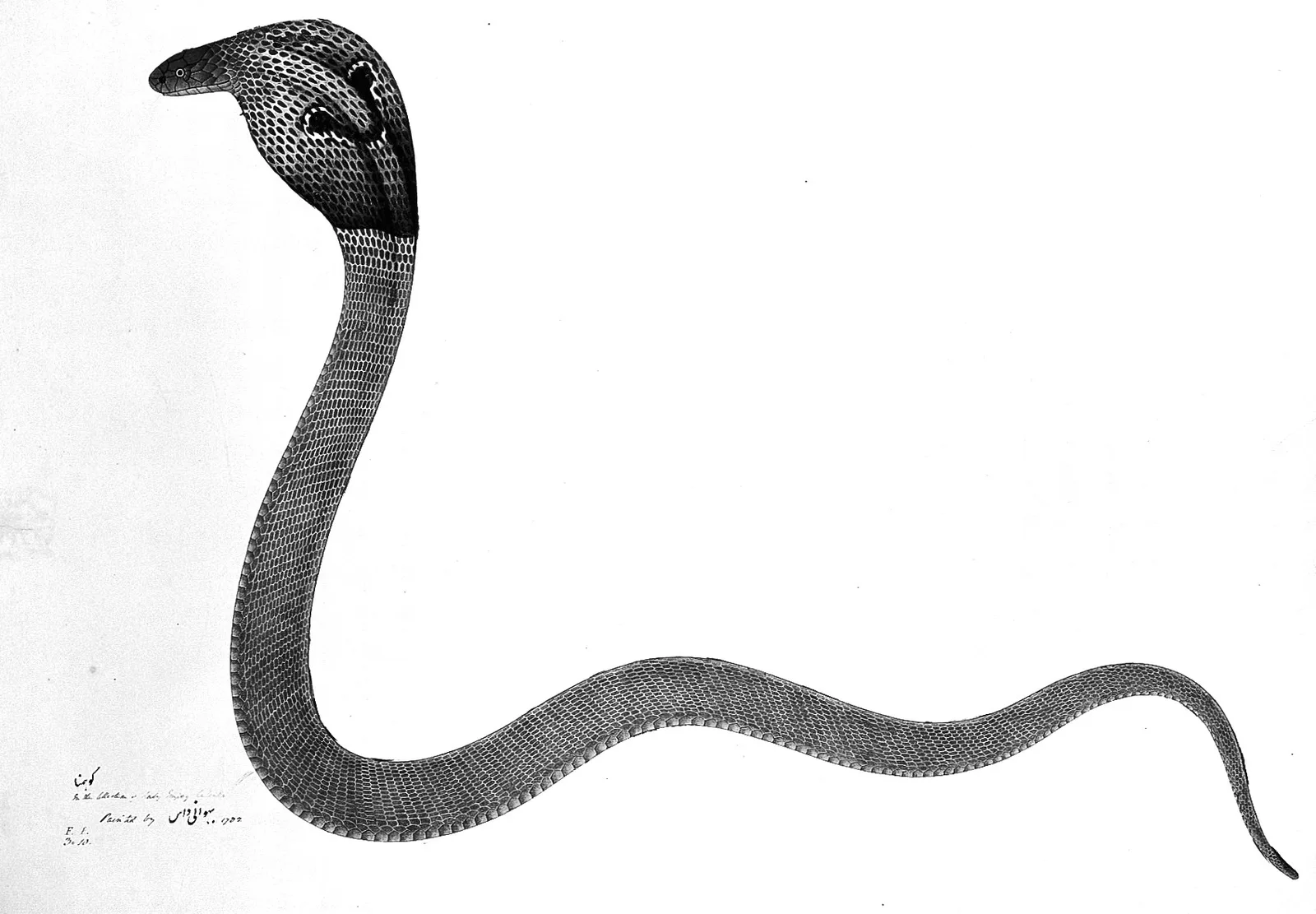
Indian cobra, with 'spectacle' marking on hood. Watercolour by Bhawani Das, Wellcome Collection.
The versions this page could read agree on the shape of the story and drift on the details. In a 2021 paper in the Eastern Economic Journal, Lorán Chollete and Sharon Harrison have local policymakers in Delhi pay for dead cobras. Residents breed cobras, the reward is removed, and the freed snakes leave Delhi with more cobras than before. They cite Siebert's book for it, with the year 2003.
Della Sala's 2022 article adds a British Governor and a city hall. In a 2025 paper in PLOS One, Christopher Rodriguez and Daniel Oppenheimer have the British pay for cobra skins. They name no city. Matthew Kelleher and five coauthors, writing in 2025 about medical board scores, place the story in Delhi and cite an online encyclopedia entry on perverse incentives for the term.
The newest version read here is a 2026 review of species bounty programs by Julian Olden and six coauthors in npj Biodiversity. It places the story in colonial Delhi under British rule and says the bounty paid more than breeding the snakes cost. For this it cites a 2018 article by David Lucas and Caleb Fuller in The Independent Review, which this page could read only as a citation.
None of these papers points to a document from the time, such as an order, a ledger, a newspaper report or an official's letter. Alongside the story they cite a 2001 book, a 2016 magazine blog post, a 2018 article and an encyclopedia entry.
Looking for the source
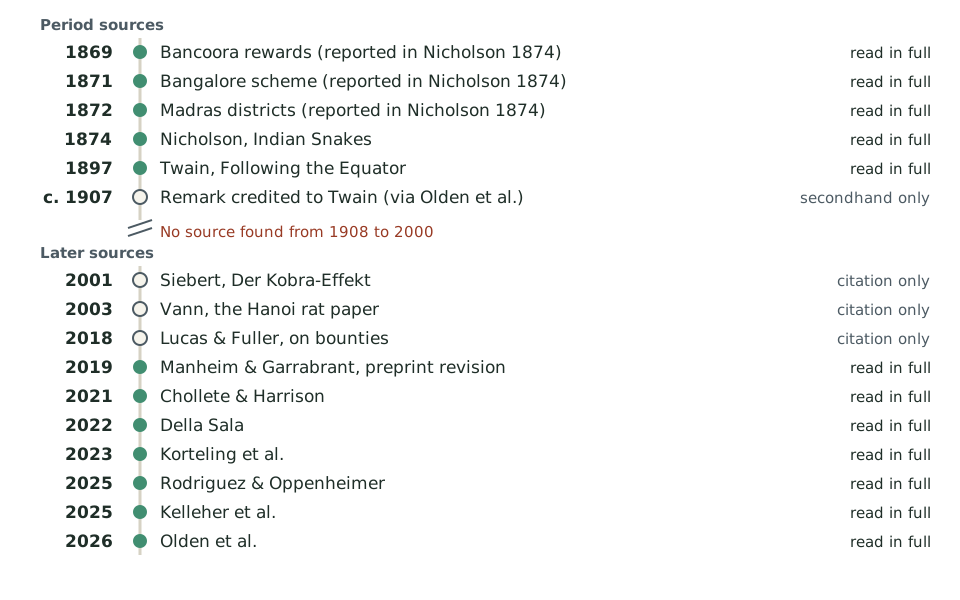
Diagram: Feedback & Forgetting, CC BY 4.0
Copy the credit line
"The cobra story and snake rewards in India: sources by year" by Feedback & Forgetting, https://feedbackandforgetting.com/systems-loops/cobra-effect/, licensed under CC BY 4.0, https://creativecommons.org/licenses/by/4.0/Every source this page found, by year. Filled markers were read in full; open markers were read only as citations or secondhand. The same list is in the table below.
This page searched Europe PMC for papers that use the phrase cobra effect and for open-access papers that mention cobras, a bounty and Delhi or India. It read eleven of the papers it turned up in full through PubMed Central, searched Crossref by title, and read the scanned text of two 19th-century books on the Internet Archive.
The earliest telling of the cobra bounty and the breeding found in that search is the preprint by Manheim and Garrabrant, first posted on arXiv in 2018 and read here in its February 2019 revision. It has not been peer reviewed. It describes “a supposed situation in colonial India” (p. 8), names no city, does not mention the release, and cites Siebert's book.
Several papers credit the name itself to that book, Horst Siebert's Der Kobra-Effekt: Wie man Irrwege der Wirtschaftspolitik vermeidet, published in 2001. Della Sala writes that the term was “originally introduced” there. This page read only its catalog details, so it cannot say whether the book tells the story as history or as a parable.
One wording is older, but it reaches this page secondhand. Olden and colleagues quote a remark they date to 1907 and credit to Mark Twain, citing a 2010 edition of his autobiography. In paraphrase, it says that a bounty on wolves in America, rabbits in Australia or snakes in India is the best way to increase them, because people start raising them. The remark is about bounties in general, not a record of any one bounty, and this page could not read the book it comes from.
Source status: later retelling only The Delhi cobra bounty, the breeding and the release. No record from the period found as of this date; earliest readable telling: Manheim and Garrabrant's preprint, 2019 revision (full text, not peer reviewed); Siebert 2001 and the Twain autobiography read as citations only. Checked 2026-11-06.
| Year | Source | What it is | Read as |
|---|---|---|---|
| 1869–1872 | Snake rewards in Bancoora, Bangalore and the Madras Presidency | Reported in Nicholson 1874 | Full text |
| 1874 | Nicholson, Indian Snakes | Book from the period | Full text |
| 1897 | Twain, Following the Equator | Book from the period | Full text |
| c. 1907 | Remark credited to Twain (via Olden et al.) | Quoted in Olden et al. 2026 | Secondhand only |
| 2001 | Siebert, Der Kobra-Effekt | Book credited with the name | Citation only |
| 2003 | Vann, the Hanoi rat paper | History paper | Citation only |
| 2018 | Lucas & Fuller, on bounties | Article cited for the Delhi story | Citation only |
| 2019 | Manheim & Garrabrant, preprint revision | Preprint telling, not peer reviewed | Full text |
| 2021 | Chollete & Harrison | Paper telling | Full text |
| 2022 | Della Sala | Paper telling | Full text |
| 2023 | Korteling et al. | Paper using the name | Full text |
| 2025 | Rodriguez & Oppenheimer | Paper telling | Full text |
| 2025 | Kelleher et al. | Paper telling | Full text |
| 2026 | Olden et al. | Paper telling | Full text |
What the period records show here
“Indian serpent-charmers and cobras (naja tripudians)”, Gustav Mützel, public domain
Full credit
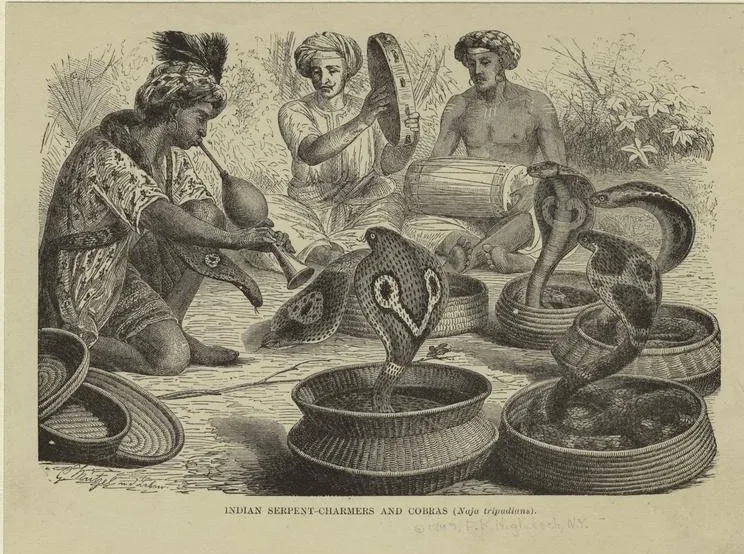
"Indian serpent-charmers and cobras (naja tripudians)" by Gustav Mützel — https://commons.wikimedia.org/wiki/File:Indian_serpent-charmers_and_cobras_(naja_tripudians).jpg — Public domain (US: published 1893 (printed copyright line 1893, F. R. Niglutsch, New York), before 1931. EU: Gustav Mützel died 29 October 1893 (Commons creator data), more than 70 years ago; the engraver who cut the block is not named and, as an anonymous contributor to an 1893 publication, is past 70 years from publication (engraver not checked). Scan from the NYPL Digital Gallery (Commons Source field); Commons marks it Public Domain Mark 1.0.); modifications: croppedIndian serpent-charmers and cobras (Naja tripudians). Engraving after Gustav Mützel, 1893.
Records of snake rewards from the time do exist. Edward Nicholson's Indian Snakes, printed in Madras in 1874, has a chapter on schemes to wipe out venomous snakes. He calls the idea “theoretically preposterous and practically impossible of execution” and dismisses a proposal that would “turn half the labourers of the country into snake-hunting loafers” (p. 161).
His figures come from several places. In Bancoora, a small district of Lower Bengal, no less than 44,450 snakes were brought in for a reward between May 29 and December 7, 1869; he lists them as venomous with a question mark. At 4 annas a head for most of that time, he puts the cost at not less than 10,000 rupees (pp. 162–163). In a note at the end of the book, he reports that five districts of the Madras Presidency spent 157,290 rupees in 1872 on two-anna rewards for snakes destroyed (Note D).
Mark Twain's Following the Equator (1897) works from the government's own tallies. After six-year totals for people killed by wild animals and by snakes, he ends: “In the same six the government kills 1,073,540 snakes. Plenty left.” (p. 547). This page searched the scanned text of both books for words such as breed and bred and found no account of anyone raising snakes to collect a reward.
Source status: contemporary record read Rewards for killed snakes in Bancoora (1869), Bangalore (1871) and five Madras districts (1872). Earliest readable source: Edward Nicholson's Indian Snakes (1874), a book from the period. Based on full text (the scanned text of the 1874 edition). Checked 2026-11-06.
A documented cousin?
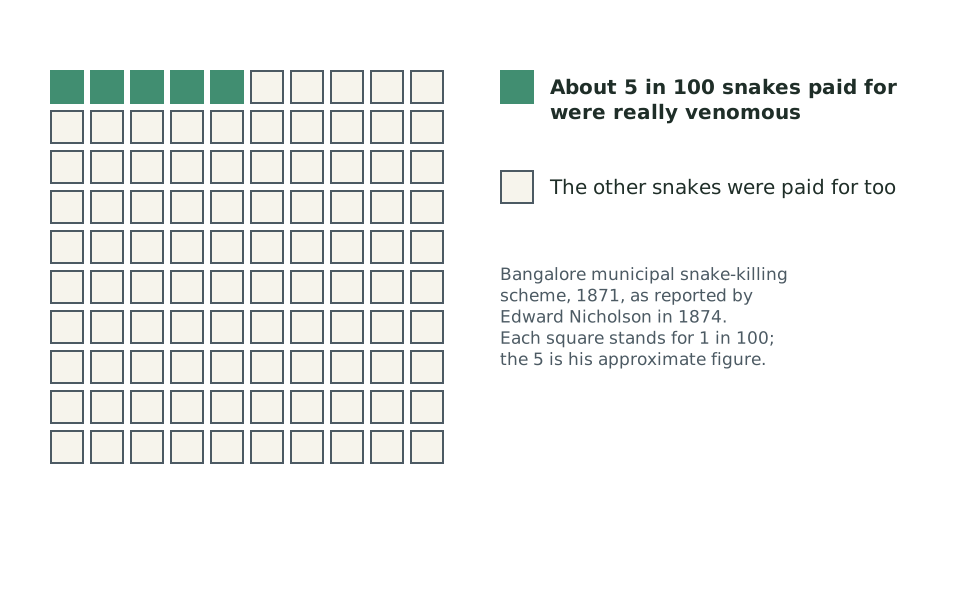
Diagram: Feedback & Forgetting, CC BY 4.0
Copy the credit line
"Bangalore, 1871: share of paid-for snakes that were venomous" by Feedback & Forgetting, https://feedbackandforgetting.com/systems-loops/cobra-effect/, licensed under CC BY 4.0, https://creativecommons.org/licenses/by/4.0/Data: Nicholson, E. (1874). Indian Snakes: An Elementary Treatise on Ophiology. Madras: Higginbotham, p. 163, footnote. Public domain.
Bangalore's municipal snake-killing scheme of 1871, as Nicholson reported it. Each square stands for 1 in 100 snakes paid for; his figure is approximate.
Nicholson's own station gives the nearest thing to a backfire on record here. In a footnote, he reports that in the Bangalore municipal scheme of 1871, about 5 per cent of the snakes paid for were really venomous (p. 163). A reward meant to cut down dangerous snakes paid, about nineteen times in twenty, for other snakes.
He does not say anyone raised them. In the same chapter he notes that rewards had to be paid out by civil officials, who would accept any snake as venomous on an office messenger's word.
Nicholson also reports a later season in Bangalore, from May to September, when no less than 1,400 venomous snakes came in for reward (further down the page he calls them “the 1,400 cobras”). In August they arrived at an average of 32 a day, and “the expenditure became so great that the reward was reduced from 8 annas to 3 annas” (p. 164). The year of that season is unclear in the scanned text.
That is a loop you can follow on paper: the reward pulled in snakes, the payments climbed, and the reward was cut. In the terms of this site's page on everyday feedback loops, it is a balancing loop. A loop literacy check would note what is missing: Nicholson gives counts and money, but no count of the snakes left afterward.
Another candidate cousin could not be read. A 2003 paper by Michael Vann in French Colonial History is titled “Of Rats, Rice, and Race: The Great Hanoi Rat Massacre, an Episode in French Colonial History.” This page read only its citation, so it cannot say what the paper reports.
Source status
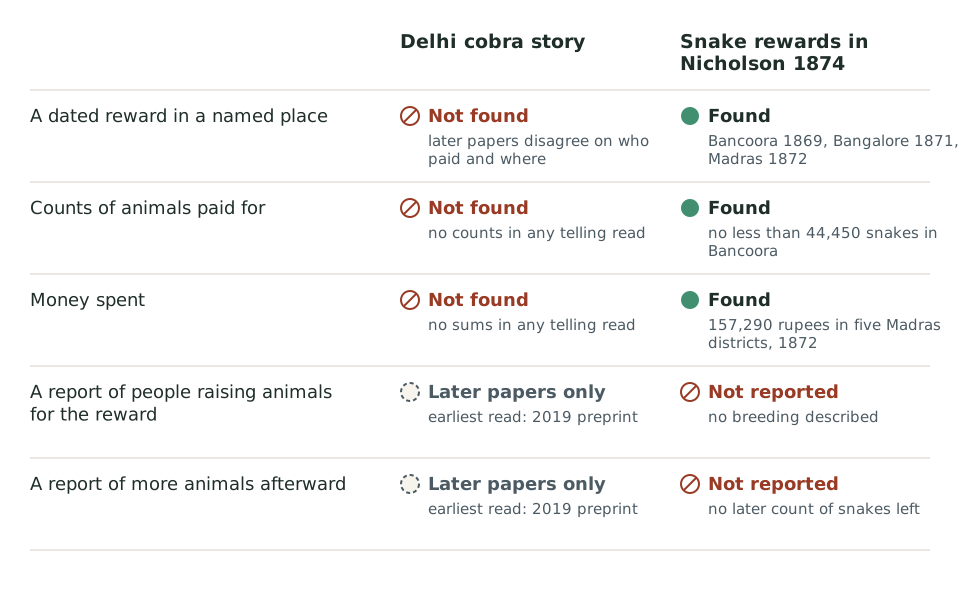
Diagram: Feedback & Forgetting, CC BY 4.0
Copy the credit line
"What a record would show: the cobra story vs. snake rewards on record" by Feedback & Forgetting, https://feedbackandforgetting.com/systems-loops/cobra-effect/, licensed under CC BY 4.0, https://creativecommons.org/licenses/by/4.0/What a record of a reward that backfired would show, for the Delhi story and for the rewards Nicholson reported. The same grid is in the table below.
As of November 6, 2026, the cobra bounty story has the source status later retelling only. The readable versions date from 2019 to 2026, the name is credited to a 2001 book, and no record of the Delhi bounty from the time of British rule turned up. That is a statement about this search as of that date, and it leaves the question of what happened open. Archives in Delhi, Indian newspapers of the period and Siebert's book were not read, and a record could sit in any of them.
| What a record would show | Delhi cobra story | Snake rewards in Nicholson 1874 |
|---|---|---|
| A dated reward in a named place | Not found; later papers disagree on who paid and where | Found: Bancoora 1869, Bangalore 1871, Madras 1872 |
| Counts of animals paid for | Not found; no counts in any telling read | Found: no less than 44,450 snakes in Bancoora |
| Money spent | Not found; no sums in any telling read | Found: 157,290 rupees in five Madras districts, 1872 |
| A report of people raising animals for the reward | Later papers only; earliest read: 2019 preprint | Not reported; no breeding described |
| A report of more animals afterward | Later papers only; earliest read: 2019 preprint | Not reported; no later count of snakes left |
The cobra story is also a different kind of claim from Goodhart's law, which this site follows back to a 1975 paper. That law is a general rule about measures, while the cobra story is told as a single example of a reward that backfired. A general rule can be tested on many cases, but an example only works as evidence if the example itself is on record.
If you reward yourself for a count, such as cards reviewed or pages read, check now and then what the count is buying. Nicholson did that when he reported which snakes the Bangalore rewards had bought. Most of them were the wrong snakes. A few questions answered from memory, days after you studied, will tell you whether your count still tracks what you wanted from it.
Data: Sources on the cobra story and on snake rewards in India
Each row is one claim about one source. Four sources described in the text above are left out of this file: the Manheim and Garrabrant preprint and the Olden review, which carry non-commercial licenses; the Chollete and Harrison paper, whose reuse permission is limited in time; and the remark credited to Twain, known here only secondhand.
| Row | Source | Claim | Value (quoted) | Read as |
|---|---|---|---|---|
| R01 | Nicholson 1874 | Snakes brought in for a reward in Bancoora, Lower Bengal, May 29 to December 7, 1869, listed as venomous with a question mark | no less than 44,450 snakes | Full text |
| R02 | Nicholson 1874 | Money spent on the Bancoora reward, May 29 to December 7, 1869, at 4 annas a head for most of the period | not less than 10,000 rupees | Full text |
| R03 | Nicholson 1874 | Share of snakes paid for that were really venomous, Bangalore municipal scheme, 1871 | about 5 percent | Full text |
| R04 | Nicholson 1874 | Venomous snakes brought in for reward in one Bangalore season, May to September; reward cut from 8 annas to 3 annas | no less than 1,400 snakes | Full text |
| R05 | Nicholson 1874 | Spent in five Madras Presidency districts in 1872 on two-anna rewards for snakes destroyed | 157,290 rupees | Full text |
| R06 | Twain 1897 | Snakes killed by the government in India over six years, from government tallies | 1,073,540 snakes | Full text |
| R08 | Siebert 2001 | A 2001 book titled Der Kobra-Effekt, credited in later papers with the name | Citation only | |
| R09 | Vann 2003 | A 2003 paper titled Of Rats, Rice, and Race: The Great Hanoi Rat Massacre, an Episode in French Colonial History | Citation only | |
| R10 | Lucas & Fuller 2018 | A 2018 article titled Bounties, grants, and market-making entrepreneurship, details as given in a later reference list | Citation only | |
| R13 | Della Sala 2022 | Sets the story in New Delhi, with a British Governor paying cash at city hall | Full text | |
| R14 | Della Sala 2022 | Calls the story a likely apocryphal anecdote and credits the term to Siebert | Full text | |
| R15 | Korteling et al. 2023 | Gives cobra effect as another name for a perverse incentive effect, citing Siebert 2001; tells no story | Full text | |
| R16 | Rodriguez & Oppenheimer 2025 | Has the British pay for cobra skins, then release of bred cobras; names no city | Full text | |
| R17 | Kelleher et al. 2025 | Sets the story in Delhi, with a bounty on dead cobras; cites an online encyclopedia entry | Full text |
Download the data (CSV, cobra-effect-sources.csv) · Where each value comes from (JSON) Data: Nicholson, E. (1874). Indian Snakes: An Elementary Treatise on Ophiology. Madras: Higginbotham. Public domain.; Twain, M. (1897). Following the Equator. Hartford, CT: American Publishing Company. Public domain.; Della Sala, S. (2022). Dementia & Neuropsychologia 16(2): 129-134, doi:10.1590/1980-5764-DN-2022-V001, CC BY 4.0 (https://creativecommons.org/licenses/by/4.0/); Korteling, J. E., Paradies, G. L., & Sassen-van Meer, J. P. (2023). Frontiers in Psychology 14: 1129835, doi:10.3389/fpsyg.2023.1129835, CC BY 4.0 (https://creativecommons.org/licenses/by/4.0/); Rodriguez, C., & Oppenheimer, D. M. (2025). PLOS One 20(4): e0322149, doi:10.1371/journal.pone.0322149, CC BY 4.0 (https://creativecommons.org/licenses/by/4.0/); Kelleher, M. E., et al. (2025). AEM Education and Training 9(2): e70006, doi:10.1002/aet2.70006, CC BY 4.0 (https://creativecommons.org/licenses/by/4.0/)
Retrieval check
Answer from memory first, then follow the link to the passage and check.
- What is the earliest telling of the cobra bounty story this page could read, and when was that version written? Back to the passage
- Why is “no record found so far” a statement about a search rather than about the past? Back to the passage
- What would a record of a reward that backfired need to show? Back to the passage · How this site checks a feedback loop for a test on record
Sources
- Nicholson, E. (1874). Indian Snakes: An Elementary Treatise on Ophiology, with a Descriptive Catalogue of the Snakes Found in India and the Adjoining Countries. Madras: Higginbotham. https://archive.org/details/cu31924002874356
- Twain, M. (1897). Following the Equator: A Journey Around the World. Hartford, CT: American Publishing Company. https://archive.org/details/followingequator00twaiuoft
- Twain, M. (2010). Autobiography of Mark Twain, Volume 1. Berkeley: University of California Press. As listed by Olden et al. (2026, ref. 88). https://doi.org/10.1038/s44185-026-00132-x
- Siebert, H. (2001). Der Kobra-Effekt: Wie man Irrwege der Wirtschaftspolitik vermeidet. Munich: Deutsche Verlags-Anstalt. As listed by Korteling et al. (2023) and Della Sala (2022, ref. 26). https://doi.org/10.3389/fpsyg.2023.1129835
- Manheim, D., & Garrabrant, S. (2018). Categorizing variants of Goodhart's Law. arXiv:1803.04585, version 4 (2019). Preprint. https://arxiv.org/abs/1803.04585
- Chollete, L., & Harrison, S. G. (2021). Unintended consequences: Ambiguity neglect and policy ineffectiveness. Eastern Economic Journal, 47(2), 206–226. doi:10.1057/s41302-021-00187-7 https://doi.org/10.1057/s41302-021-00187-7
- Della Sala, S. (2022). Individual integrity and public morality in scientific publishing. Dementia & Neuropsychologia, 16(2), 129–134. doi:10.1590/1980-5764-DN-2022-V001 https://doi.org/10.1590/1980-5764-DN-2022-V001
- Korteling, J. E., Paradies, G. L., & Sassen-van Meer, J. P. (2023). Cognitive bias and how to improve sustainable decision making. Frontiers in Psychology, 14, 1129835. doi:10.3389/fpsyg.2023.1129835 https://doi.org/10.3389/fpsyg.2023.1129835
- Rodriguez, C., & Oppenheimer, D. M. (2025). Side effects may include: Consequence neglect in generating solutions. PLOS One, 20(4), e0322149. doi:10.1371/journal.pone.0322149 https://doi.org/10.1371/journal.pone.0322149
- Kelleher, M. E., Santen, S. A., Draper, C., Jordan, J., Gottlieb, M., & Kinnear, B. (2025). Board scores in the spotlight: Public reporting and the unintended consequences. AEM Education and Training, 9(2), e70006. doi:10.1002/aet2.70006 https://doi.org/10.1002/aet2.70006
- Olden, J. D., Diallo, J. O., Fricke, R. M., Jameson, E., Johnson, R. C., Stiling, R. R., & Thompson, B. K. (2026). Society’s struggle with unwanted species: what centuries of history reveal about species bounty programs. npj Biodiversity, 5, 22. doi:10.1038/s44185-026-00132-x https://doi.org/10.1038/s44185-026-00132-x
- Lucas, D. S., & Fuller, C. S. (2018). Bounties, grants, and market-making entrepreneurship. The Independent Review, 22, 507–528. As listed by Olden et al. (2026, ref. 89). https://doi.org/10.1038/s44185-026-00132-x
- Vann, M. G. (2003). Of rats, rice, and race: The Great Hanoi Rat Massacre, an episode in French colonial history. French Colonial History, 4, 191–203. doi:10.1353/fch.2003.0027 https://doi.org/10.1353/fch.2003.0027
- Crossref. Update searches (corrections, retractions, expressions of concern) for doi:10.1353/fch.2003.0027, doi:10.1057/s41302-021-00187-7, doi:10.1590/1980-5764-DN-2022-V001, doi:10.3389/fpsyg.2023.1129835, doi:10.1371/journal.pone.0322149, doi:10.1002/aet2.70006 and doi:10.1038/s44185-026-00132-x. https://api.crossref.org/works?filter=updates:10.1353/fch.2003.0027
Cite this page
Feedback & Forgetting. (2026-11-06). Cobra Effect: Did People Breed Cobras? No Record Found Yet. https://feedbackandforgetting.com/systems-loops/cobra-effect/ (accessed [date you read it])
No DOI is assigned to this page; cite the address above with the date you read it.
Related reading
-
Systems & Loops
Feedback Loop Examples: Which Ones Have a Test on Record
Picture credit
"Boulton and Watt centrifugal governor" by Andy Dingley — https://commons.wikimedia.org/wiki/File:Boulton_and_Watt_centrifugal_governor.jpg — CC BY 3.0 (https://creativecommons.org/licenses/by/3.0/); modifications: cropped
-
Systems & Loops
Goodhart’s Law: Cited to a 1975 Paper on Monetary Policy
Picture credit
Illustration: Feedback & Forgetting. Generated schematic illustration — not a photograph or historical record. © Feedback & Forgetting, all rights reserved.