Vocabulary Size Test: What Counts as a Word Sets the Score
Study File Feedback & Forgetting Published
Short answer. A vocabulary size test like the one Marc Brysbaert and colleagues ran online checks which words from a fixed list you know, so its total depends on what that list counts as a word and on what the task accepts as knowing one. In their 2016 study, the median 20-year-old native speaker of American English knew about 42,000 lemmas, or dictionary-style base forms, but about 11,100 word families. Earlier estimates for adults gathered in the same paper run from 9,800 to 215,000. Before you compare two scores, check which unit and which task each test used.
In one sentence: The same 2016 test put the median 20-year-old native speaker of American English at about 42,000 lemmas or about 11,100 word families, so a vocabulary size score means little until you know what the test counted as a word.
Outline5 sections
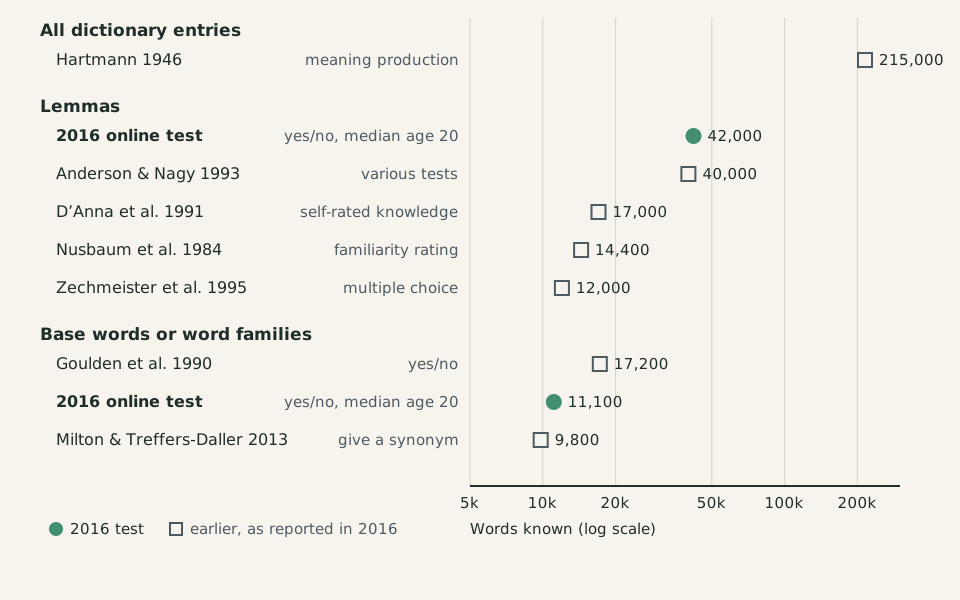
Diagram: Feedback & Forgetting, CC BY 4.0
Copy the credit line
"Estimates of English words known by adults, grouped by what counted as a word" by Feedback & Forgetting, https://feedbackandforgetting.com/language-minds/vocabulary-size/, licensed under CC BY 4.0, https://creativecommons.org/licenses/by/4.0/Data: Brysbaert, M., Stevens, M., Mandera, P., & Keuleers, E. (2016). How many words do we know? Practical estimates of vocabulary size dependent on word definition, the degree of language input and the participant's age. Frontiers in Psychology 7: 1116, doi:10.3389/fpsyg.2016.01116, CC BY 4.0 (https://creativecommons.org/licenses/by/4.0/), Table 3 (earlier estimates, as reported) and Table 4 (2016 medians)
Figure 1. Estimates of how many English words adults know, grouped by what each study counted as a word. The earlier values are as listed in Table 3 of Brysbaert, Stevens, Mandera and Keuleers (2016); the filled dots are that paper's own medians for 20-year-olds.
You get 100 letter strings on a screen and tick the ones you know as English words. A third of them are made up, and you were warned that ticking those counts against you. Published answers to how many words an adult knows run from under 10,000 to over 200,000, and this page asks what a test like this actually counts.
That task was one session of an online vocabulary test analyzed by Marc Brysbaert, Michaël Stevens, Paweł Mandera and Emmanuel Keuleers in a 2016 paper in Frontiers in Psychology. The paper, “How Many Words Do We Know?”, is open access under a CC BY license and could be read in full. The test drew 221,268 people, and the estimates below are for the native speakers of American English among them.
Study File
- Experiment
- Online yes/no vocabulary test of a 61,800-lemma list ("How Many Words Do We Know?")
- Researcher and year
- Marc Brysbaert, Michaël Stevens, Paweł Mandera and Emmanuel Keuleers; Frontiers in Psychology, 2016
- Subjects
- 221,268 people took the online test (265,346 sessions; at most three per person analyzed); the estimates are for the native speakers of American English among them, whose number the paper does not state
- Materials and delays
- 67 real words and 33 made-up non-words per session, drawn from 61,800 lemmas (18,269 word families); up to three sessions per person analyzed, no delay
- Design
- Participants marked the words they knew; the share of non-words marked was subtracted from the share of words marked, and each corrected score was read as the share of the full list known, reported by age and education level.
- Main finding
- Median 20-year-old: 68.0% of the lemma list, about 42,000 lemmas, or about 11,100 word families; median 60-year-old: about 48,200 lemmas or 13,400 word families. Range among 20-year-olds (5th to 95th percentile): 27,100 to 51,700 lemmas.
- Replication status
- Replication tag: [single study] About 42,000 lemmas known by the median 20-year-old. No independent replication with a matching design found in a search of Europe PMC on 2026-11-06. Scope: native speakers of American English, online yes/no recognition test with a guessing correction, up to three sessions per person, no delay. Based on full text. Checked 2026-11-06.
- Validity
- Crossref lists no correction, retraction or expression of concern for Brysbaert et al. 2016, Goulden, Nation & Read 1990 or Nation 2006 (checked 2026-11-06).
- Meaning for learners, within these conditions
- For native speakers of American English on a recognition test, the total depends on the unit: lemmas give nearly four times the count of word families. Before comparing two vocabulary scores, check which unit and which task each used.
This card as a spreadsheet (CSV, vocabulary-size-study-file.csv) · Where each value comes from (JSON)
Data: Brysbaert, M., Stevens, M., Mandera, P., & Keuleers, E. (2016). How many words do we know? Practical estimates of vocabulary size dependent on word definition, the degree of language input and the participant's age. Frontiers in Psychology 7: 1116, doi:10.3389/fpsyg.2016.01116, CC BY 4.0 (https://creativecommons.org/licenses/by/4.0/)
How the test worked
Each session showed 67 real words and 33 non-words, drawn at random. The non-words were generated with a program called Wuggy. The real words came from a list of 61,800 lemmas that the team assembled from word-frequency lists and free spell-checker lists, keeping words that people outside a specialty would likely want to know.
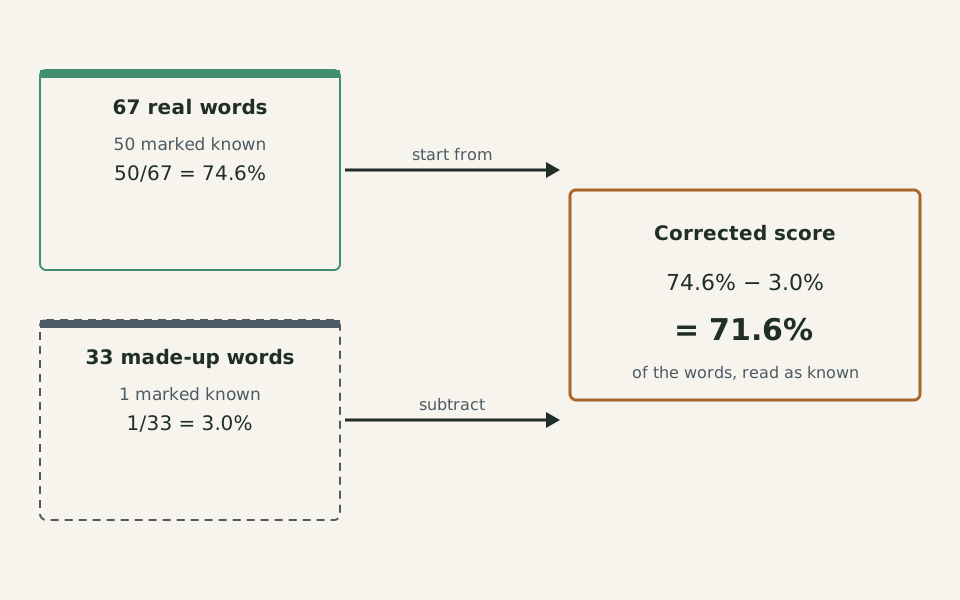
Diagram: Feedback & Forgetting, CC BY 4.0
Copy the credit line
"How the 2016 yes/no vocabulary test scored one session" by Feedback & Forgetting, https://feedbackandforgetting.com/language-minds/vocabulary-size/, licensed under CC BY 4.0, https://creativecommons.org/licenses/by/4.0/Figure 2. The guessing correction in the 2016 test, using the worked example from the paper with the arithmetic redone. The share of made-up words ticked is subtracted from the share of real words ticked.
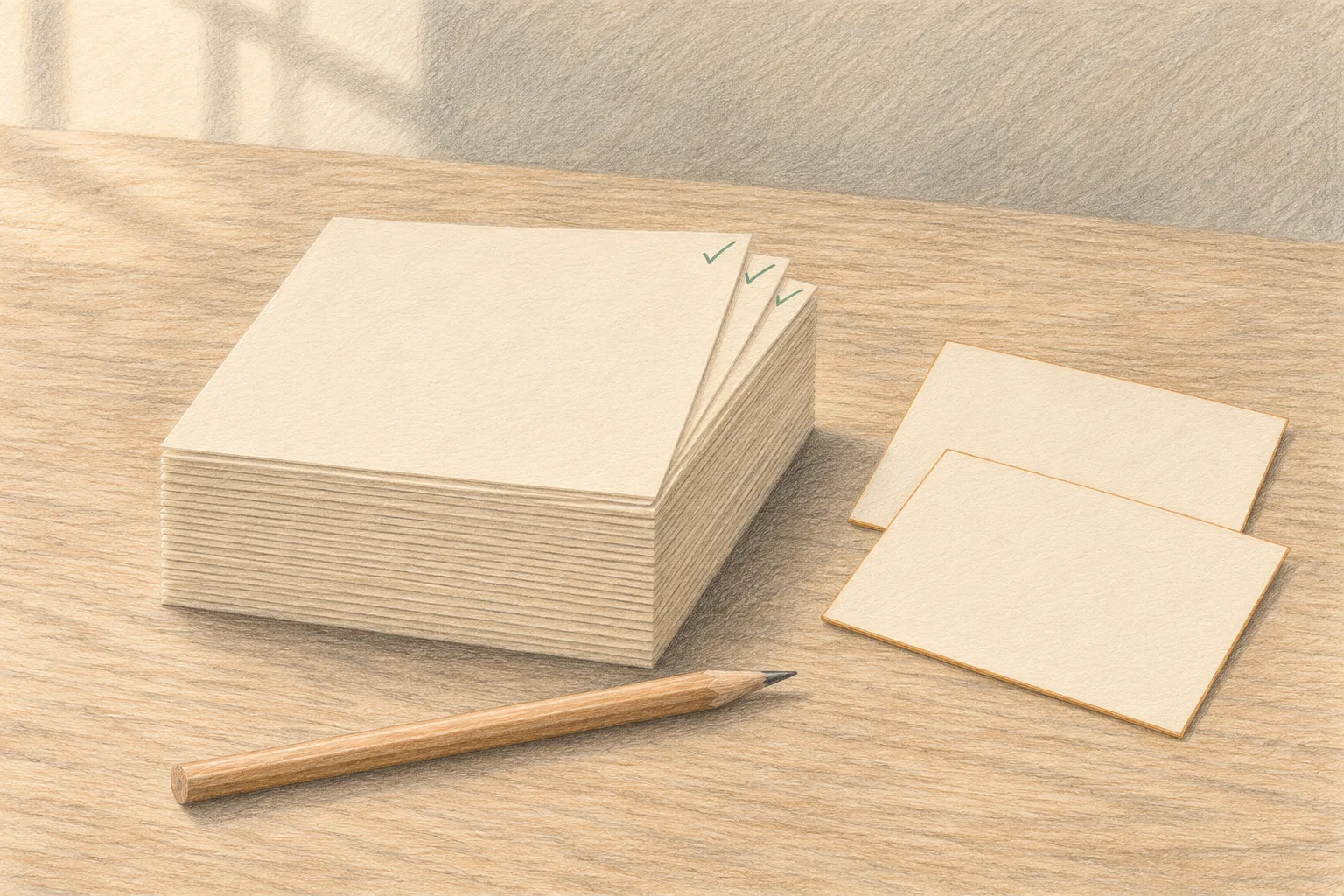
Illustration: Feedback & Forgetting. Generated schematic illustration — not a photograph or historical record. © Feedback & Forgetting, all rights reserved.
Ticking the words you know: in the 2016 test, made-up words were mixed in with the real ones so that guessing could be caught. A scene illustration; the cards set aside stand for no number.
The correction is simple. Your share of real words ticked, minus your share of non-words ticked, is read as the share of words you know.
The paper's example is someone who ticked 50 of 67 words and 1 of 33 non-words. It prints the result as 0.746 − 0.033 = 0.713. Recomputed, 1 of 33 is 0.030, so the corrected score works out to 0.716. The example only shows how the rule works; the paper's estimates come from the full data, which this page did not recompute.
Across people, the sessions covered all 61,800 lemmas and more than 100,000 non-words. Some people took the test over and over, so the analysis kept at most each person's first three sessions. A tick only means you recognized a string as a word. The authors stress that this knowledge “can be as shallow as knowing that the word exists.”
What counts as a word
Change the unit, and the same pile of words gives a very different total. A word form is any distinct spelling, so play, plays and played count as three. A lemma drops the regular endings: those three become the single lemma play. A word family goes one step further and groups a base word with the words built from it, so player, playful and replay join play.
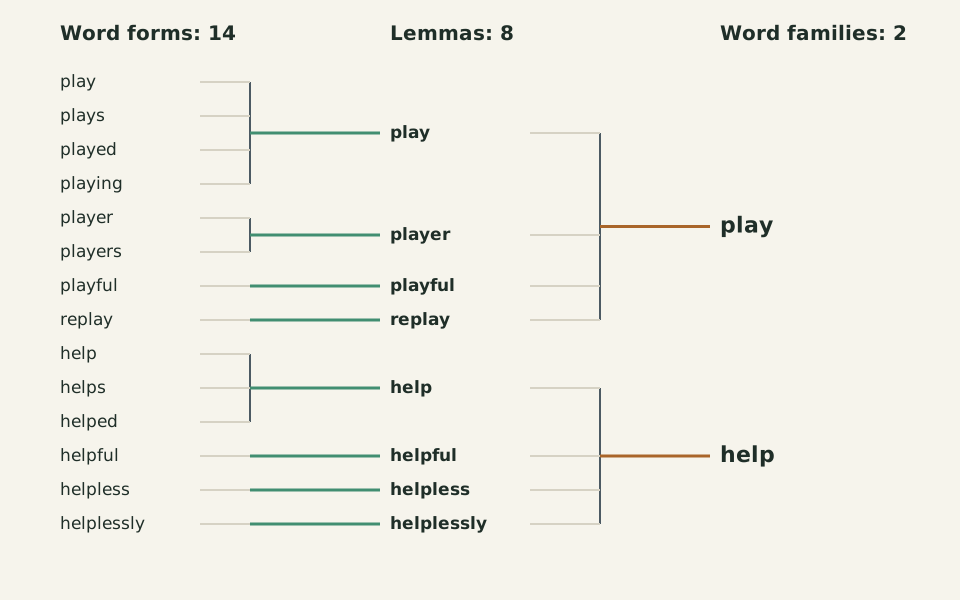
Diagram: Feedback & Forgetting, CC BY 4.0
Copy the credit line
"The same 14 words counted as word forms, lemmas and word families" by Feedback & Forgetting, https://feedbackandforgetting.com/language-minds/vocabulary-size/, licensed under CC BY 4.0, https://creativecommons.org/licenses/by/4.0/Figure 3. A made-up example of the three units defined in Brysbaert and colleagues (2016): 14 word forms, 8 lemmas and 2 word families. In that paper's definition, lemmas generally leave out names.
Grouped into families, the 61,800 lemmas on the test list came down to 18,269 word families. The team grouped words as broadly as they reasonably could, and they write that less strict grouping, which keeps more related words apart, could push the count to 20,000 or even 25,000 families. Some cases have no clean answer, such as whether abbey, abbot and abbess form one family or three.
The list itself matters too. As described in the 2016 paper, the preface of Webster's Third New International Dictionary claimed over 450,000 words. By that paper's account, a 1990 analysis by Goulden, Nation and Read brought that down to 208,000 distinct lemmas once inflections, names and repeat entries for words with several meanings were removed, and to 54,000 base words. A test scales its score up from the size of its list, so the same share known gives a bigger total on a bigger list.
The estimates
In the 2016 test, the median 20-year-old knew 68.0% of the lemma list. That is 42,024 lemmas when recomputed from the list size; the paper gives 42,000. The same people knew 60.8% of the word families, or about 11,100. Same people, same answers, different unit: counting lemmas gave nearly four times the total of counting families (3.78 times).
Replication tag: [single study] About 42,000 lemmas known by the median 20-year-old. Native speakers of American English, online yes/no test with a guessing correction, up to three sessions per person, no delay. No independent replication with a matching design found in a search of Europe PMC. Based on full text. Checked 2026-11-06.
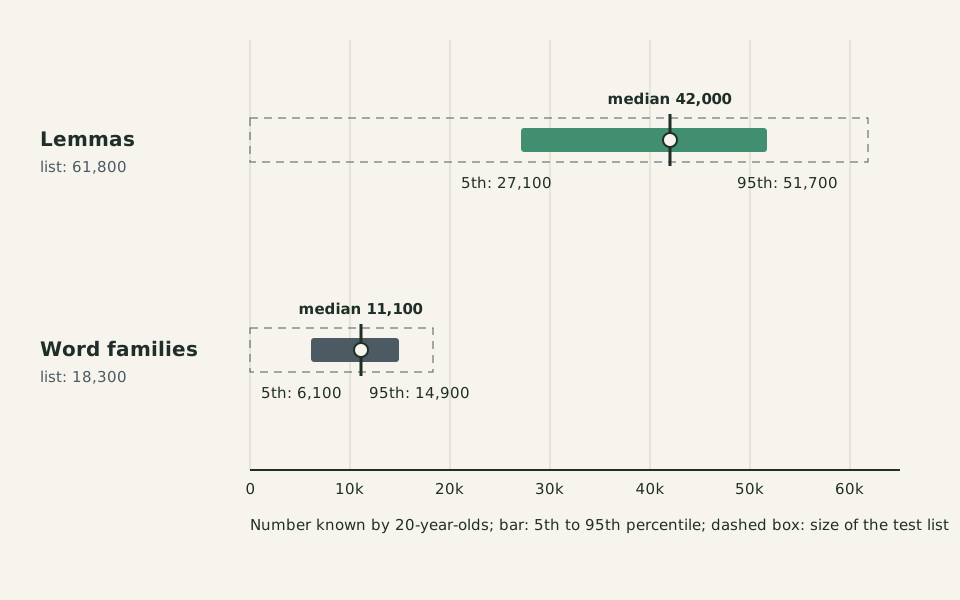
Diagram: Feedback & Forgetting, CC BY 4.0
Copy the credit line
"Spread among 20-year-olds in the 2016 test, lemmas versus word families" by Feedback & Forgetting, https://feedbackandforgetting.com/language-minds/vocabulary-size/, licensed under CC BY 4.0, https://creativecommons.org/licenses/by/4.0/Data: Brysbaert, M., Stevens, M., Mandera, P., & Keuleers, E. (2016). How many words do we know? Practical estimates of vocabulary size dependent on word definition, the degree of language input and the participant's age. Frontiers in Psychology 7: 1116, doi:10.3389/fpsyg.2016.01116, CC BY 4.0 (https://creativecommons.org/licenses/by/4.0/), Table 4
Figure 4. How much 20-year-olds in the 2016 test differed, from the 5th to the 95th percentile, for lemmas and word families. Values from Table 4 of Brysbaert and colleagues (2016). The dashed boxes show the size of each list.
People differed widely. Among 20-year-olds, the 5th percentile knew about 27,100 lemmas and the 95th about 51,700. The paper adds about 4,200 multiword expressions, such as kick the bucket, whose meaning can't be read from their parts. These were not on the test list.
Counting every inflected form instead of lemmas would raise the total again. The paper estimates that lemmas make up about 60% of English word forms, so it multiplies by 1.7. For the median 20-year-old, that gives about 71,400 word forms, including endings such as -s and -ed.
The task matters too. In Hartmann's 1946 study, as described in the 2016 paper, 106 students defined 50 words sampled from a dictionary of 400,000. They managed 26.9 on average, which scales to the 215,000 in Figure 1. By the same account, Milton and Treffers-Daller used the same words as Goulden and colleagues but asked mainly first-year students for a synonym or explanation, and got 9,800 word families against 17,200 from 20 graduates' simple yes or no. The 2016 authors call their own figures “upper estimates” of word knowledge, measured for breadth rather than depth.
Age and reading
Older test takers knew more words. The median 60-year-old knew 78.0% of the lemma list, about 48,200 lemmas, against 42,000 at age 20. For word families, the medians were 13,400 and 11,100.
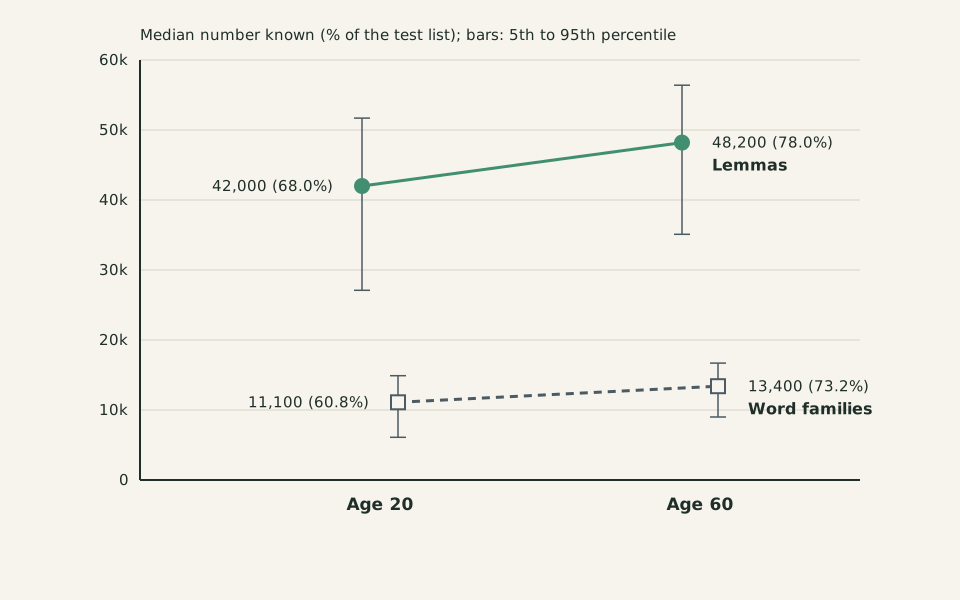
Diagram: Feedback & Forgetting, CC BY 4.0
Copy the credit line
"Median words known at age 20 and age 60 in the 2016 test" by Feedback & Forgetting, https://feedbackandforgetting.com/language-minds/vocabulary-size/, licensed under CC BY 4.0, https://creativecommons.org/licenses/by/4.0/Data: Brysbaert, M., Stevens, M., Mandera, P., & Keuleers, E. (2016). How many words do we know? Practical estimates of vocabulary size dependent on word definition, the degree of language input and the participant's age. Frontiers in Psychology 7: 1116, doi:10.3389/fpsyg.2016.01116, CC BY 4.0 (https://creativecommons.org/licenses/by/4.0/), Table 4 and Results
Figure 5. Median lemmas and word families known at ages 20 and 60 in the 2016 test, with the share of each list in brackets. Bars show the 5th to 95th percentile. Values from Table 4 and the results of Brysbaert and colleagues (2016).
The gap is 6,200 lemmas over 40 years, which the paper describes as about one new lemma every two days. Recomputed, it is one every 2.36 days. The abstract gives the gap as 6,000. These are different people of different ages who took the test, not the same people tested twice.
Scores also rose with education, and the authors think this gap “likely illustrates the impact of reading and studying.” The paper shows the education groups only in a figure, so this page gives no numbers for them. It also works out how many distinct letter strings a person could meet. A 20-year-old whose language came only from conversation would meet about 84,000 (Table 4; a summary sentence in the text gives 81,000), and one reading nonstop 16 hours a day about 292,000. Those are strings encountered, including names and typos, not words known.
What the counts mean for a learner
The 2016 estimates are for native speakers, so their totals are not targets for someone learning English. A separate question is how many words you need to follow a text. Nation, of Victoria University of Wellington, took up that question in a 2006 paper in The Canadian Modern Language Review. According to its abstract, if you need to know 98% of the words in a text to understand it without help, written English takes 8,000 to 9,000 word families and spoken English 6,000 to 7,000.
[status not assigned] Word families needed to follow written and spoken English, if 98% coverage is needed. Word-family lists made from the British National Corpus; abstract-level evidence only. Based on the abstract. Checked 2026-11-06.
The 2016 figures also measure recognition, not use. Citing earlier studies, the authors write that the words you can use yourself are thought to be less than half the words you recognize, and the gap is widest for rarer words.
Nation's counts are word families, but not the same families as in the 2016 list. As described in the 2016 paper, Nation's own grouping kept more words apart, giving about 28,000 families from the British National Corpus. So even two family counts need checking before you set them side by side.
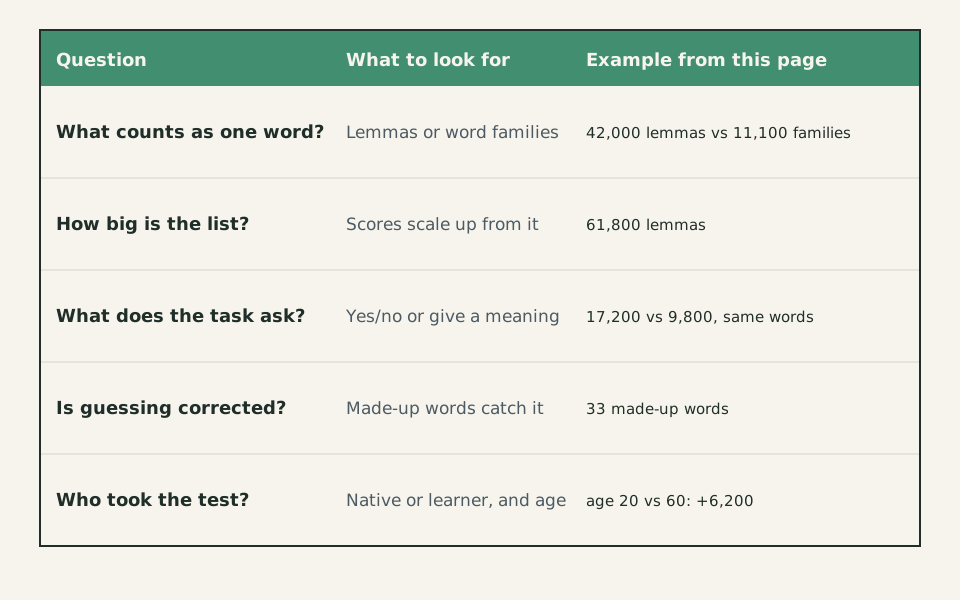
Diagram: Feedback & Forgetting, CC BY 4.0
Copy the credit line
"Five questions to ask before comparing two vocabulary size test scores" by Feedback & Forgetting, https://feedbackandforgetting.com/language-minds/vocabulary-size/, licensed under CC BY 4.0, https://creativecommons.org/licenses/by/4.0/Figure 6. Five things to check before comparing two vocabulary size test scores, with an example of each from this page. The same content is in the table below.
| Question | What to look for | Example from this page |
|---|---|---|
| What counts as one word? | Lemmas or word families | 42,000 lemmas vs 11,100 families |
| How big is the list? | Scores scale up from it | 61,800 lemmas |
| What does the task ask? | Yes/no or give a meaning | 17,200 vs 9,800, same words |
| Is guessing corrected? | Made-up words catch it | 33 made-up words |
| Who took the test? | Native or learner, and age | age 20 vs 60: +6,200 |
The age you start learning is a separate question; this site's critical period hypothesis review reads a large 2018 grammar quiz on whether a late start limits grammar. And the review of the benefits of being bilingual looks at what a second language might change beyond words themselves.
The next time you see a vocabulary size score, yours or a quoted one, find three things before you compare it: the unit it counts, the size of the list it scales from, and whether it asked you to recognize a word or explain it.
Data: Words known in the 2016 test, by age and percentile
| Age | Percentile | Lemmas known (quoted) | Word families known (quoted) | Source (read as) |
|---|---|---|---|---|
| 20 | 5th | about 27,100 | about 6,100 | Brysbaert et al. 2016, Table 4 (full text) |
| 20 | median | about 42,000 | about 11,100 | Brysbaert et al. 2016, Table 4 (full text) |
| 20 | 95th | about 51,700 | about 14,900 | Brysbaert et al. 2016, Table 4 (full text) |
| 60 | 5th | about 35,100 | about 9,000 | Brysbaert et al. 2016, Table 4 (full text) |
| 60 | median | about 48,200 | about 13,400 | Brysbaert et al. 2016, Table 4 (full text) |
| 60 | 95th | about 56,400 | about 16,700 | Brysbaert et al. 2016, Table 4 (full text) |
Download the data (CSV, vocabulary-size-estimates.csv) · Where each value comes from (JSON) Data: Brysbaert, M., Stevens, M., Mandera, P., & Keuleers, E. (2016). How many words do we know? Practical estimates of vocabulary size dependent on word definition, the degree of language input and the participant's age. Frontiers in Psychology 7: 1116, doi:10.3389/fpsyg.2016.01116, CC BY 4.0 (https://creativecommons.org/licenses/by/4.0/), Tables 3 and 4 and text; Nation, I. (2006). How large a vocabulary is needed for reading and listening? The Canadian Modern Language Review 63(1), 59–82, doi:10.3138/cmlr.63.1.59 (abstract; quoted values, publisher's terms apply)
How the table was built. Values are from Table 4 of Brysbaert, Stevens, Mandera and Keuleers (2016), CC BY 4.0, for native speakers of American English. The download adds the median shares of each list, the earlier estimates from the paper's Table 3 as reported there, the recomputed values named on this page, and the ranges from the abstract of Nation (2006). Recomputing the medians from the shares and list sizes gives 42,024, 48,204, 11,108 and 13,373, each within 50 of the printed value.
Retrieval check
Answer from memory first, then follow the link to the passage and check.
- Counted as word forms, lemmas and word families, how many words are play, plays, player and replay? Back to the passage
- How did the 2016 test correct for people who ticked words they did not know? Back to the passage
- What three things should you check before comparing two vocabulary size scores? Back to the passage · Age and grammar in the critical period review
Sources
- Brysbaert, M., Stevens, M., Mandera, P., & Keuleers, E. (2016). How many words do we know? Practical estimates of vocabulary size dependent on word definition, the degree of language input and the participant's age. Frontiers in Psychology, 7, 1116. doi:10.3389/fpsyg.2016.01116 https://doi.org/10.3389/fpsyg.2016.01116
- Goulden, R., Nation, P., & Read, J. (1990). How large can a receptive vocabulary be? Applied Linguistics, 11(4), 341–363. doi:10.1093/applin/11.4.341 https://doi.org/10.1093/applin/11.4.341
- Nation, I. (2006). How large a vocabulary is needed for reading and listening? The Canadian Modern Language Review, 63(1), 59–82. doi:10.3138/cmlr.63.1.59 https://doi.org/10.3138/cmlr.63.1.59
- Crossref. Work records and update searches (corrections, retractions, expressions of concern) for the three DOIs cited on this page. https://api.crossref.org/works?filter=updates:10.3389/fpsyg.2016.01116
Cite this page
Feedback & Forgetting. (2026-11-06). Vocabulary Size Test: What Counts as a Word Sets the Score. https://feedbackandforgetting.com/language-minds/vocabulary-size/ (accessed [date you read it])
No DOI is assigned to this page; cite the address above with the date you read it.
Related reading
-
Language Minds
Critical Period Hypothesis: Does Grammar Learning Ebb at 17?
Picture credit
Illustration: Feedback & Forgetting. Generated schematic illustration — not a photograph or historical record. © Feedback & Forgetting, all rights reserved.
-
Language Minds
Bilingual Advantage: Mixed Evidence on Adult Mental Control
Picture credit
"The Tower of Babel" by Pieter Bruegel the Elder — https://commons.wikimedia.org/wiki/File:Pieter_Bruegel_d._%C3%84.,_Kunsthistorisches_Museum_Wien,_Gem%C3%A4ldegalerie_-_Turmbau_zu_Babel_-_GG_1026_-_Kunsthistorisches_Museum.jpg — Public domain (painter d. 1569; oil on oak panel, 1563, Kunsthistorisches Museum Vienna GG 1026; public domain in the EU (70 years after the author's death) and in the US (published long before 1931); faithful photographic reproduction of a two-dimensional work (PD-Art); photograph supplied by the Kunsthistorisches Museum (file page source field))