Bilingual Advantage: Mixed Evidence on Adult Mental Control
Method deep read Feedback & Forgetting Published
Short answer. The best-known claimed benefit of being bilingual is sharper mental control, which researchers call executive control: better scores on lab tasks of attention, inhibition and switching. A 2018 meta-analysis that pooled 152 studies of adults found a very small edge in inhibition, switching and working memory, and no evidence of it remained after correcting for publication bias, according to its abstract. A 2015 study found that conference reports backing the advantage were the most likely to reach print. A 2020 open-access meta-analysis that pooled children and adults found that the corrected answer depends on the correction method; taken together, the adult evidence is mixed.
In one sentence: In adult studies, the claim that being bilingual sharpens mental control shrank under some corrections for which studies got published, but not under all.
Outline6 sections
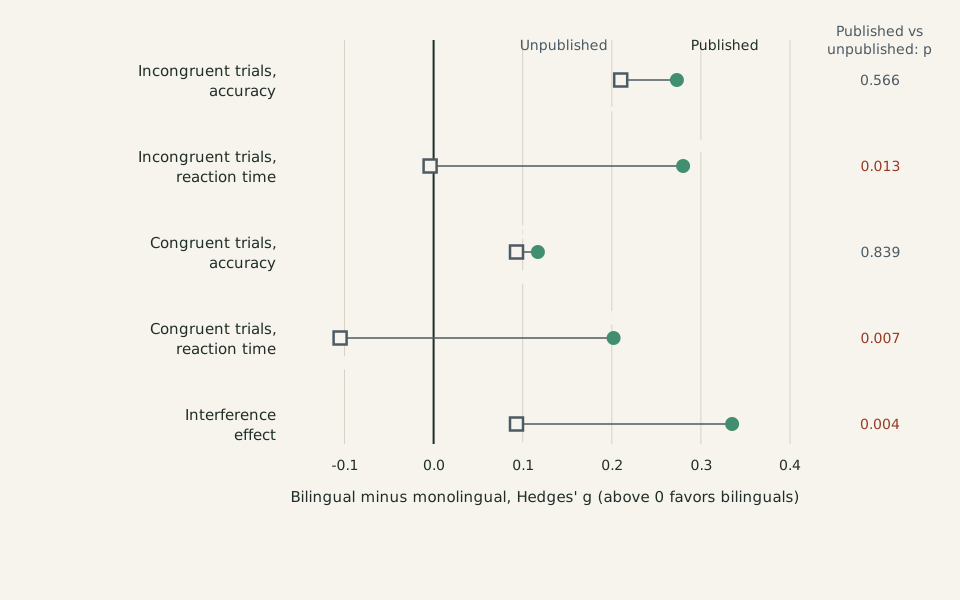
Diagram: Feedback & Forgetting, CC BY 4.0
Copy the credit line
"Published and unpublished studies of the bilingual advantage" by Feedback & Forgetting, https://feedbackandforgetting.com/language-minds/bilingual-advantage/, licensed under CC BY 4.0, https://creativecommons.org/licenses/by/4.0/Data: Ware, A. T., Kirkovski, M., & Lum, J. A. G. (2020). Meta-analysis reveals a bilingual advantage that is dependent on task and age. Frontiers in Psychology 11: 1458, doi:10.3389/fpsyg.2020.01458, CC BY 4.0 (https://creativecommons.org/licenses/by/4.0/), Table 5 and Results
Average difference between bilingual and monolingual groups, in Hedges' g, for published and unpublished studies on five task measures (Ware, Kirkovski and Lum 2020, Table 5). The studies pool all ages, from children to adults aged 50 and over. The right-hand column gives the p value of the test comparing published with unpublished averages.
In 2015, Angela de Bruin and two colleagues checked which bilingualism conference abstracts from 1999 to 2012 later reached print. The abstracts were all on bilingualism and executive control, the skill of steering attention and holding back a habitual response. Studies that fully backed a bilingual advantage were the most likely to become journal papers, and studies that challenged it were the least likely. The question is whether speaking two languages gives adults sharper mental control, or whether the published record made the edge look bigger than it is.
This page reads the evidence on that one claimed benefit. It covers adults and lab tasks of attention and switching; studies of children and of aging are left out, for reasons given below. Most of the studies could be read only as abstracts, and the wording here is matched to that.
What the bilingual advantage claim says

“The Tower of Babel”, Pieter Bruegel the Elder, public domain
Full credit
"The Tower of Babel" by Pieter Bruegel the Elder — https://commons.wikimedia.org/wiki/File:Pieter_Bruegel_d._%C3%84.,_Kunsthistorisches_Museum_Wien,_Gem%C3%A4ldegalerie_-_Turmbau_zu_Babel_-_GG_1026_-_Kunsthistorisches_Museum.jpg — Public domain (painter d. 1569; oil on oak panel, 1563, Kunsthistorisches Museum Vienna GG 1026; public domain in the EU (70 years after the author's death) and in the US (published long before 1931); faithful photographic reproduction of a two-dimensional work (PD-Art); photograph supplied by the Kunsthistorisches Museum (file page source field))Pieter Bruegel the Elder, The Tower of Babel, 1563 (Kunsthistorisches Museum, Vienna).
On one account, a bilingual person has to keep selecting the right language while holding back the other. Researchers proposed that years of this practice train general control skills. If so, bilinguals should do better even on tasks with no language in them. The 2020 review by Anna Ware, Melissa Kirkovski and Jarrad Lum sets out this account and cites, among others, a series of papers by Ellen Bialystok.
This page calls the claimed effect the mental-control edge. Researchers use several names for the skills involved: executive functioning, executive control, cognitive control. The 2018 meta-analysis led by Minna Lehtonen sorted them into six executive domains, including inhibition, shifting, working memory, monitoring and attention.
The theory also makes predictions about who should gain most. Lehtonen's team tested a number of study, task and participant features as moderators. By the abstract, the moderator results did not support the theory's assumptions.
The tasks behind it
Most of these studies use reaction-time tasks with two kinds of trials. On a congruent trial, everything on the screen points to the same answer. On an incongruent trial, something on the screen points to the wrong answer, and you have to hold back that pull.
In a Flanker task, you press a key for the direction of a center arrow while ignoring the arrows on either side. Ware's review also scored the Simon task by congruent and incongruent trials. Its Stroop example is built the same way: the word GREEN printed in red ink, where you name the ink color.
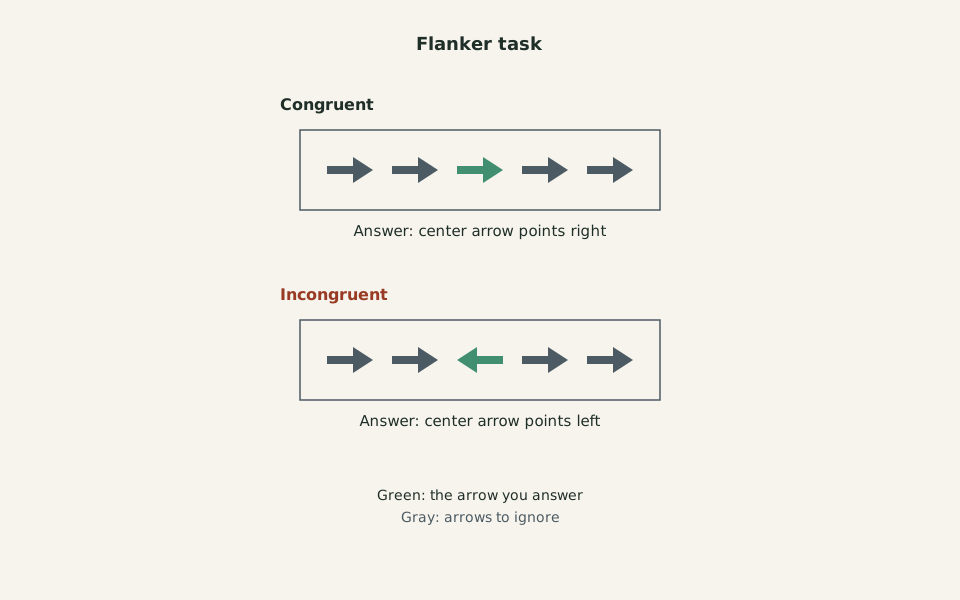
Diagram: Feedback & Forgetting, CC BY 4.0
Copy the credit line
"Congruent and incongruent trials in a Flanker task" by Feedback & Forgetting, https://feedbackandforgetting.com/language-minds/bilingual-advantage/, licensed under CC BY 4.0, https://creativecommons.org/licenses/by/4.0/Congruent and incongruent trials in a Flanker task, drawn from Ware's description of the task rather than from any published version. On incongruent trials the side arrows pull toward the wrong answer; the extra time those trials take is the interference cost.
The interference cost is the difference between the two kinds of trials: how much slower you are when the screen pulls the wrong way. A smaller cost is read as better control. Ware's team treats congruent trials as a measure of general speed, since they place the least demand on control.
Results are given as Hedges' g, the gap between two group averages, in standard deviations, adjusted for sample size. A g of 0.1 means the group averages sit a tenth of a standard deviation apart. Lehtonen's abstract calls the advantages it found before correction very small.
One complication runs through this work. Tasks meant to measure the same skill often fail to agree within the same people. Kenneth Paap and Zachary Greenberg wrote in 2013 that interference in one task often does not predict interference in a related one, according to their abstract. Ware's team cites a correlation of just 0.14 between Simon and Flanker scores from earlier studies.
Which results reached print
De Bruin, Barbara Treccani and Sergio Della Sala started from conference abstracts presented between 1999 and 2012 on bilingualism and executive control. They then checked which of those studies were later published. Those whose results fully supported the advantage were the most likely to be published. Studies with mixed results came next; those that challenged the advantage came last.
Replication tag: [single study] Conference abstracts on bilingualism and executive control, 1999–2012, followed to journal publication. No study repeating this design was found in the searches for this page. Based on the abstract. Checked 2026-11-06.
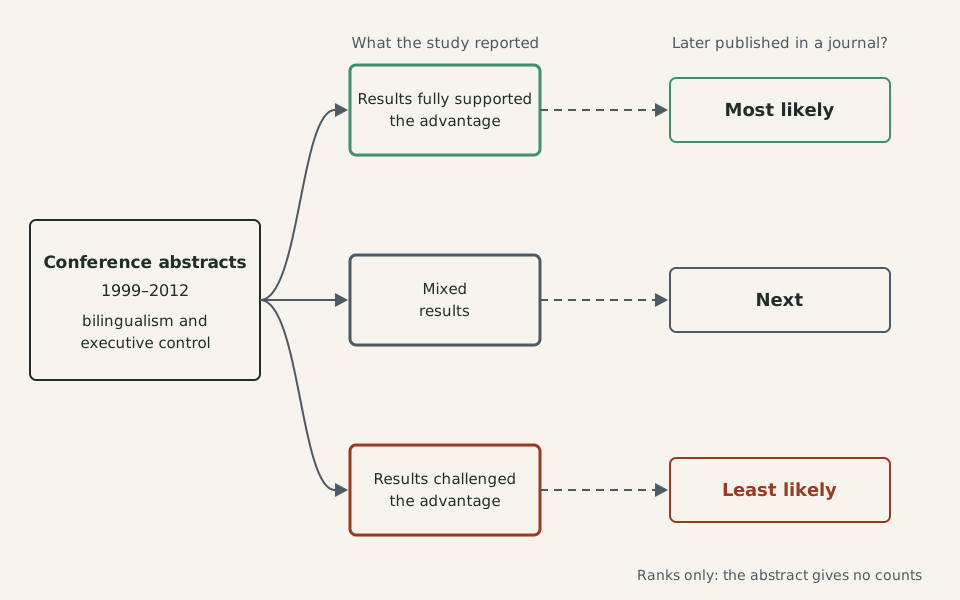
Diagram: Feedback & Forgetting, CC BY 4.0
Copy the credit line
"From conference abstract to journal paper" by Feedback & Forgetting, https://feedbackandforgetting.com/language-minds/bilingual-advantage/, licensed under CC BY 4.0, https://creativecommons.org/licenses/by/4.0/The 2015 study's design, as its abstract describes it: conference abstracts sorted by what their studies reported, then followed to journal publication. The order comes from the abstract, which gives no counts, so none are drawn.
By the abstract, the gap was not explained by sample size, the tests used or statistical power. A funnel-plot test also pointed to publication bias. Since the abstract gives no counts, this page gives no publication rate.
What a funnel plot looks for
A funnel plot sets each study's effect size against its standard error, a measure of how precise the study is. Without publication bias, Ware's team explains, the effect sizes spread evenly around the average; with it, the plot turns lopsided. Egger's test puts a number on that lopsidedness, and a significant result means bias may be present.
Publication bias, as Ware's team defines it, means that positive or significant results are more likely to reach print than non-significant ones. When that happens, a review that pools only published studies can overestimate the effect. The 2015 finding drew a published reply in the same journal that year from Ellen Bialystok, Judith Kroll, David Green, Brian MacWhinney and Fergus Craik, titled “Publication Bias and the Validity of Evidence: What’s the Connection?” Only its citation was read for this page.
Ware's 2020 meta-analysis put numbers on a related question. Its 170 studies included 59 unpublished ones, found through the reference lists of earlier reviews. On all five measures in its bias table, published studies showed a larger bilingual edge than unpublished ones. For the interference effect, the published average was g = 0.335 and the unpublished average 0.093, a gap of 0.242.
That gap was statistically significant for the three reaction-time measures, with p values from 0.004 to 0.013, but not for the two accuracy measures. The table pools every age group in the review, from children to adults aged 50 and over.
What corrected reviews found
A meta-analysis pools many studies into one estimate. A publication-bias correction then asks what that estimate would be if the missing, mostly unpublished results were counted. Ware's team points out that there is no agreed way to do this. The methods can disagree widely.
Lehtonen's team pooled 891 effect sizes from 152 studies of adults and included unpublished data. Before correction, the abstract reports a very small bilingual advantage for inhibition, shifting and working memory, and none for monitoring or attention. After correction, no evidence for an advantage remained. As reported by Ware's team, Lehtonen's overall estimate went from g = 0.06 to g = −0.08 (p = 0.099) under a correction called PET-PEESE.
The same abstract also reports a small bilingual disadvantage in verbal fluency, possibly because each language gets less use when a person splits time between two. [status not assigned] Adults, verbal fluency tasks. One meta-analysis, read as an abstract only. Abstract-level evidence only. Checked 2026-11-06.
Word knowledge in each language is a different measurement question, covered in this site's look at what vocabulary size tests count.
A 2019 meta-analysis by Seamus Donnelly, Patricia Brooks and Bruce Homer pooled 80 studies, with 253 effect sizes, on nonverbal interference-control tasks. Its preferred analysis found a very small edge in overall reaction time, g = 0.13, which was no longer significant after correction, according to the abstract. For the interference cost itself, it found a very small but significant edge, g = 0.11; the abstract does not say whether that estimate was corrected. The authors call the evidence for an advantage on these tasks weak.
Earlier, in 2013, Paap and Greenberg compared bilinguals and monolinguals in three studies on 15 measures of executive processing, using Simon, Flanker, antisaccade and color-shape switching tasks. By their abstract, the key group-by-condition pattern showed up on only one measure, and that one pointed toward a bilingual disadvantage. The result held when the authors looked only at highly fluent bilinguals, or at groups closely matched on their parents' education. The two groups also scored the same on a reasoning test.
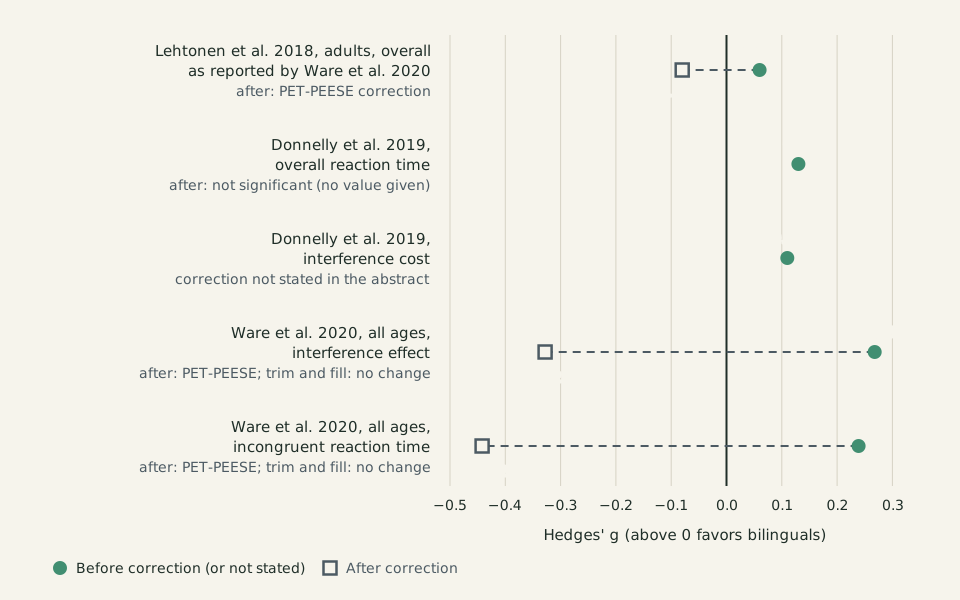
Diagram: Feedback & Forgetting, CC BY 4.0
Copy the credit line
"Bilingual-advantage estimates before and after bias correction" by Feedback & Forgetting, https://feedbackandforgetting.com/language-minds/bilingual-advantage/, licensed under CC BY 4.0, https://creativecommons.org/licenses/by/4.0/Data: Ware, A. T., Kirkovski, M., & Lum, J. A. G. (2020). Meta-analysis reveals a bilingual advantage that is dependent on task and age. Frontiers in Psychology 11: 1458, doi:10.3389/fpsyg.2020.01458, CC BY 4.0 (https://creativecommons.org/licenses/by/4.0/), Table 5; Lehtonen et al. (2018) values as reported there; Donnelly, S., Brooks, P. J., & Homer, B. D. (2019). Psychonomic Bulletin & Review 26(4): 1122–1147, doi:10.3758/s13423-019-01567-z, abstract (quoted figures only)
Estimates before correction (circles) and after correction for publication bias (squares), where a value could be read. For Donnelly's interference cost, the abstract does not say whether the value was corrected. Lehtonen values are as reported by Ware's team; Donnelly values come from that paper's abstract; Ware values come from their Table 5, all ages pooled.
| Review | Measure | Before correction, g (quoted) | After correction, g (quoted) | Read as |
|---|---|---|---|---|
| Lehtonen et al. 2018, adults | All executive domains together | 0.06 (as reported) | −0.08 (as reported) | Abstract; values from Ware et al. 2020 |
| Donnelly et al. 2019 | Overall reaction time | 0.13 | Not significant; no value given | Abstract |
| Donnelly et al. 2019 | Interference cost | 0.11 (correction not stated) | Not stated | Abstract |
| Ware et al. 2020, all ages | Interference effect | 0.268 | 0.268 (trim and fill); −0.328 (PET-PEESE) | Full text |
| Ware et al. 2020, all ages | Incongruent reaction time | 0.239 | 0.239 (trim and fill); −0.442 (PET-PEESE) | Full text |
Why two corrections disagree
Before any correction, Ware's review found bilingual edges on some tasks but not others: four of seven tasks for speed and four of seven for accuracy on incongruent trials.
The team then ran two checks that only ask whether bias is likely. Egger's test said yes for four of the five measures, while a count called the fail-safe N said no wherever it could be computed.
Two further corrections estimate a corrected effect. They split. Trim and fill left every estimate unchanged. PET-PEESE turned all five negative, which taken literally would mean monolinguals do better.
The authors tentatively suggest that PET-PEESE overcorrects here. It lowered their estimates by 0.110 to 0.681, while published and unpublished averages differed by only 0.024 to 0.307 (both ranges recomputed here from their bias table, and matching the ranges the authors give). Even so, they partly align with Donnelly's team's suggestion that the size of the advantage has been overstated.
Put together, the corrected reviews do not agree. In Lehtonen's review no evidence of the edge remained after correction; in Donnelly's, one measure lost significance and the abstract gives no corrected value for the other; in Ware's, the answer depends on the method. Lehtonen's review and the 2015 publication study share an author, Angela de Bruin. So the two are not independent checks on each other.
Bilingual adults outperforming monolingual adults on executive-control tasks: Replication tag: [mixed] Adults (Ware's pooled analysis also includes children, and Donnelly's abstract does not limit the age range), nonverbal lab tasks of attention, inhibition and switching, single test sessions. Based on abstracts and one full text. Checked 2026-11-06.
This page does not call the advantage unsupported. That would take a corrected estimate with a confidence interval narrow enough to rule out a meaningful edge, and the abstracts read here give none.
What this page leaves out
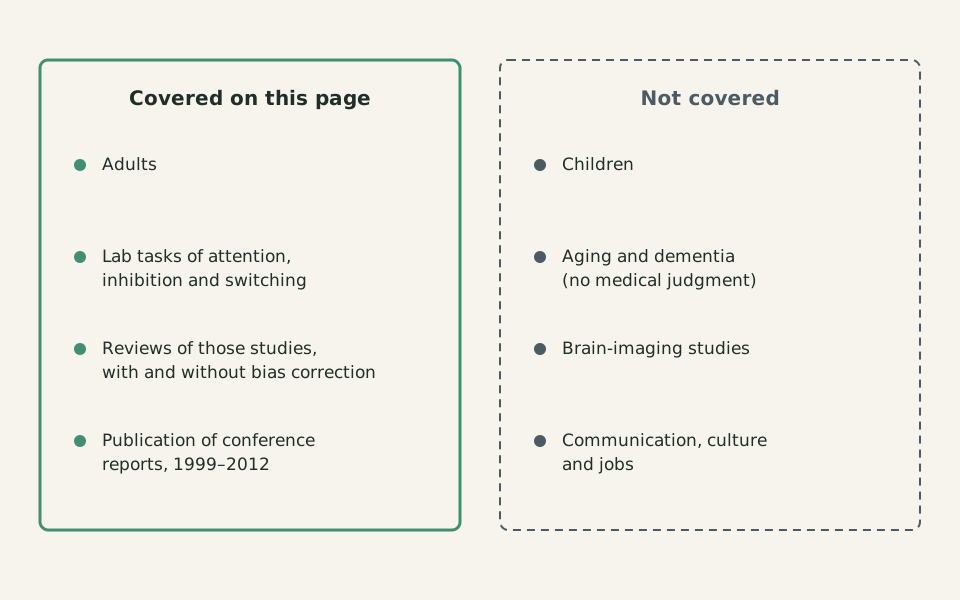
Diagram: Feedback & Forgetting, CC BY 4.0
Copy the credit line
"What this page covers and leaves out" by Feedback & Forgetting, https://feedbackandforgetting.com/language-minds/bilingual-advantage/, licensed under CC BY 4.0, https://creativecommons.org/licenses/by/4.0/What this page covers and what it leaves out. The same list appears in the table below.
| Topic | On this page? | Why |
|---|---|---|
| Adults on lab tasks of attention, inhibition and switching | Yes | The claim this page checks |
| Reviews with and without bias correction | Yes | They decide how big the edge is |
| Publication of conference reports, 1999–2012 | Yes | It shows how the record could tilt |
| Children | No | A separate set of studies, not read for this page |
| Aging and dementia | No | A health question; no medical judgment is offered |
| Brain-imaging studies | No | Not read for this page |
| Communication, culture and jobs | No | No studies on these were read for this page |
Studies of bilingual children and of adults aged 50 and over are both part of Ware's pooled table. That review reports that the uncorrected edge differed by age group. Whether children show an edge is a separate question with its own reviews, and this page does not weigh it.
This page does not cover studies of aging or of dementia, and it offers no medical judgment; questions about changes in memory or thinking belong with a doctor.
Being able to talk, read and work in two languages is the direct result of learning them, not a side effect on attention. This page read no studies on communication, culture or job outcomes, so it makes no claim about them. How the age you start relates to how far you get is a separate question, taken up in this site's review of the critical period hypothesis.
If you’re learning a second language

Illustration: Feedback & Forgetting. Generated schematic illustration — not a photograph or historical record. © Feedback & Forgetting, all rights reserved.
Two paths of the same width meeting at one gate: a scene illustration for this section. It does not show any study or result.
If part of your reason for learning a language is a sharper mind, the adult evidence above gives you little to count on. Where the abstracts give a size, the edge on these tasks was very small before correction. After correction, no evidence of it remained in one review; in the others it lost significance or depended on the method. These reviews pooled comparisons between bilingual and monolingual groups, not studies that followed adults as they learned a new language.
One detail surprised the review's own authors. In Donnelly's review, the edge in interference cost was larger in studies of people who learned their second language late than in studies of early learners, according to the abstract. That is one moderator result in one review. It does not show that starting a language as an adult will change your scores.
What a language course does give you can be checked directly in the language. For your next study session, measure progress there: test yourself a day later on the new words you studied, or check how much of a short recording you can follow before replaying it. If you want a broader measure of word knowledge, this site's guide to vocabulary size tests explains what those counts include and leave out.
Data: Publication-bias analyses in Ware, Kirkovski and Lum (2020)
| Study and measure, all ages pooled | Effect sizes, k (quoted) | Published g (quoted) | Unpublished g (quoted) | Published minus unpublished (recomputed) | Observed g (quoted) | Trim and fill g (quoted) | PET-PEESE g (quoted) |
|---|---|---|---|---|---|---|---|
| Ware 2020, Table 5 (full text): incongruent trials, accuracy | 118 | 0.273 | 0.210 | 0.063 | 0.261 | 0.261 | −0.330 |
| Ware 2020, Table 5 (full text): incongruent trials, reaction time | 180 | 0.280 | −0.004 | 0.284 | 0.239 | 0.239 | −0.442 |
| Ware 2020, Table 5 (full text): congruent trials, accuracy | 109 | 0.117 | 0.093 | 0.024 | 0.108 | 0.108 | −0.002 |
| Ware 2020, Table 5 (full text): congruent trials, reaction time | 181 | 0.202 | −0.105 | 0.307 | 0.150 | 0.150 | −0.334 |
| Ware 2020, Table 5 (full text): interference effect | 116 | 0.335 | 0.093 | 0.242 | 0.268 | 0.268 | −0.328 |
Download the data (CSV, bilingual-advantage-reviews.csv) · Where each value comes from (JSON) Data: Ware, A. T., Kirkovski, M., & Lum, J. A. G. (2020). Meta-analysis reveals a bilingual advantage that is dependent on task and age. Frontiers in Psychology 11: 1458, doi:10.3389/fpsyg.2020.01458, CC BY 4.0 (https://creativecommons.org/licenses/by/4.0/); Lehtonen, M., et al. (2018). Psychological Bulletin 144(4): 394–425, doi:10.1037/bul0000142, abstract (quoted figures only); Donnelly, S., Brooks, P. J., & Homer, B. D. (2019). Psychonomic Bulletin & Review 26(4): 1122–1147, doi:10.3758/s13423-019-01567-z, abstract (quoted figures only); Paap, K. R., & Greenberg, Z. I. (2013). Cognitive Psychology 66(2): 232–258, doi:10.1016/j.cogpsych.2012.12.002, abstract (quoted figures only); de Bruin, A., Treccani, B., & Della Sala, S. (2015). Psychological Science 26(1): 99–107, doi:10.1177/0956797614557866, abstract (no figures)
How the table was built. All quoted values are from Table 5 of Ware, Kirkovski and Lum (2020), licensed CC BY 4.0. Positive values favor bilinguals. The published-minus-unpublished column is recomputed here. The CSV also holds the abstract-level figures from the other reviews, one row per value.
Retrieval check
Answer from memory first, then follow the link to the passage and check.
- In a Flanker task, which kind of trial carries the conflict, and what score compares the two kinds? Back to the passage
- How did the 2015 study look for publication bias without running a new experiment? Back to the passage
- Which topics does this page leave out, and why? Back to the passage · Starting age and the critical period hypothesis
Sources
- Lehtonen, M., Soveri, A., Laine, A., Järvenpää, J., de Bruin, A., & Antfolk, J. (2018). Is bilingualism associated with enhanced executive functioning in adults? A meta-analytic review. Psychological Bulletin, 144(4), 394–425. doi:10.1037/bul0000142 https://doi.org/10.1037/bul0000142
- de Bruin, A., Treccani, B., & Della Sala, S. (2015). Cognitive advantage in bilingualism: An example of publication bias? Psychological Science, 26(1), 99–107. doi:10.1177/0956797614557866 https://doi.org/10.1177/0956797614557866
- Ware, A. T., Kirkovski, M., & Lum, J. A. G. (2020). Meta-analysis reveals a bilingual advantage that is dependent on task and age. Frontiers in Psychology, 11, 1458. doi:10.3389/fpsyg.2020.01458 https://doi.org/10.3389/fpsyg.2020.01458
- Paap, K. R., & Greenberg, Z. I. (2013). There is no coherent evidence for a bilingual advantage in executive processing. Cognitive Psychology, 66(2), 232–258. doi:10.1016/j.cogpsych.2012.12.002 https://doi.org/10.1016/j.cogpsych.2012.12.002
- Donnelly, S., Brooks, P. J., & Homer, B. D. (2019). Is there a bilingual advantage on interference-control tasks? A multiverse meta-analysis of global reaction time and interference cost. Psychonomic Bulletin & Review, 26(4), 1122–1147. doi:10.3758/s13423-019-01567-z https://doi.org/10.3758/s13423-019-01567-z
- Bialystok, E., Kroll, J. F., Green, D. W., MacWhinney, B., & Craik, F. I. M. (2015). Publication bias and the validity of evidence: What's the connection? Psychological Science, 26(6), 944–946. doi:10.1177/0956797615573759 https://doi.org/10.1177/0956797615573759
- Crossref. Work records and update searches (corrections, retractions, expressions of concern) for doi:10.1037/bul0000142, doi:10.1177/0956797614557866, doi:10.3389/fpsyg.2020.01458, doi:10.1016/j.cogpsych.2012.12.002, doi:10.3758/s13423-019-01567-z and doi:10.1177/0956797615573759. https://api.crossref.org/works/10.1037/bul0000142
Cite this page
Feedback & Forgetting. (2026-11-06). Bilingual Advantage: Mixed Evidence on Adult Mental Control. https://feedbackandforgetting.com/language-minds/bilingual-advantage/ (accessed [date you read it])
No DOI is assigned to this page; cite the address above with the date you read it.
Related reading
-

Language Minds
Critical Period Hypothesis: Does Grammar Learning Ebb at 17?
Picture credit
Illustration: Feedback & Forgetting. Generated schematic illustration — not a photograph or historical record. © Feedback & Forgetting, all rights reserved.
-

Language Minds
Vocabulary Size Test: What Counts as a Word Sets the Score
Picture credit
Illustration: Feedback & Forgetting. Generated schematic illustration — not a photograph or historical record. © Feedback & Forgetting, all rights reserved.