Incubation Effect: The Classic Stages Came From Self-Reports
Method deep read Feedback & Forgetting Published
Short answer. The incubation effect is the finding that setting an unsolved problem aside for a while can help you solve it when you come back. Graham Wallas's four stages of creative thought (1926), the usual starting point, were built from accounts that Hermann von Helmholtz and Henri Poincaré gave of their own discoveries, not from experiments. Lab tests came later: a 2009 meta-analysis by Ut Na Sio and Thomas Ormerod reported a positive incubation effect overall, larger for divergent thinking tasks than for insight puzzles, according to its abstract.
In one sentence: The famous four stages of creativity came from thinkers' memories of their own breakthroughs; the lab tests came decades later.
Outline6 sections
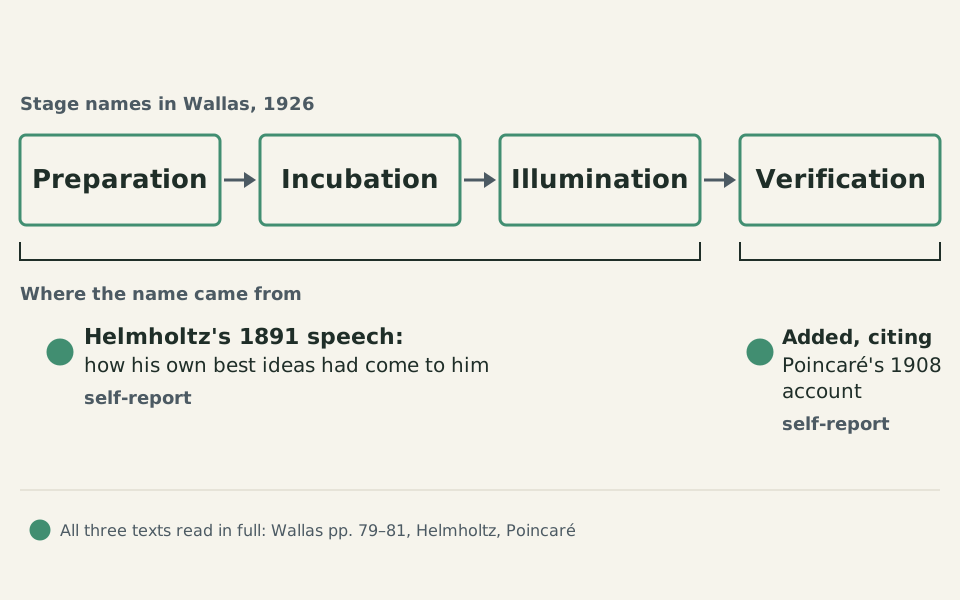
Diagram: Feedback & Forgetting, CC BY 4.0
Copy the credit line
"Where the four stage names came from" by Feedback & Forgetting, https://feedbackandforgetting.com/creative-minds/incubation-effect/, licensed under CC BY 4.0, https://creativecommons.org/licenses/by/4.0/Where each of Graham Wallas's four stage names came from, by his own account in The Art of Thought (1926, pp. 79–81). Both sources are people describing their own work.
In 1908, Henri Poincaré wrote that a mathematical idea came to him as he stepped onto a bus. In George Bruce Halsted's 1913 English translation the line reads: “At the moment when I put my foot on the step the idea came to me” (pp. 387–388). He had not been working on the problem; a geological field trip had pulled him away from it.
That story, and a similar one from Hermann von Helmholtz, became the base of the best-known model of creative thinking. Graham Wallas named the time away from the problem Incubation. This page asks what the classic stages rest on, and what lab tests have found since about setting a problem aside.
Where the four stages came from
“Henri Poincaré”, Manuel (photograph); Ch. Wittmann (printer), public domain
Full credit
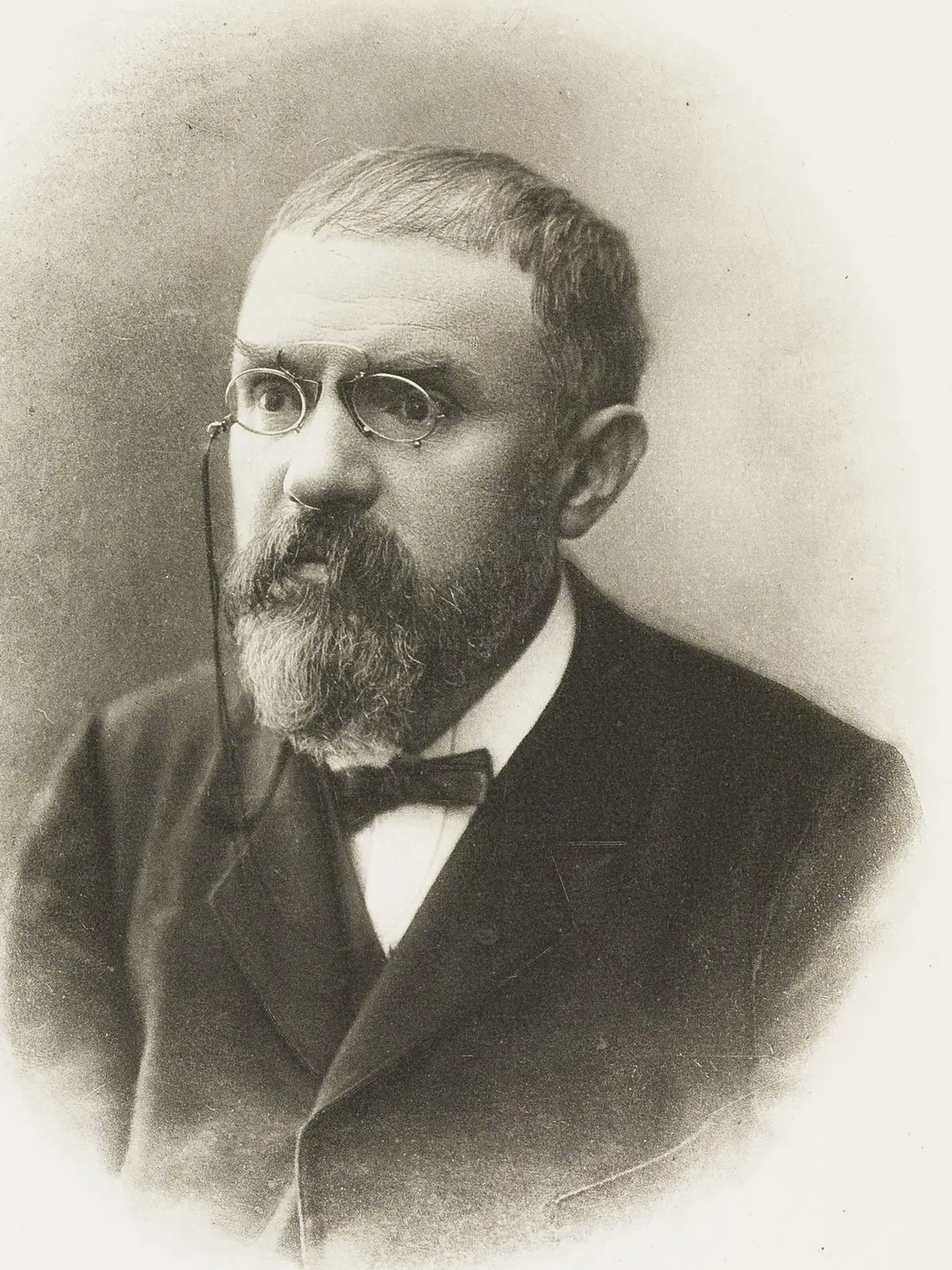
"Henri Poincaré" by Manuel (photograph); Ch. Wittmann (printer) — https://commons.wikimedia.org/wiki/File:Henri_Poincar%C3%A9,_PA03199.jpg — Public domain (Print inscribed “Cliché Manuel” (photograph) and “Imp. Ch. Wittmann” (printer); KU Leuven catalogue dates the printer as active 1891–1907, so the print was published by 1907. US: published before 1931, public domain. EU: photographer counted as Henri Manuel, head of the Manuel studio, d. 1947, so public domain since 2018 (70 years). Not verified: the studio was run by Henri Manuel with his brother Gaston, and the individual photographer is not named; no sign that the Mort pour la France extension applies (Henri Manuel died in 1947, after the war), not checked case by case. Year 1907 is the latest possible date, not a known date. Scan: KU Leuven Libraries print collection, PA03199, uploaded to Commons); modifications: cropped, resizedHenri Poincaré. Photograph by the Manuel studio, printed by Ch. Wittmann (KU Leuven Libraries, PA03199); undated, from the printer's active years 1891–1907.
Graham Wallas, an emeritus professor of political science at the University of London, published The Art of Thought in 1926. In it he set out four stages: Preparation, Incubation, Illumination and Verification. Three of them came from a single speech. In 1891, at a banquet for his seventieth birthday, the physicist Hermann von Helmholtz described how his best ideas had come to him (pp. 79–80).
In the English that Wallas quotes, Helmholtz said that once a problem had been investigated “in all directions,” happy ideas arrived unexpectedly. They never came to a tired mind or at his working table, and came most readily “during the slow ascent of wooded hills on a sunny day” (p. 80). Wallas took the quotation from a 1923 book by Rignano, Psychology of Reasoning. This page checked it against the German text of the speech, reprinted in Helmholtz's Vorträge und Reden (1903, vol. 1, pp. 15–16), and the sense matches.
Wallas then wrote: “Helmholtz here gives us three stages in the formation of a new thought” (p. 80). He named them Preparation, Incubation and Illumination, and added a fourth, Verification, “which Helmholtz does not here mention.” For it he turned to Poincaré's account of two of his own discoveries (pp. 80–81). The book came 35 years after the speech.
So the stages rest on self-reports: people describing, after the fact, how their own ideas arrived. Wallas said as much. His preface says his main material came from his own experience as a teacher and administrator and from accounts that poets and others gave of their thought processes. He calls Poincaré's account “introspective evidence” (p. 77).
Wallas also added a sub-stage, Intimation: the moment in Illumination when you sense that a solution is coming before you know what it is (p. 97). His evidence for it was again reported experience. A senior English civil servant and a university student had each described that feeling to him in almost the same words.
Poincaré's bus step, in his words
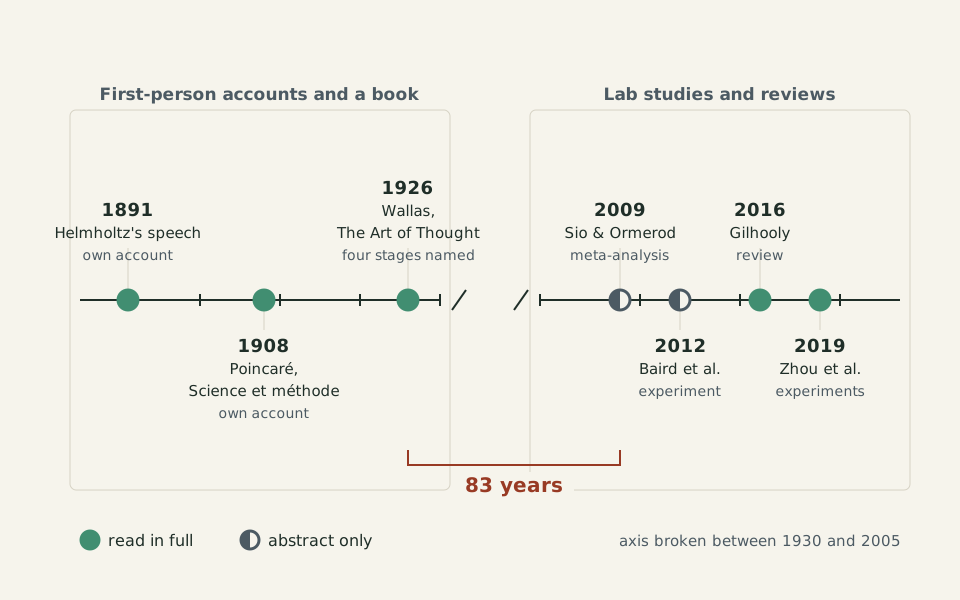
Diagram: Feedback & Forgetting, CC BY 4.0
Copy the credit line
"Incubation sources by year and by how much was read" by Feedback & Forgetting, https://feedbackandforgetting.com/creative-minds/incubation-effect/, licensed under CC BY 4.0, https://creativecommons.org/licenses/by/4.0/The sources this page draws on, by year: the year Helmholtz gave his speech, and the year of publication for the rest. Filled markers: read in full; half-filled: abstract only. The axis is broken between 1930 and 2005.
Poincaré told the story in a chapter on mathematical creation, “L'invention mathématique,” in Science et méthode (1908). For fifteen days he had sat at his work table for an hour or two at a time, trying combinations without result. A first result came one night soon after, and he took the next step by deliberate reasoning (p. 387). Just then he left Caen for a geological excursion, and “the changes of travel made me forget my mathematical work” (p. 387).
At Coutances the group boarded an omnibus, and the idea came as his foot touched the step, without anything in his earlier thoughts seeming to lead to it (French original, p. 51). He did not check it then. He went on with a conversation, felt “a perfect certainty,” and verified the result back in Caen (p. 388). He describes two more such moments, one on a walk along a seaside bluff and one in a street during his military service.
His reading of these moments was a theory, not a measurement. He called sudden illumination “a manifest sign of long, unconscious prior work” (p. 389). This unconscious work, he added, is fruitful only when conscious work comes before and after it.
Poincaré even weighed a plainer explanation and set it aside. Work after a rest might go better, he wrote, because “the rest has given back to the mind its force and freshness”; he judged it “more probable” that the rest had been filled with unconscious work (p. 389). That judgment came from his own memories, not from a test. The word incubation does not appear in the book, in French or in Halsted's English; Wallas supplied it.
Kenneth Gilhooly, in a 2016 review read here in full, points out the limit of evidence like this. Poincaré, he notes, based his analysis on self-reports of episodes from nearly 30 years earlier, and personal reports given long after the events are of doubtful reliability. That does not make Poincaré wrong. It makes his account a hypothesis to test.
How incubation is tested in the lab
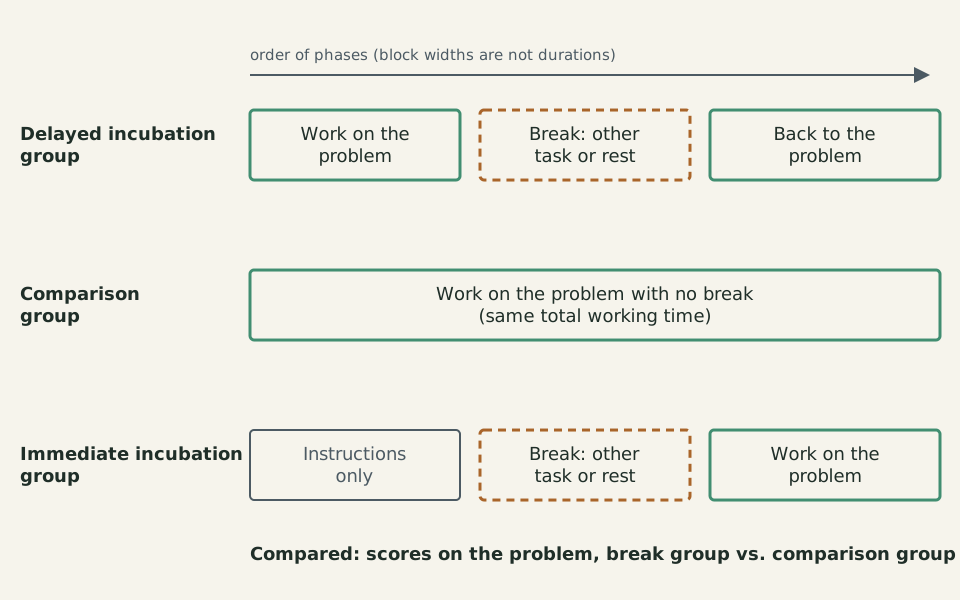
Diagram: Feedback & Forgetting, CC BY 4.0
Copy the credit line
"How incubation is tested: three lab designs" by Feedback & Forgetting, https://feedbackandforgetting.com/creative-minds/incubation-effect/, licensed under CC BY 4.0, https://creativecommons.org/licenses/by/4.0/Two lab designs described in Gilhooly's 2016 review, with their comparison group. The blocks show the order of the phases, not their length.
In the classic lab design, which Gilhooly calls the Delayed Incubation paradigm, people work on a problem for a set time. Then they switch to a different activity for a set break and return to the problem. A comparison group works on the problem without a break for the same total working time. If the break group does better, the difference is the incubation effect.
A newer variant, the Immediate Incubation paradigm, puts the break straight after the instructions, before any work on the problem. The tasks come in two kinds. Insight problems have one answer that needs a new way of seeing the problem. Divergent thinking tasks ask for many answers, such as listing unusual uses for a brick.
What gets scored depends on the task. Insight studies report solution rates, the share of people who solve the problem within the time allowed, the measure the 2009 meta-analysis abstract names. For divergent tasks, the studies Gilhooly describes score the number of ideas and sometimes also how novel they are.
A 2019 study by Xiang Zhou and colleagues shows the delayed design at small scale. In its second experiment, 48 pairs of college students listed ways to improve their university, sending ideas by chat for 20 minutes while seeing their partner's ideas.
One group worked straight through. The others stopped after 10 minutes for a 5-minute break, either relaxing or answering reasoning questions, then worked 10 minutes more. In the last 10 minutes, pairs who had answered the questions produced 4.81 more ideas on average than pairs who worked straight through.
Replication tag: [single study] Pairs of college students sending ideas by chat; 10 minutes, a 5-minute break, 10 more minutes; number of ideas in the last 10 minutes. No independent replication of this design found (search of 2026-11-06). Based on full text. Checked 2026-11-06.
The relaxing pairs also came out ahead, by 3.50 ideas, but that gap did not pass the stricter cutoff the authors used for testing several comparisons at once. In a third experiment, with individuals shown planted example ideas, it went the other way. Compared with people who saw the same examples and worked straight through, the relaxation break passed the authors' corrected cutoff and the task break did not. The same paper's findings on judged ideas appear in this site's review of brainstorming.
What the 2009 review reported
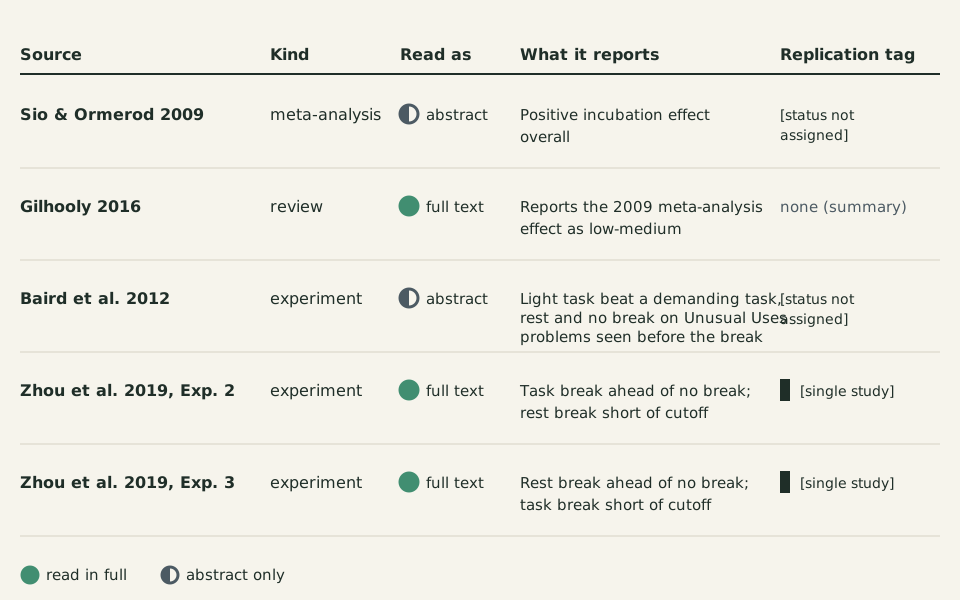
Diagram: Feedback & Forgetting, CC BY 4.0
Copy the credit line
"Lab evidence on incubation, source by source" by Feedback & Forgetting, https://feedbackandforgetting.com/creative-minds/incubation-effect/, licensed under CC BY 4.0, https://creativecommons.org/licenses/by/4.0/The lab evidence behind this page, source by source. The same information is in the Data table below, with a CSV file.
Ut Na Sio and Thomas Ormerod published a meta-analysis, which pools the results of many earlier studies, in Psychological Bulletin in 2009, 83 years after Wallas's book. Only its abstract could be read here. The abstract notes that some researchers had reported higher solution rates after an incubation period while others had failed to find an effect. Pooling the studies, the authors identified a positive incubation effect.
[status not assigned] Lab problem-solving and idea tasks pooled in one meta-analysis. Based on the review's abstract; bias correction not checked. Checked 2026-11-06.
The abstract gives neither the number of studies nor an effect size. Gilhooly's 2016 review reports both: 117 studies and a mean effect size of d = 0.29, which he places in the low-medium band. Here d is a standardized gap, the difference between the break and no-break groups divided by the spread of scores. This page took both numbers as Gilhooly reports them and did not check them against the 2009 paper.
The tag is missing for a reason. On this site a meta-analysis counts as replicated evidence only when its result holds after correcting for publication bias, the tendency of positive results to be published more often. The abstract does not say whether that correction was made, and the full paper could not be read. A reading of the full 2009 paper, or a later meta-analysis that reports a bias correction, could settle it.
Gilhooly concludes that delayed incubation effects are clearly established, especially for divergent problem solving; that is his reading, and the tag here waits for the bias check. He also draws the conclusion this page started from: with so many lab studies, the field no longer has to rely on introspective accounts like Poincaré's.
If you came here because a break seemed to help you remember something, that is a different question. Spacing study sessions apart is about memory for what you studied, and this site's review of spaced repetition covers its evidence; incubation is about solving a problem you are stuck on.
Which tasks, which breaks
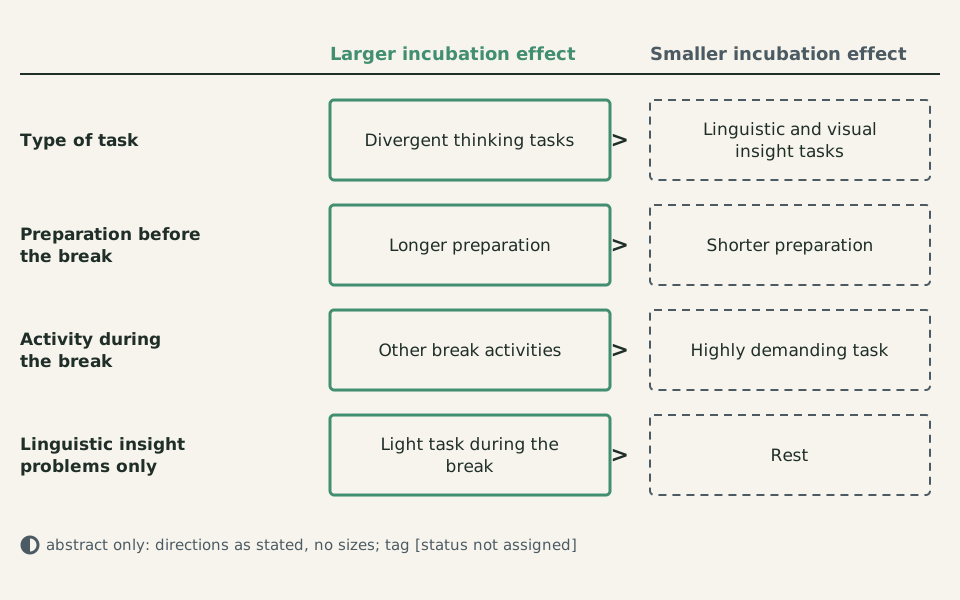
Diagram: Feedback & Forgetting, CC BY 4.0
Copy the credit line
"Which tasks and breaks showed larger incubation effects" by Feedback & Forgetting, https://feedbackandforgetting.com/creative-minds/incubation-effect/, licensed under CC BY 4.0, https://creativecommons.org/licenses/by/4.0/Four patterns reported in the abstract of the 2009 meta-analysis, without sizes. Each is listed in the text below.
The 2009 abstract also says where the incubation effect was larger or smaller:
- Type of task. Divergent thinking tasks benefited more from incubation than linguistic and visual insight tasks.
- Preparation. Longer preparation before the break gave a larger effect.
- Demanding break tasks. Filling the break with a highly demanding task gave a smaller effect.
- Light tasks vs. rest. For linguistic insight problems, a task of low cognitive demand gave a stronger effect than rest.
[status not assigned] Moderators in one meta-analysis of lab tasks; no effect sizes read. Based on the review's abstract; bias correction not checked. Checked 2026-11-06.
A 2012 experiment by Benjamin Baird and colleagues points the same way for the break activity. By its abstract, people who did an undemanding task during the break scored better on Unusual Uses problems they had already seen than people who did a demanding task, rested or had no break. The undemanding task went with more mind wandering, but not with more deliberate thoughts about the problem.
[status not assigned] Unusual Uses Task, one experiment; sample size not given in the abstract. Abstract-level evidence only. Checked 2026-11-06.
Wallas had already given his own advice in 1926. The break could go to other problems or to rest, and he thought the first kind “economizes time, and is therefore often the better” (p. 86).
Why a break might help
Gilhooly lists three candidate explanations. In intermittent work, people slip in thoughts about the problem during the break. In beneficial forgetting, a misleading approach fades, so you return with a fresh start.
In unconscious work, processing goes on without awareness, as Poincaré believed. Gilhooly argues that the evidence favors unconscious work, but at the level read here all three remain possible explanations, not tested causes. Getting stuck on a misleading approach is close to the fixation in this site's study file on functional fixedness.
Gilhooly also reports the evidence he weighs. Against intermittent work, he cites studies in which the break task did not suffer, as it should if people were secretly working on the problem, and Baird's finding that deliberate thoughts about the problem did not track the benefit. For beneficial forgetting, he cites a 1995 study in which people who had forgotten misleading cues were more likely to solve the problem. Those studies were not read here; they are his account of them.
What to do with a stuck problem
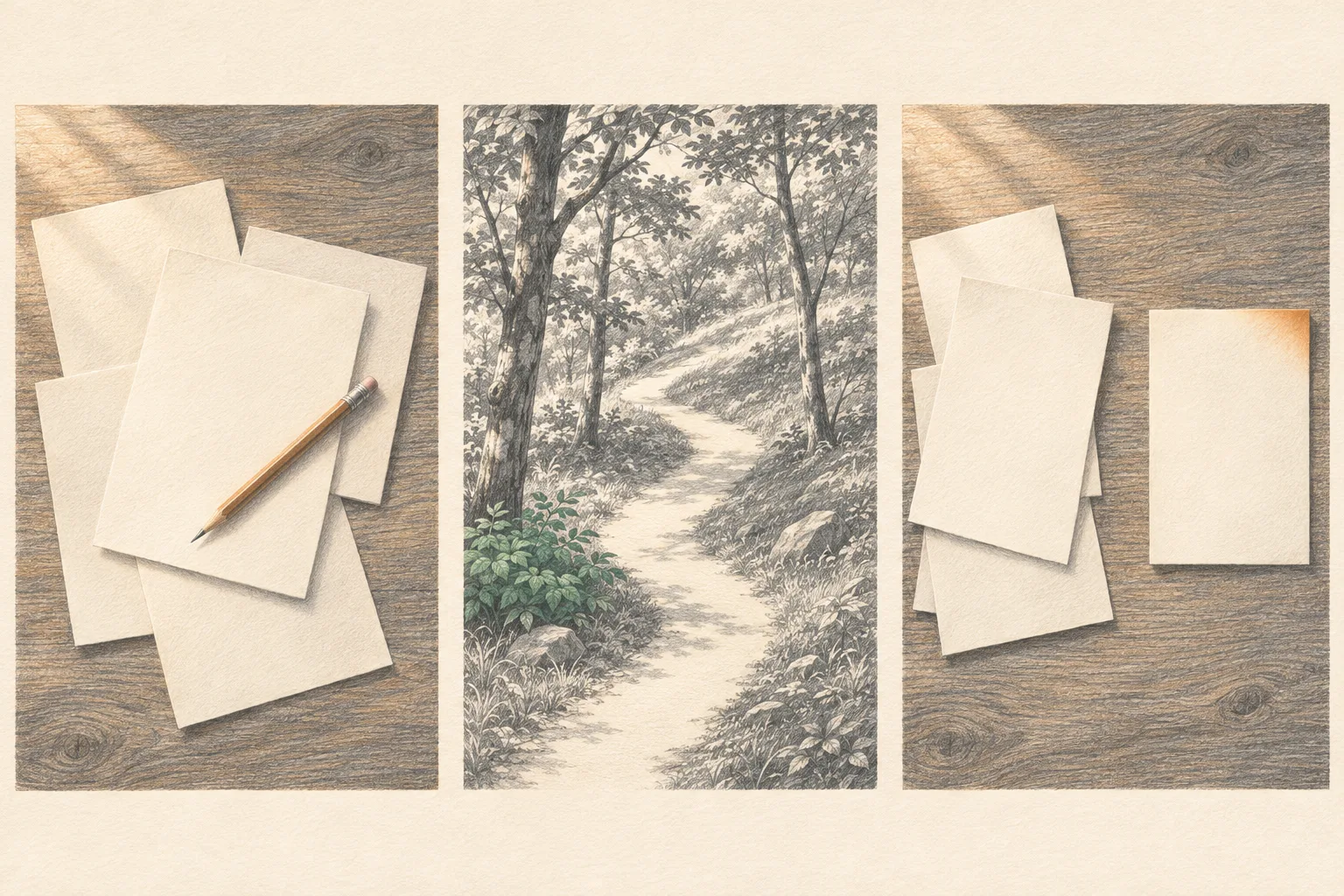
Illustration: Feedback & Forgetting. Generated schematic illustration — not a photograph or historical record. © Feedback & Forgetting, all rights reserved.
Work, a break, and a return to the same desk. A sketch of the sequence described above, not a record of any study or of any person's working habits.
The lab results cover short, set problems: lists of uses, word puzzles, breaks of minutes. They do not show that a week away will crack a hard project, and the Poincaré and Helmholtz stories cannot show that either. With that limit in mind, the readable evidence suggests a sequence:
- Work on the problem first. Poincaré and Helmholtz both describe long effort before the idea, and the 2009 abstract links longer preparation with a larger effect. In the delayed lab design, too, the break comes only after a set period of real work.
- When you stall, switch to something light. A highly demanding task in the break went with a smaller effect, and in Baird's experiment a light task beat rest. The line is not sharp, though: in Zhou's second experiment, a break spent on reasoning questions also helped.
- Come back and check. Poincaré verified his omnibus idea on his return, and warned that the feeling of certainty, though usually right in his cases, has exceptions: “often this feeling deceives us” (p. 390).
The 2009 abstract names break length among the factors it examined but gives no result for it, so this page cannot say how long the break should be. The readable experiment used 5 minutes. Sleep is outside the sources read here, so this page offers no advice about sleeping on a problem.
Next time you stall after a real effort, note where you got stuck, spend a few minutes on an undemanding task, then return and test whatever comes to mind.
Data: Who said what about incubation, and on what evidence
| Claim | Who, year | Evidence | Read as | Value (quoted) | Value (recomputed) |
|---|---|---|---|---|---|
| Good ideas came after investigating a problem in all directions, never to a tired mind or at the desk, and readily on slow walks up wooded hills | Hermann von Helmholtz, 1891 | self-report | full text | – | – |
| An idea about Fuchsian functions came at the moment he stepped onto an omnibus, on a trip that had made him forget his mathematical work | Henri Poincaré, 1908 | self-report | full text | – | – |
| Sudden illumination is a sign of long unconscious work, fruitful only when conscious work comes before and after it | Henri Poincaré, 1908 | self-report (interpretation) | full text | – | – |
| Preparation, Incubation and Illumination were named from Helmholtz's account, and Verification was added with Poincaré's account | Graham Wallas, 1926 | book (theory) | full text | – | – |
| The book's main material came from the author's experience as a teacher and administrator and from accounts of thought processes by poets and others | Graham Wallas, 1926 | book (method statement) | full text | – | – |
| Incubation time can go to other problems or to rest, and the first kind saves time and is often the better | Graham Wallas, 1926 | book (advice) | full text | – | – |
| Lab studies pooled in a meta-analysis showed a positive incubation effect overall | Sio & Ormerod, 2009 | meta-analysis | abstract | – | – |
| As reported by Gilhooly (2016), the 2009 meta-analysis covered 117 studies | Gilhooly (reporting Sio & Ormerod), 2016 | review | full text | 117 studies | – |
| As reported by Gilhooly (2016), the 2009 meta-analysis found a mean effect size in the low-medium band | Gilhooly (reporting Sio & Ormerod), 2016 | review | full text | mean d = 0.29 | – |
| Divergent thinking tasks benefited more from incubation than linguistic and visual insight tasks | Sio & Ormerod, 2009 | meta-analysis | abstract | – | – |
| Longer preparation periods gave a larger incubation effect | Sio & Ormerod, 2009 | meta-analysis | abstract | – | – |
| Filling the incubation period with a highly demanding task gave a smaller effect | Sio & Ormerod, 2009 | meta-analysis | abstract | – | – |
| For linguistic insight problems, a light task during incubation gave a stronger effect than rest | Sio & Ormerod, 2009 | meta-analysis | abstract | – | – |
| On Unusual Uses problems seen before the break, an undemanding task during the break led to better scores than a demanding task, rest or no break | Baird et al., 2012 | lab study | abstract | – | – |
| Pairs who spent a 5-minute break on reasoning questions produced more ideas in the last 10 minutes than pairs who worked straight through | Zhou et al., 2019 | lab study | full text | 4.81 ideas (mean difference) | – |
| Pairs who relaxed during the 5-minute break produced more ideas in the last 10 minutes than pairs who worked straight through, but not by enough to pass the corrected cutoff | Zhou et al., 2019 | lab study | full text | 3.50 ideas (mean difference) | – |
| With individuals shown planted example ideas, a relaxation break gave more ideas in the last 10 minutes than working straight through with the same examples, passing the corrected cutoff; a task break did not pass it | Zhou et al., 2019 | lab study | full text | – | – |
| Poincaré based his analysis on self-reports of episodes from many years before | Gilhooly, 2016 | review | full text | nearly 30 years | – |
| Years from Helmholtz's speech to Wallas's book | Feedback & Forgetting | derived | full text | – | 35 years |
| Years from Wallas's book to the 2009 meta-analysis | Feedback & Forgetting | derived | full text | – | 83 years |
Download the data (CSV, incubation-effect-sources.csv) · Where each value comes from (JSON) Data: Gilhooly, K. J. (2016). Incubation and intuition in creative problem solving. Frontiers in Psychology 7: 1076, doi:10.3389/fpsyg.2016.01076, section Delayed and Immediate Incubation Effects, CC BY 4.0 (https://creativecommons.org/licenses/by/4.0/); Zhou, X., et al. (2019). Exposure to ideas, evaluation apprehension, and incubation intervals in collaborative idea generation. Frontiers in Psychology 10: 1459, doi:10.3389/fpsyg.2019.01459, Experiment 2 Table 1 and Experiment 3, CC BY 4.0 (https://creativecommons.org/licenses/by/4.0/)
Retrieval check
Answer from memory first, then follow the link to the passage and check.
- Whose account of his own ideas gave Wallas three of his four stage names? Back to the passage
- In the classic lab design, what does the comparison group do while the other group takes its break? Back to the passage
- How much of the 2009 meta-analysis could this page read, and what did that leave unchecked? Back to the passage · Why a break that helps memory is a different effect
Sources
- Poincaré, H. (1908). Science et méthode. Paris: Flammarion. Chapter “L'invention mathématique”. https://archive.org/details/scienceetmthod00poin
- Poincaré, H. (1913). The Foundations of Science: Science and Hypothesis, The Value of Science, Science and Method (G. B. Halsted, Trans.). New York and Garrison, NY: The Science Press. “Mathematical Creation”, pp. 383–394. https://www.gutenberg.org/ebooks/39713
- Wallas, G. (1926). The Art of Thought. New York: Harcourt, Brace and Company. https://archive.org/details/artofthought0000grah
- Helmholtz, H. von (1903). Erinnerungen: Tischrede gehalten bei der Feier des 70. Geburtstages, Berlin 1891. In Vorträge und Reden, vol. 1. Braunschweig: Vieweg. https://archive.org/details/vortrgeundrede01helm
- Rignano, E. (1923). Psychology of Reasoning, pp. 267–8. As cited by Wallas (1926), p. 80, note 1. https://archive.org/details/artofthought0000grah
- Gilhooly, K. J. (2016). Incubation and intuition in creative problem solving. Frontiers in Psychology, 7, 1076. doi:10.3389/fpsyg.2016.01076 https://doi.org/10.3389/fpsyg.2016.01076
- Zhou, X., Zhai, H.-K., Delidabieke, B., Zeng, H., Cui, Y.-X., & Cao, X. (2019). Exposure to ideas, evaluation apprehension, and incubation intervals in collaborative idea generation. Frontiers in Psychology, 10, 1459. doi:10.3389/fpsyg.2019.01459 https://doi.org/10.3389/fpsyg.2019.01459
- Sio, U. N., & Ormerod, T. C. (2009). Does incubation enhance problem solving? A meta-analytic review. Psychological Bulletin, 135(1), 94–120. doi:10.1037/a0014212 https://doi.org/10.1037/a0014212
- Baird, B., Smallwood, J., Mrazek, M. D., Kam, J. W. Y., Franklin, M. S., & Schooler, J. W. (2012). Inspired by distraction: Mind wandering facilitates creative incubation. Psychological Science, 23(10), 1117–1122. doi:10.1177/0956797612446024 https://doi.org/10.1177/0956797612446024
- Crossref. Update searches (corrections, retractions, expressions of concern) for doi:10.1037/a0014212, doi:10.3389/fpsyg.2016.01076, doi:10.3389/fpsyg.2019.01459 and doi:10.1177/0956797612446024. https://api.crossref.org/works?filter=updates:10.1037/a0014212
Cite this page
Feedback & Forgetting. (2026-11-06). Incubation Effect: The Classic Stages Came From Self-Reports. https://feedbackandforgetting.com/creative-minds/incubation-effect/ (accessed [date you read it])
No DOI is assigned to this page; cite the address above with the date you read it.
Related reading
-
Creative Minds
Does Brainstorming Work? In a Review, Groups Had Fewer Ideas
Picture credit
Illustration: Feedback & Forgetting. Generated schematic illustration — not a photograph or historical record. © Feedback & Forgetting, all rights reserved.
-
Creative Minds
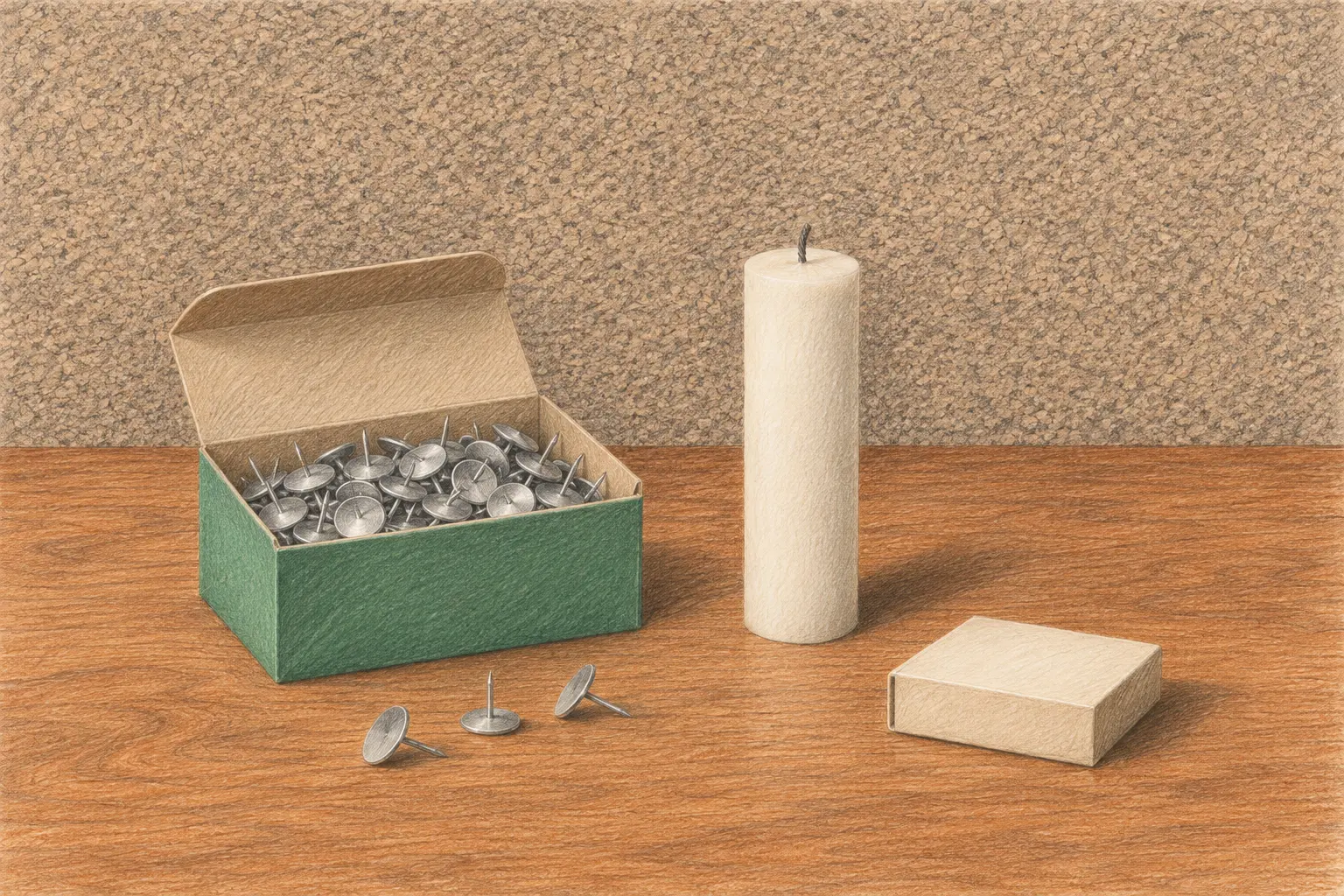
Functional Fixedness: The Candle Problem Turns on the Box
Picture credit
Illustration: Feedback & Forgetting. Generated schematic illustration — not a photograph or historical record. © Feedback & Forgetting, all rights reserved.