Functional Fixedness: The Candle Problem Turns on the Box
Study File Feedback & Forgetting Published
Short answer. Functional fixedness is difficulty seeing a new use for an object that already has a familiar one. In Karl Duncker's candle problem, you must fix a candle to a wall using only a box of tacks and some matches; the answer, as later papers describe it, is to empty the box, tack it to the wall and stand the candle in it. The classic studies from 1945, 1952 and 1962 could be read here only as citations, so their results are not given. In a 2021 study, 56 of 69 students solved a drawn version within 8 minutes.
In one sentence: The candle problem turns on seeing the tack box as a shelf rather than a container, and the classic studies cited for it, including a 1962 study later cited for financial rewards, could be read here only as citations.
Outline5 sections
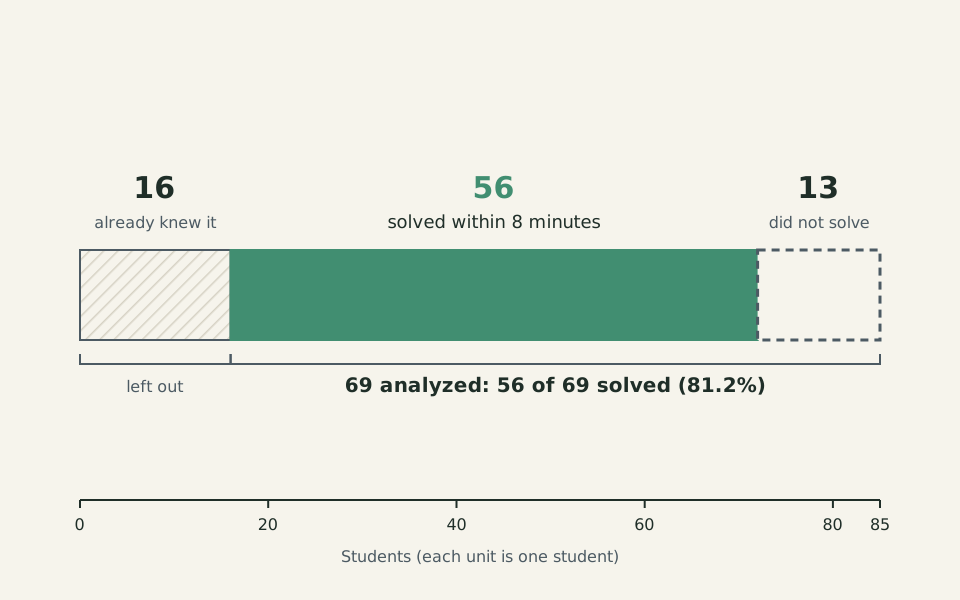
Diagram: Feedback & Forgetting, CC BY 4.0
Copy the credit line
"Candle problem outcomes for 85 students, 2021" by Feedback & Forgetting, https://feedbackandforgetting.com/creative-minds/candle-problem/, licensed under CC BY 4.0, https://creativecommons.org/licenses/by/4.0/Data: Ibáñez de Aldecoa, P., de Wit, S., & Tebbich, S. (2021). Can habits impede creativity by inducing fixation? Frontiers in Psychology 12: 683024, doi:10.3389/fpsyg.2021.683024, CC BY 4.0 (https://creativecommons.org/licenses/by/4.0/), Materials and Methods and Table 2 (counts; percentage recomputed)
Figure 1. Outcomes for the candle problem in a 2021 study by Paula Ibáñez de Aldecoa, Sanne de Wit and Sabine Tebbich. Students saw a drawing of the materials and typed their answer, with up to 8 minutes.
In 2021, 85 university students in Amsterdam saw a drawing of a candle, matches and a box of pushpins. They had up to 8 minutes to type how they would fix the candle to a wall so the wax would not drip below. Sixteen said they already knew the answer. The puzzle is Karl Duncker's candle problem, the stock example of functional fixedness, and this page asks how much of its famous record you can still read.
The 2021 study, by Paula Ibáñez de Aldecoa, Sanne de Wit and Sabine Tebbich, appeared in Frontiers in Psychology under a CC BY license and could be read in full. The older work could not. Duncker's 1945 monograph, Robert Adamson's 1952 repetition and Sam Glucksberg's 1962 study each had a citation record here, but no abstract.
Study File
- Experiment
- Duncker's candle problem: fix a candle to a wall using only a box of tacks and matches; here, a 2021 run of a drawn version, read in full
- Researcher and year
- Karl Duncker, 1945, and Robert E. Adamson, 1952 (citations only); the 2021 run by Paula Ibáñez de Aldecoa, Sanne de Wit and Sabine Tebbich (full text)
- Subjects
- 2021: 85 university students in Amsterdam, aged 18 to 30; 16 who already knew the solution were left out, leaving 69. Not read for 1945 and 1952.
- Materials and delays
- A drawing of a candle, a pack of matches and a box of pushpins on a screen; typed answer; up to 8 minutes; one session, no delay
- Design
- Correlational: habit tendency, measured with a slips-of-action task, compared with whether and how fast each student solved the problem
- Main finding
- 56 of 69 (81.2%) solved within 8 minutes; habit tendency did not significantly predict solving (p = 0.169) or time to solve (p = 0.697)
- Replication status
- Replication tag: [single study] Habit tendency not shown to predict solving. University students, drawn version, one session; no independent replication read. Based on full text. Checked 2026-11-06. No tag for the classic claim that a full box makes the problem harder: the 1945 and 1952 studies were read only as citations.
- Validity
- Crossref lists no correction, retraction or expression of concern for any of the nine DOIs cited, including Duncker 1945, Adamson 1952, Glucksberg 1962 and the 2021 study (checked 2026-11-06).
- Meaning for learners, within these conditions
- In one timed session with a drawing, most students who did not already know the puzzle solved it. Whether a full box or a cash prize changes solving is not settled by what could be read.
This card as a spreadsheet (CSV, candle-problem-study-file.csv) · Where each value comes from (JSON)
Data: Ibáñez de Aldecoa, P., de Wit, S., & Tebbich, S. (2021). Can habits impede creativity by inducing fixation? Frontiers in Psychology 12: 683024, doi:10.3389/fpsyg.2021.683024, CC BY 4.0 (https://creativecommons.org/licenses/by/4.0/); Kroneisen, M., et al. (2021). How can I use it? The role of functional fixedness in the survival-processing paradigm. Psychonomic Bulletin & Review 28(1), 324–332, doi:10.3758/s13423-020-01802-y, CC BY 4.0 (https://creativecommons.org/licenses/by/4.0/); Duncker (1945), doi:10.1037/h0093599; Adamson (1952), doi:10.1037/h0062487 (citation records only; no values)
The puzzle and its answer
In the candle problem, as Meike Kroneisen and colleagues describe it in a 2021 paper, you are asked to fix a candle to a wall and light it. Besides the candle, you have only a matchbox and a box of thumbtacks. The answer is to empty the box, tack it to the wall, stand the candle in it and light it.
Functional fixedness is the name for what gets in the way. Kroneisen and colleagues define it as focusing on an object's common function while overlooking other functions that could solve the problem. Here, that means struggling to see the box as something that can hold the candle. They note that Duncker already used the term in 1945.
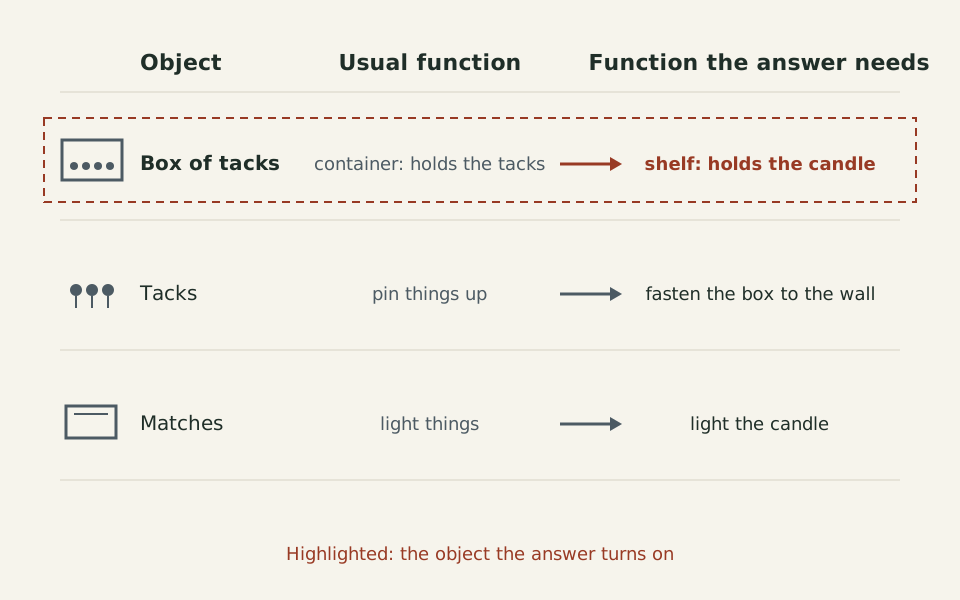
Diagram: Feedback & Forgetting, CC BY 4.0
Copy the credit line
"Usual function vs the function the candle problem needs" by Feedback & Forgetting, https://feedbackandforgetting.com/creative-minds/candle-problem/, licensed under CC BY 4.0, https://creativecommons.org/licenses/by/4.0/Figure 2. The shift the candle problem asks for, drawn from the descriptions in Kroneisen and colleagues (2021) and Ibáñez de Aldecoa and colleagues (2021).
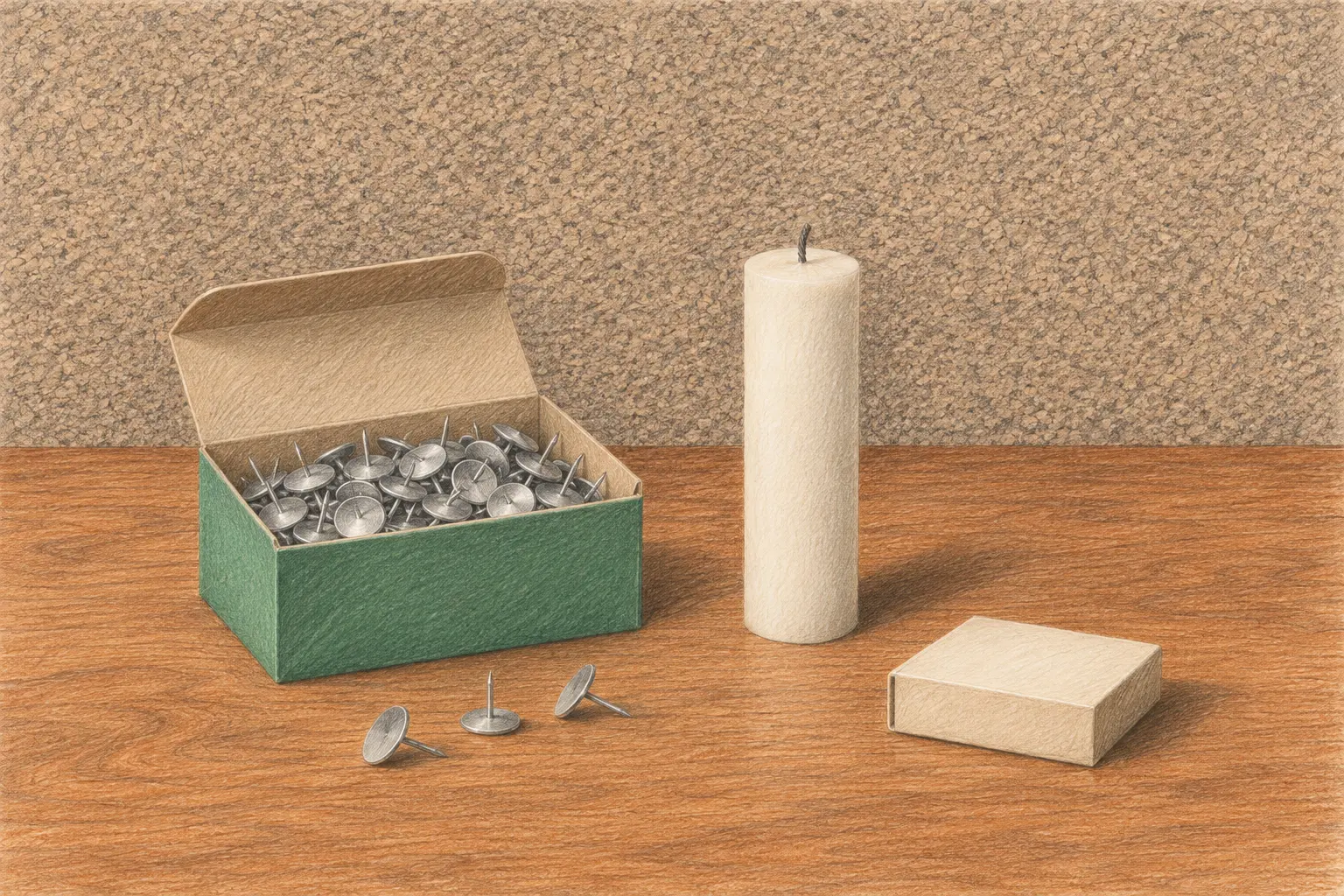
Illustration: Feedback & Forgetting. Generated schematic illustration — not a photograph or historical record. © Feedback & Forgetting, all rights reserved.
The materials of the candle problem as a 2021 paper describes them: a candle, a matchbox and a box of thumbtacks, with the candle to be fixed to a wall. A scene illustration; it does not show the answer.
The 2021 Amsterdam study scored an answer as correct only if it fixed the candle to the wall and treated the pushpin box as a platform, not only a container. Its question was whether people who lean on habits get stuck more often. The researchers measured habit tendency with a slips-of-action task, a computer task that counts how often people keep pressing a learned key for an outcome that now costs points.
Of the 69 students who did not already know the puzzle, 56 (81.2%) solved it and 13 did not. Habit tendency did not significantly predict who solved it (p = 0.169) or how fast (p = 0.697). The authors add that a drawing may show fixation less strongly than real objects in the hand.
Replication tag: [single study] Habit tendency not shown to predict solving the candle problem. University students in Amsterdam, drawn version with typed answers, one session of up to 8 minutes. No independent replication read. Based on full text. Checked 2026-11-06.
Box full, box empty
A classic variation asks whether the box is harder to see as a shelf when it arrives full of tacks. This page could not read the studies that tested it. Duncker's monograph, “On problem-solving,” appeared in Psychological Monographs in 1945, and only its citation record was available.
Adamson's 1952 paper in the Journal of Experimental Psychology is titled “Functional fixedness as related to problem solving: a repetition of three experiments.” Its citation record has no abstract, so this page does not say which experiments it repeated or what it found.
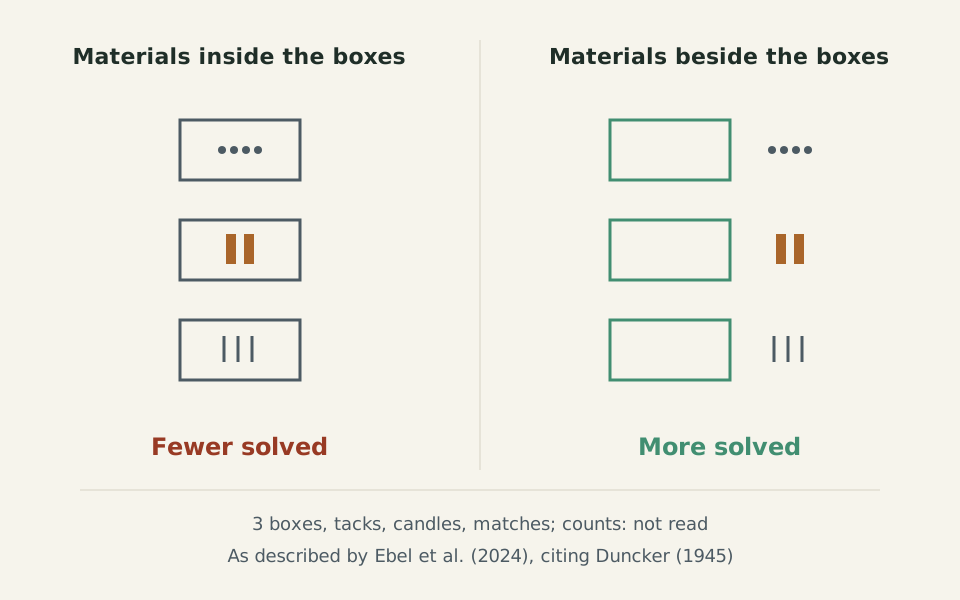
Diagram: Feedback & Forgetting, CC BY 4.0
Copy the credit line
"Duncker's box problem: materials inside vs beside the boxes" by Feedback & Forgetting, https://feedbackandforgetting.com/creative-minds/candle-problem/, licensed under CC BY 4.0, https://creativecommons.org/licenses/by/4.0/Figure 3. The comparison in Duncker's box version as Sonja Ebel and colleagues (2024) describe it. No counts are shown because the original study could be read only as a citation.
What remains are later descriptions. A 2024 paper by Sonja Ebel and colleagues, on functional fixedness in chimpanzees, describes Duncker's version as a “box problem” with three boxes. As Ebel and colleagues describe it, participants had to attach the boxes to a wall with tacks, set candles in them and light them. Fewer people solved it when the materials came inside the boxes than when they lay beside them.
A 2021 review by Antonio Osuna-Mascaró and Alice Auersperg adds a second detail of Duncker's work. According to the review, when he asked people to use the objects in their usual way before the test, fewer solved it. The one-candle puzzle described above is not the three-box setup in the 2024 account.
These are secondhand accounts, and the original numbers could not be read. So this page gives the full-box claim no replication tag. Fixation on a familiar use is one kind of getting stuck; this site's review of group brainstorming covers another, where a 2019 study offered fixation on a partner's ideas as one possible explanation for a narrower range of ideas.
The 1962 reward study
Sam Glucksberg's paper appeared in the Journal of Experimental Psychology in 1962. Its title is “The influence of strength of drive on functional fixedness and perceptual recognition.” Drive here means the strength of motivation to reach a goal. Neither Crossref nor Europe PMC holds an abstract for it, so its design, sample, conditions and times are not given here.
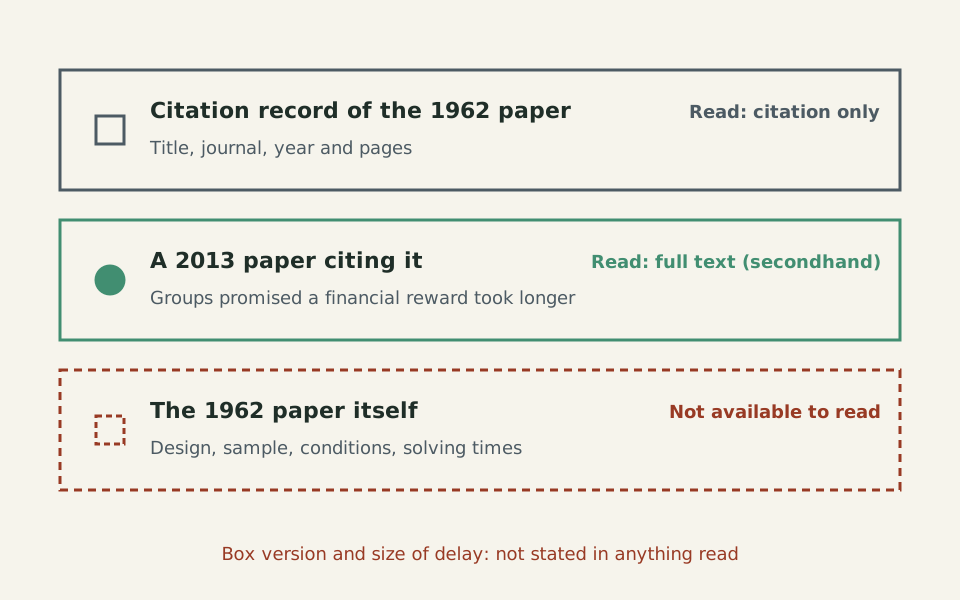
Diagram: Feedback & Forgetting, CC BY 4.0
Copy the credit line
"What could be read about Glucksberg's 1962 study" by Feedback & Forgetting, https://feedbackandforgetting.com/creative-minds/candle-problem/, licensed under CC BY 4.0, https://creativecommons.org/licenses/by/4.0/Figure 4. What could be read about Glucksberg's 1962 study, from the most to the least direct source.
The gap matters because later papers cite the 1962 study for a result about rewards. A 2013 paper in BMC Medical Education by Jeffrey Lyness and colleagues, citing Glucksberg, says that groups asked to solve the candle problem “take longer to solve the problem if they are promised a financial reward.”
The sentence names no box version and no size of delay. It also calls the solvers groups, a detail this page could not check. So this page does not say which versions the 1962 study compared or how much slower anyone was, and it gives the reward claim no tag.
How the result traveled
Laid out by date, the readable record is thinnest at the start, where the original results would be. Duncker in 1945, Adamson in 1952 and Glucksberg in 1962 could be read only as citations. In 2012, a meta-analysis on rewards and creativity by Kris Byron and Shalini Khazanchi appeared; its abstract could be read, and the next section covers it.
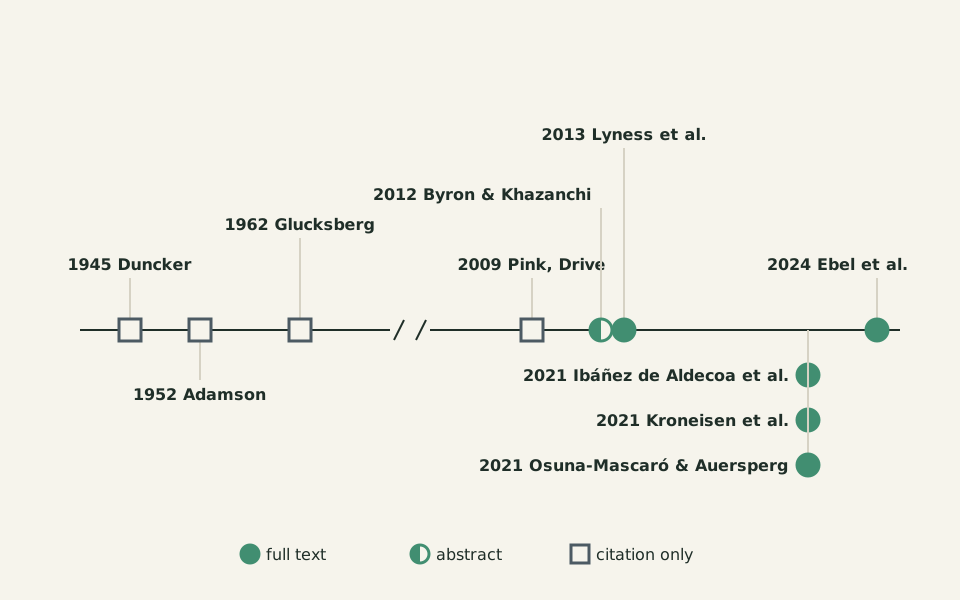
Diagram: Feedback & Forgetting, CC BY 4.0
Copy the credit line
"Candle problem sources by year, 1945 to 2024" by Feedback & Forgetting, https://feedbackandforgetting.com/creative-minds/candle-problem/, licensed under CC BY 4.0, https://creativecommons.org/licenses/by/4.0/Figure 5. The sources on the candle problem read for this page, by year, with how much of each could be read.
In 2013, the Lyness paper used the candle problem as one example of a broader claim. Incentives, it says, increase desired behaviors on straightforward tasks but “actually produce poorer performance on tasks that require flexible, creative problem-solving.” The same paper lists Daniel Pink's 2009 book Drive among reviews of self-determination theory written for general readers. The book itself was not read for this page.
By 2021 the puzzle was familiar enough to get in the way of research. In the Amsterdam study, 16 of the 85 students (18.8%) said they already knew the problem and its solution, and their answers were left out. The 2021 review calls it a classic insight challenge in which people often hit an impasse before solving. The 2024 chimpanzee paper uses Duncker's box version as its example of functional fixedness in people.
Rewards and creativity, more broadly
The 2013 sentence speaks for rewards in general. The most direct general source read here is the Byron and Khazanchi meta-analysis in Psychological Bulletin. A meta-analysis pools the results of many studies. According to its abstract, it combined 60 experimental and nonexperimental studies, with 69 independent samples of children or adults.
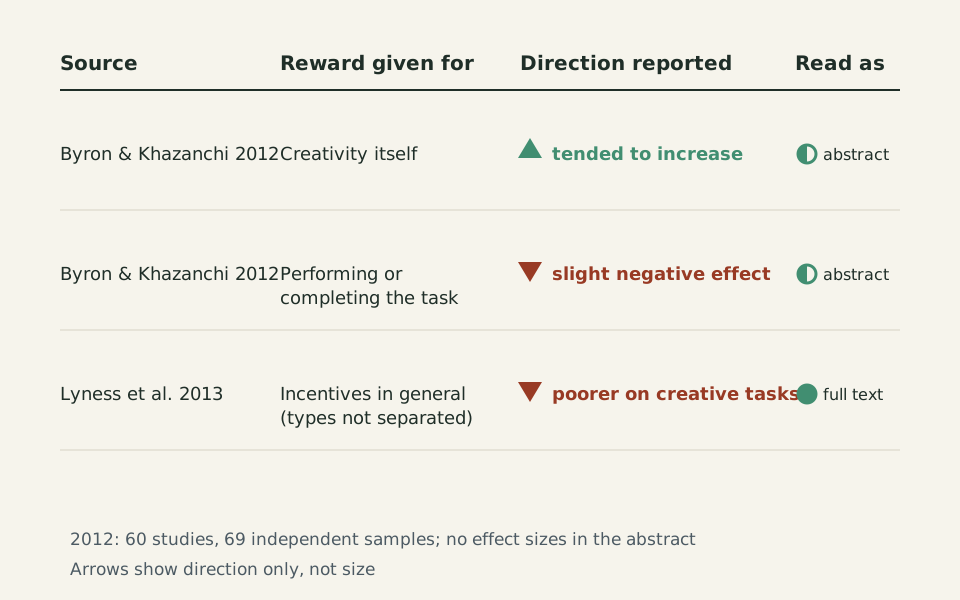
Diagram: Feedback & Forgetting, CC BY 4.0
Copy the credit line
"Rewards and creative performance by reward type, 2012 and 2013" by Feedback & Forgetting, https://feedbackandforgetting.com/creative-minds/candle-problem/, licensed under CC BY 4.0, https://creativecommons.org/licenses/by/4.0/Figure 6. The direction of the link between rewards and creative performance by type of reward, as the abstract of Byron and Khazanchi (2012) reports it, set beside the 2013 summary. The abstract gives no effect sizes.
The abstract reports that the direction depended on what the reward was for. Rewards tied to creativity itself tended to increase creative performance, more so when people got positive, task-focused feedback and more choice. Rewards for performing or completing a task tended to have a slight negative effect. Whether the pooled results were corrected for publication bias could not be checked.
[status not assigned] Direction of the link between rewards and creative performance, by reward type. Children and adults, 60 experimental and nonexperimental studies. The abstract reports no effect sizes, and bias correction was not checked. Based on the abstract. Checked 2026-11-06.
So the abstract draws a narrower line than the 2013 summary, and neither is a test of the candle problem itself. Getting unstuck by setting a problem aside is a separate line of research, covered in this site's deep read on the incubation effect.
If you plan to use the candle problem in a class or a talk, ask first who has already seen it; in the 2021 study, nearly one in five students had. If you cite it on rewards, name the 1962 paper by its title and year, and say that the reward detail comes from later summaries.
Data: Candle problem sources and what each supports
| Claim | Source | Read as | Value (quoted) | Value (recomputed) | Tag |
|---|---|---|---|---|---|
| Monograph titled On problem-solving | Duncker 1945 | citation only | – | – | none (citation only) |
| In Duncker's box version (three boxes, candles to set in them), fewer people solved when the materials were inside the boxes than beside them | Duncker 1945, as described by Ebel et al. 2024 | full text | 3 boxes | – | none (secondhand) |
| When Duncker asked people to use the objects in their usual way before the test, fewer solved it | Duncker 1945, as described by Osuna-Mascaró & Auersperg 2021 | full text | – | – | none (secondhand) |
| Paper titled Functional fixedness as related to problem solving: a repetition of three experiments | Adamson 1952 | citation only | – | – | none (citation only) |
| Paper titled The influence of strength of drive on functional fixedness and perceptual recognition | Glucksberg 1962 | citation only | – | – | none (citation only) |
| Lyness et al. list Pink's book Drive: The Surprising Truth About What Motivates Us among reviews of self-determination theory for lay audiences; the book itself was not read | Pink 2009, as listed by Lyness et al. 2013 | full text | – | – | none (secondhand) |
| Groups promised a financial reward took longer to solve the candle problem; no box version or size of delay given | Glucksberg 1962, as described by Lyness et al. 2013 | full text | – | – | none (secondhand) |
| Meta-analysis of rewards and creative performance: studies pooled | Byron & Khazanchi 2012 | abstract | 60 studies | – | none |
| Meta-analysis of rewards and creative performance: independent samples | Byron & Khazanchi 2012 | abstract | 69 independent samples | – | none |
| Rewards contingent on creativity tended to increase creative performance | Byron & Khazanchi 2012 | abstract | – | – | [status not assigned] |
| Rewards contingent on performance or completion tended to have a slight negative effect on creative performance | Byron & Khazanchi 2012 | abstract | – | – | [status not assigned] |
| Lyness et al. state that incentives produce poorer performance on tasks that require flexible, creative problem-solving; a broad summary, reward types not separated | Lyness et al. 2013 | full text | – | – | none |
| Students who said they already knew the candle problem and its solution | Ibáñez de Aldecoa, de Wit & Tebbich 2021 | full text | 16 of 85 students | 18.8% | none |
| Students who solved the drawn candle problem within 8 minutes | Ibáñez de Aldecoa, de Wit & Tebbich 2021 | full text | 56 of 69 students | 81.2% | none |
| Habit tendency did not significantly predict solving the candle problem | Ibáñez de Aldecoa, de Wit & Tebbich 2021 | full text | p = 0.169 | – | Replication tag: [single study] |
| Functional fixedness means focusing on an object's common function and overlooking others; in the candle problem, the answer is to empty the box, tack it to the wall and stand the candle in it | Kroneisen et al. 2021 | full text | – | – | none |
| Kroneisen et al. note that Duncker already used the term functional fixedness in 1945 and cite his monograph for the candle problem | Duncker 1945, as described by Kroneisen et al. 2021 | full text | – | – | none (secondhand) |
Download the data (CSV, candle-problem-studies.csv) · Where each value comes from (JSON) Data: Ibáñez de Aldecoa, P., de Wit, S., & Tebbich, S. (2021). Can habits impede creativity by inducing fixation? Frontiers in Psychology 12: 683024, doi:10.3389/fpsyg.2021.683024, CC BY 4.0 (https://creativecommons.org/licenses/by/4.0/); Byron, K., & Khazanchi, S. (2012). Rewards and creative performance: A meta-analytic test of theoretically derived hypotheses. Psychological Bulletin 138(4), 809–830, doi:10.1037/a0027652 (abstract; quoted values, publisher's terms apply); Lyness, J. M., Lurie, S. J., Ward, D. S., Mooney, C. J., & Lambert, D. R. (2013). Engaging students and faculty. BMC Medical Education 13: 151, doi:10.1186/1472-6920-13-151, CC BY 2.0 (https://creativecommons.org/licenses/by/2.0/) (text; no values); Ebel, S. J., et al. (2024). Functional fixedness in chimpanzees. Scientific Reports 14: 12155, doi:10.1038/s41598-024-62685-w, CC BY 4.0 (https://creativecommons.org/licenses/by/4.0/) (text; one value); Osuna-Mascaró, A. J., & Auersperg, A. M. I. (2021). Current understanding of the “insight” phenomenon across disciplines. Frontiers in Psychology 12: 791398, doi:10.3389/fpsyg.2021.791398, CC BY 4.0 (https://creativecommons.org/licenses/by/4.0/) (text; no values); Kroneisen, M., et al. (2021). How can I use it? The role of functional fixedness in the survival-processing paradigm. Psychonomic Bulletin & Review 28(1), 324–332, doi:10.3758/s13423-020-01802-y, CC BY 4.0 (https://creativecommons.org/licenses/by/4.0/) (text; no values); Duncker (1945), doi:10.1037/h0093599; Adamson (1952), doi:10.1037/h0062487; Glucksberg (1962), doi:10.1037/h0044683 (citation records only; no values)
Retrieval check
Answer from memory first, then follow the link to the passage and check.
- What does the candle problem ask you to do, and which object holds the answer? Back to the passage
- What can be read about the 1962 study cited for financial rewards, and what cannot? Back to the passage
- According to the 2012 abstract, which kind of reward tended to raise creative performance? Back to the passage · Setting a problem aside: the incubation effect
Sources
- Duncker, K. (1945). On problem-solving. Psychological Monographs, 58(5), i–113. doi:10.1037/h0093599 https://doi.org/10.1037/h0093599
- Adamson, R. E. (1952). Functional fixedness as related to problem solving: A repetition of three experiments. Journal of Experimental Psychology, 44(4), 288–291. doi:10.1037/h0062487 https://doi.org/10.1037/h0062487
- Glucksberg, S. (1962). The influence of strength of drive on functional fixedness and perceptual recognition. Journal of Experimental Psychology, 63(1), 36–41. doi:10.1037/h0044683 https://doi.org/10.1037/h0044683
- Pink, D. H. (2009). Drive: The surprising truth about what motivates us. New York: Riverhead Books. As listed by Lyness et al. (2013). https://doi.org/10.1186/1472-6920-13-151
- Byron, K., & Khazanchi, S. (2012). Rewards and creative performance: A meta-analytic test of theoretically derived hypotheses. Psychological Bulletin, 138(4), 809–830. doi:10.1037/a0027652 https://doi.org/10.1037/a0027652
- Lyness, J. M., Lurie, S. J., Ward, D. S., Mooney, C. J., & Lambert, D. R. (2013). Engaging students and faculty: Implications of self-determination theory for teachers and leaders in academic medicine. BMC Medical Education, 13, 151. doi:10.1186/1472-6920-13-151 https://doi.org/10.1186/1472-6920-13-151
- Ibáñez de Aldecoa, P., de Wit, S., & Tebbich, S. (2021). Can habits impede creativity by inducing fixation? Frontiers in Psychology, 12, 683024. doi:10.3389/fpsyg.2021.683024 https://doi.org/10.3389/fpsyg.2021.683024
- Kroneisen, M., Kriechbaumer, M., Kamp, S.-M., & Erdfelder, E. (2021). How can I use it? The role of functional fixedness in the survival-processing paradigm. Psychonomic Bulletin & Review, 28(1), 324–332. doi:10.3758/s13423-020-01802-y (published online 2020) https://doi.org/10.3758/s13423-020-01802-y
- Osuna-Mascaró, A. J., & Auersperg, A. M. I. (2021). Current understanding of the “insight” phenomenon across disciplines. Frontiers in Psychology, 12, 791398. doi:10.3389/fpsyg.2021.791398 https://doi.org/10.3389/fpsyg.2021.791398
- Ebel, S. J., Völter, C. J., Sánchez-Amaro, A., Helming, K. A., Herrmann, E., & Call, J. (2024). Functional fixedness in chimpanzees. Scientific Reports, 14, 12155. doi:10.1038/s41598-024-62685-w https://doi.org/10.1038/s41598-024-62685-w
- Crossref. Work records and update searches (corrections, retractions, expressions of concern) for the nine DOIs cited on this page. https://api.crossref.org/works?filter=updates:10.1037/h0044683
Cite this page
Feedback & Forgetting. (2026-11-06). Functional Fixedness: The Candle Problem Turns on the Box. https://feedbackandforgetting.com/creative-minds/candle-problem/ (accessed [date you read it])
No DOI is assigned to this page; cite the address above with the date you read it.
Related reading
-
Creative Minds
Incubation Effect: The Classic Stages Came From Self-Reports
Picture credit
"Henri Poincaré" by Manuel (photograph); Ch. Wittmann (printer) — https://commons.wikimedia.org/wiki/File:Henri_Poincar%C3%A9,_PA03199.jpg — Public domain (Print inscribed “Cliché Manuel” (photograph) and “Imp. Ch. Wittmann” (printer); KU Leuven catalogue dates the printer as active 1891–1907, so the print was published by 1907. US: published before 1931, public domain. EU: photographer counted as Henri Manuel, head of the Manuel studio, d. 1947, so public domain since 2018 (70 years). Not verified: the studio was run by Henri Manuel with his brother Gaston, and the individual photographer is not named; no sign that the Mort pour la France extension applies (Henri Manuel died in 1947, after the war), not checked case by case. Year 1907 is the latest possible date, not a known date. Scan: KU Leuven Libraries print collection, PA03199, uploaded to Commons); modifications: cropped, resized
-

Creative Minds
Does Brainstorming Work? In a Review, Groups Had Fewer Ideas
Picture credit
Illustration: Feedback & Forgetting. Generated schematic illustration — not a photograph or historical record. © Feedback & Forgetting, all rights reserved.